As pandemic fades, Guatemalan motorcyclists resume religious pilgrimage / Photo: Johan ORDONEZ - AFP

 The Dilemma of Recording Live Music: Preserving Memories vs. Being Present

 الجبهة الشعبية وحماس تبحثان التطورات السياسية وتعزيز الوحدة الوطنية

 ترامب يدافع عن جينسن هوانغ بعد كشف علاقته بجاسوسة صينية

 Thukukile Zuma Resigns from ANC Johannesburg Leadership Amid Disciplinary Dispute

 Irish Study Finds No Link Between Lifetime Fluoride Exposure and Cognitive Decline

 Calgary Councillors Prioritize Affordability Ahead of Nov. 10 Budget Release

 5 Wardrobe Design Trends Making Sydney Bedrooms Work Harder in 2026

 Judy Schavrien’s New Book ‘There’ll Be No Dying Here’ Collects Decades of Intimate Portraits
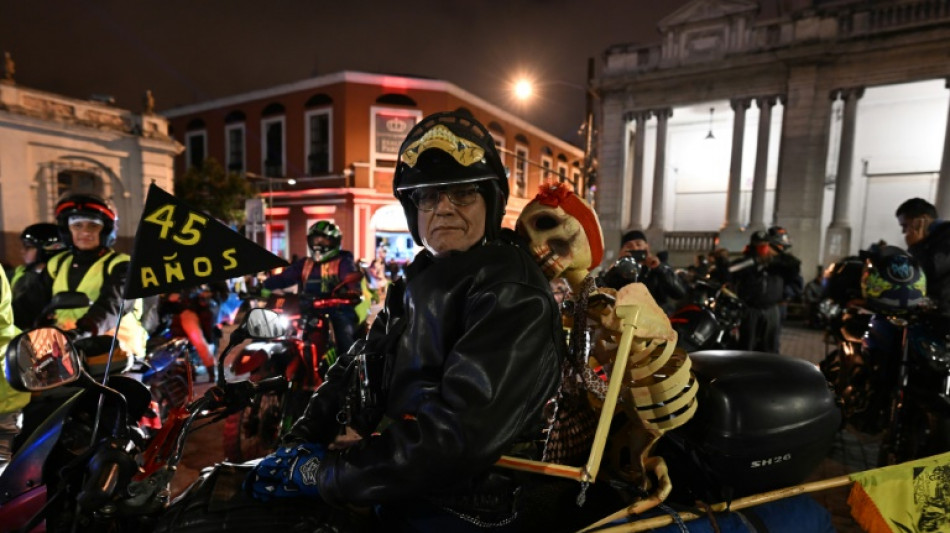
Thousands of motorcyclists on Saturday roared 140 miles across Guatemala in a rolling procession to venerate a religious crucifix, the Black Christ of Esquipulas.
Thumping motorcycle engines roared to life at dawn in Guatemala City's main Constitution Square, and riders soon sped off, resuming a practice begun in 1961 but suspended for two years by the pandemic.
"This is the 12th time that God has allowed me to arrive in Esquipulas," said Alberto Godines, 43, who wore a mask of a skull with horns.
Other participants also wore masks of devils or characters from the movies, all to take part in what is known as the "Caravan of Zorro," which every February takes cyclists to Esquipulas, a city declared in 1996 by then Pope John Paul II as the "Central American capital of Faith."
The Black Christ of Esquipulas has been venerated for more than four centuries by the Catholic faithful, and its home is in the basilica in Esquipulas.
"I was presented with the opportunity to be able to come and I took it. We hope to God that we arrive without problems at the basilica," Elena Ramirez, 39, a primary school teacher from Malacatan, a town near the border with Mexico, told AFP.
The highway journey to Esquipulas (222 kilometers) normally takes four hours but the motorcyclists normally take seven hours because they stop along the route. Police provide security and health kiosks attend to cases of illness.
- 'This is not a race' -
The pilgrimage in motorbikes was started by Ruben Villadeleon, known as "El Zorro," with a group of his friends, in 1961. As years passed, the ride became a tradition, and when Villadeleon died in 1987, his family continued to organize the ride.
Some riders have taken part dozens of times, such as Mario Villagran, 67, who said his first pilgrimage to Esquipulas was 45 years ago.
More than 30,000 motorcyclists routinely take part in the pilgrimage, although numbers have climbed past 50,000 in some years.
On Saturday, it appeared numbers were lower, but organizers did not immediately offer exact figures.
"We only ask the friends who are joining us to please understand that this is not a race. This is a pilgrimage... to venerate a saint," Tito Gonzalez, an organizer, told local TV channel TN23.
- Drawn from around region -
The Caravan of Zorro was declared by Guatemala as Intangible Heritage of the Nation in 2011, and among the participants there are many people who use motorcycles for work, such as messengers, food deliverers and motorcycle taxi drivers.
Motorcyclists from other Central American countries and Mexico also take part, according to its promoters.
Esquipulas may be best known as the city where five Central American presidents met in May 1986 to launch a regional peace process to end bloody civil wars in Nicaragua, El Salvador and Guatemala.
A.Suleiman--SF-PST