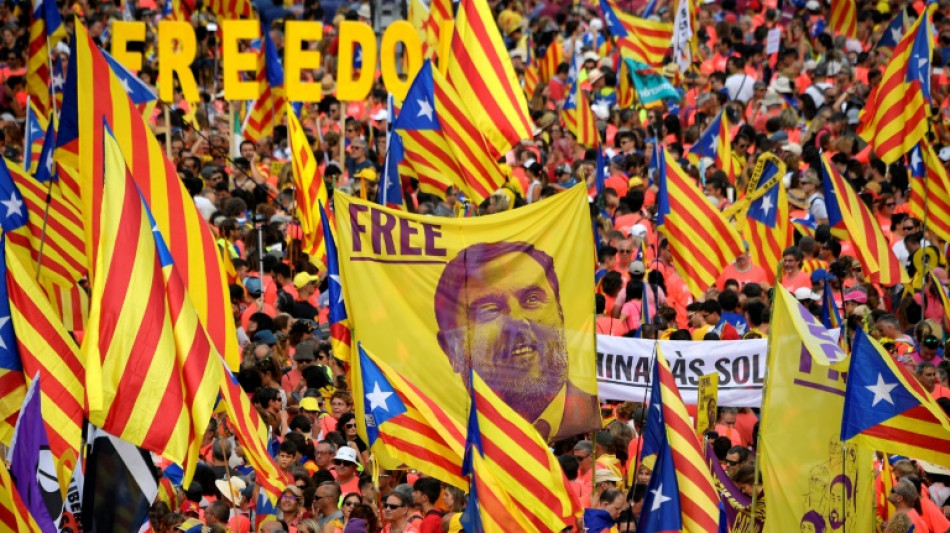
Spanish right on warpath over changes to sedition law / Photo: LLUIS GENE - AFP/File

 Hungary cuts anti-LGBTQ legislation from Orban-era law

 'Our future is being robbed': Greta Thunberg joins France student protests

 Late superstar Anita Mui's ashes missing in Hong Kong

 'No choice': IMF says developing countries must cut spending despite war shock

 Boasting South Korea footballers spark rethink of military service exemptions

 Five dead as Hurricane Simon, Rachel pummel Mexico's Pacific coast

 Seoul, Tokyo stocks plunge as Asia suffers fresh tech rout

 Damaged and drained, Indonesia's peatlands go up in smoke

 Dominant Australia wary of Pacific threat at Rugby League World Cup

 Pope to be admitted to hospital for lung operation

 Samoa's McFarland welcomes 'massive' arrival of ex-All Blacks for World Cup run-in

 Brewers beat Dodgers 7-4 to extend MLB playoff lead

 Teenager shoots headmaster, teacher at French school

 'Breaking Bad' actor RJ Mitte dead: representatives

 Former DR Congo president Kabila forms new force with M23 armed group

 Tom Cruise's 'Digger' tanks, leaving studio with $250 mn hole

 US actress Selma Blair arrested after flight altercation

 One dead as Hurricane Simon creeps along Mexico's Pacific coast

 Carrick's Man United 'hungry and eager' to fix worst start in decades

 Fury as US federal agents search anti-Trump lawmaker's home

 One goal enough for Flick as Barca enter Galatasaray cauldron

 A7 to unveil a service that will re-invent the international payments market

 'Status quo' with EU 'not good enough', UK PM says as summit date set

 Stolen Renoir paintings found behind wall in France

 French supermarkets suffer refrigerator shutdown after 'unprecedented' cyberattack

Spain's right-wing opposition is infuriated over government plans to abolish sedition, the charge used against Catalan separatist leaders, decrying the move as a gift to pro-independence parties in exchange for parliamentary support.
Parliament on Thursday approved a bill to reform the criminal code to drop what Spain's left-wing coalition government sees as an antiquated offence, replacing it with one better aligned with modern European norms.
And the change should be in place before the year's end, Spanish media reports say.
In response, the far-right Vox party has called a protest in Madrid on Sunday, while the right-wing opposition Popular Party (PP) has convened rallies across the country to express its opposition.
Right-wing parties say eliminating sedition -- the charge used to convict and jail nine Catalan separatists over their involvement with a failed 2017 independence bid -- will pave the way for another attempt to separate from Spain.
Initially condemned to between nine and 13 years behind bars, the separatists were pardoned last year by the leftist government, drawing fury from the Spanish right.
"Great for those in Catalonia who want to stage another coup!" PP lawmaker Edurne Uriarte told a parliamentary debate over the planned law changes.
- Like European democracies -
The failed independence bid sparked Spain's worst political crisis in decades, with then-Catalan leader Carles Puigdemont and several others fleeing abroad to escape prosecution.
Spain says its efforts to have them extradited have failed because many European countries simply don't recognise sedition as a crime, with the bill seeking to reframe the offence as an "aggravated public disorder".
The bill aims "to reform the crime of sedition and replace it with an offence comparable to what they have in other European democracies," Sanchez said earlier this month.
"The crimes committed in 2017 will continue to be present in our penal code, although no longer as crimes of sedition... but as a new type of crime called an aggravated public disorder," he said.
But even Puigdemont has expressed misgivings about the legal change, saying those separatists celebrating the move "have learned nothing from the last five years".
The new offence would carry a maximum penalty of five years behind bars, compared with 15 years for the crime of sedition.
Opposition leader Alberto Nunez Feijoo asked Sanchez to "clarify whether he is actually reforming the crime of sedition to protect Spanish democracy or whether he is just trying to politically survive" -- implying the bill was payback for pro-independence party support in parliament.
"The PP's stance is clear: we will increase the penalties for sedition and rebellion, we will make them criminal offences and will make the holding of an illegal referendum a crime," he said of his party's position, with a general election on the horizon.
- Some reluctance on the left -
The PP managed to ensure Thursday's vote was vocal, a rare procedure in Spain in which lawmakers verbally declare their support or opposition for a bill, in a move forcing the more reluctant Socialists to lay their cards clearly on the table.
Spain's criminal code currently defines sedition as "publicly rising up and using mass disorder to prevent the implementation of laws, by force or through means outside the law".
More succinctly, the Royal Academy of Spanish Language defines it as a "collective and violent uprising against authority, against public order or military discipline without reaching the gravity of rebellion".
The crime has survived various reforms of the legal code, the last of which was in 1995, but its critics say it dates back to the 19th century.
"We are revising a crime that was enacted in 1822 in Spain, dating back 200 years to when there were still military uprisings," Sanchez said earlier this month, pointing to Germany, where sedition was abolished in 1970.
But reclassifying it as an aggravated public disorder hasn't satisfied some on the left who fear it could be used against demonstrators.
"It concerns us... (that the new offence) could have some limiting effect on the right to peaceful protest," argued Pablo Echenique, spokesman for the hard-left Podemos, the Socialists' junior coalition partner which was behind the moves to abolish sedition.
P.Tamimi--SF-PST