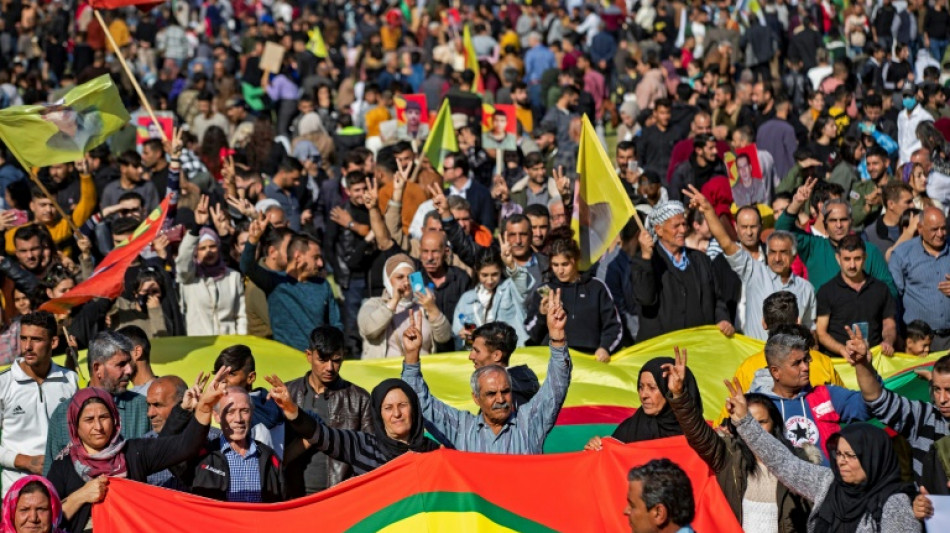
Syria Kurds fear thaw between Assad regime and Turkey / Photo: Delil SOULEIMAN - AFP/File

 Hungary cuts anti-LGBTQ legislation from Orban-era law
 'Our future is being robbed': Greta Thunberg joins France student protests

 Late superstar Anita Mui's ashes missing in Hong Kong

 'No choice': IMF says developing countries must cut spending despite war shock

 Boasting South Korea footballers spark rethink of military service exemptions
 Five dead as Hurricane Simon, Rachel pummel Mexico's Pacific coast
 Seoul, Tokyo stocks plunge as Asia suffers fresh tech rout
 Damaged and drained, Indonesia's peatlands go up in smoke

 Dominant Australia wary of Pacific threat at Rugby League World Cup
 Pope to be admitted to hospital for lung operation
 Samoa's McFarland welcomes 'massive' arrival of ex-All Blacks for World Cup run-in
 Brewers beat Dodgers 7-4 to extend MLB playoff lead

 Teenager shoots headmaster, teacher at French school
 'Breaking Bad' actor RJ Mitte dead: representatives

 Former DR Congo president Kabila forms new force with M23 armed group
 Tom Cruise's 'Digger' tanks, leaving studio with $250 mn hole
 US actress Selma Blair arrested after flight altercation
 One dead as Hurricane Simon creeps along Mexico's Pacific coast

 Carrick's Man United 'hungry and eager' to fix worst start in decades

 Fury as US federal agents search anti-Trump lawmaker's home

 One goal enough for Flick as Barca enter Galatasaray cauldron
 A7 to unveil a service that will re-invent the international payments market

 'Status quo' with EU 'not good enough', UK PM says as summit date set
 Stolen Renoir paintings found behind wall in France
 French supermarkets suffer refrigerator shutdown after 'unprecedented' cyberattack

Syria's Kurds, bracing for a Turkish land offensive against their autonomous northern region, face an additional threat: being squeezed by warming ties between their foe Ankara and the Assad regime.
The Kurds -- an ethnic minority who live in mountainous regions across Turkey, Syria, Iraq and Iran -- have long fought for their own homeland, and Turkey brands their separatist groups "terrorists".
Turkish President Recep Tayyip Erdogan has blamed Kurdish armed groups for a deadly bomb attack in Istanbul this month, an accusation they have strongly rejected.
In recent days, Turkey has launched air strikes on hundreds of Kurdish targets in Iraq and Syria and threatened a new ground operation into northern Syria, run by a Kurdish-led autonomous administration.
The region's Kurdish-led Syrian Democratic Forces (SDF), backed by US troops, spearheaded the fight against the Islamic State group in recent years.
Since Syria's civil war broke out in 2011, relations have sharply deteriorated between Erdogan and Syria's Bashar al-Assad, whose forces have since regained vast territories with backing from Russia.
But now there are signs of a Russia-brokered rapprochement between the Turkish and Syrian leaders, with Erdogan saying on Wednesday that he considered a meeting with Assad "possible".
Here is a look back at a decade of tensions and what a thaw would mean for the Syrian Kurds.
- How did Turkey-Syria relations fray? -
Before 2011, Ankara and Damascus were political and economic partners, and Erdogan and Assad cultivated a personal friendship.
But at the start of Syria's popular uprising, Turkey advised its ally to initiate political reforms, then urged Assad to "resign to prevent bloodshed".
In March 2012, Turkey closed its embassy in Damascus and Erdogan started branding Assad a "murderer" and a "terrorist".
Ankara started to welcome Syrian political opposition groups and to support the rebels.
Since 2016, Turkey has launched three offensives into Syria against Kurdish forces and it now controls a border strip inside Syria, citing its own national security needs.
Turkish and Syrian forces clashed in early 2020 when pro-Assad fighters were advancing toward the rebel-held Idlib province, before Russia intervened to calm the situation.
- How do Syrian Kurds get on with Assad? -
Before the war, Syria's Kurds faced discrimination and were barred, for example, from Kurdish language schooling.
For the past decade, as Syrian regime troops vacated the north and northeast, Kurds were able to establish limited self-rule.
The Kurds have avoided open hostilities with the Assad regime, except for some skirmishes, and maintained good ties with both US and Russian forces.
Damascus rejects the autonomous administration, accusing the Syrian Kurds of "separatism".
Several rounds of talks have brought few results but, after Russian mediation, the Syrian army was able to deploy limited forces in Kurdish-run areas against the Turkish advance.
- Are Syrian-Turkish relations warming? -
Turkey has softened its position toward the Syrian regime in recent months, nudged by Russia.
Turkey's foreign minister in August called for reconciliation between Assad and rebel groups, and Turkey's intelligence chief has visited Damascus.
Erdogan said on Wednesday he considers direct talks with Assad "possible", saying that "there is no place for resentment in politics".
Analysts say Russia, as it fights its war in Ukraine, is pushing for the rapprochement between the two neighbours, which both consider Kurdish fighters a common threat.
When the recent Turkish strikes killed around 20 Syrian military personnel, the response from Damascus was muted. Its deputy foreign minister Ayman Soussan merely denounced "the pretexts invoked by the Turkish occupation to justify its policy in Syria".
The SDF commander-in-chief Mazloum Abdi told AFP this week that he felt "Damascus' position is weaker than during previous Turkish offensives" and also claimed there had been "contacts between the two parties".
- How would a thaw impact Syrian Kurds?
Abdi charged that Turkey's aim is to reach an "agreement" with the Assad regime "to eradicate the experience" of Kurdish self-rule.
Erdogan, who faces an election next year, would also like to start sending back millions of Syrian refugees, observers say.
For Erdogan and Assad "to be on speaking terms... means they can make deals," said analyst Aron Lund of think tank Century International.
"They have common enemies and rivals, such as the SDF. They can swap assets, for example by helping each other kill or silence enemies located on the territory of the other, or arrange for mutual extraditions."
Lund stressed that "for the SDF, any serious Ankara-Damascus reconciliation would be a disaster.
"It removes their primary protection against Ankara -- which is Damascus, backstopped by Russia -- and it allows Erdogan and Assad to move in concert to resolve their Kurdish 'problems'."
I.Saadi--SF-PST