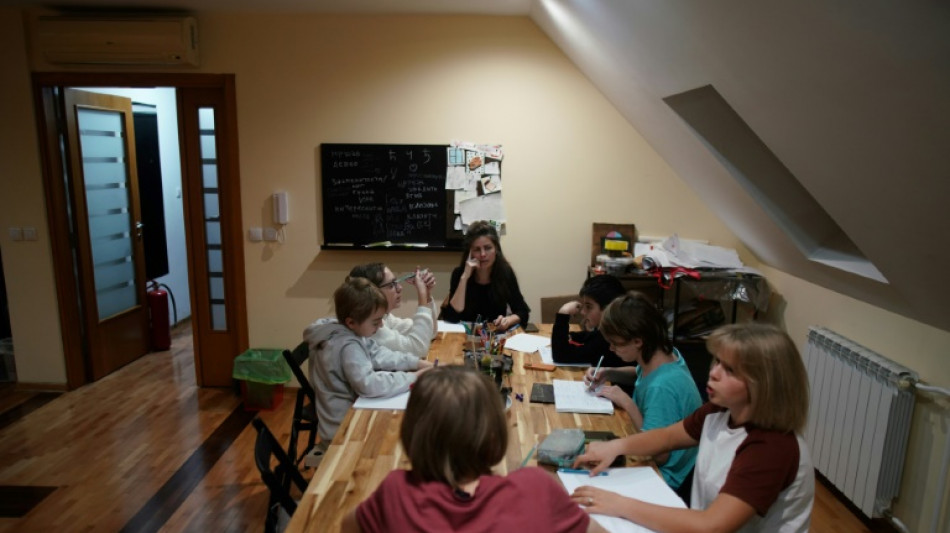
Russians fleeing Putin prepare for life in Serbian exile / Photo: OLIVER BUNIC - AFP

 Hungary cuts anti-LGBTQ measures from Orban-era law
 Tech stocks slump on AI jitters; oil falls
 ePlanet Brokers Publishes H1 2026 Transparency Report and Highlights Best Broker 2026 Award

 Van Gogh work unseen in public for 60 years on show in Hong Kong
 Prosecutors drop most impeachment charges against Philippine VP Duterte
 Hypersonic weapons highlight arms race on the Korean peninsula
 Fiji appoint ex-Springboks boss White as coach ahead of World Cup
 Hungary to reverse Orban-era anti-LGBTQ legislation
 Allen rushes Bills to thrilling 37-34 win over Rams
 India youth shift tactics as police clamp down on election protest
 Malaysia's Firefly extends flight cancellations due to haze

 IMF upgrades 2026 growth forecast but warns of 'split' outlook
 Infantino could pull off 'Houdini' act as critics struggle for candidate
 France braces for fresh nationwide student demonstrations
 Ahead of Israel vote, desert town becomes frontline against ultra-Orthodox expansion
 El Nino Watch: the impacts around the world this week

 Man City, PSG clash at contrasting time for state-backed projects
 Melbourne imam denies links to suspected flydubai hijacker

 Coventry crush Newcastle to climb out of relegation zone
 'Devastating' waves leave California beach homes on brink of collapse
 Meta says its new AI models on par with OpenAI, Anthropic
 Talarico rejects mental health conspiracy theory after return from flu
 Brazil presidential candidate Flavio Bolsonaro to visit jailed father
 Brazil's patron saint reappears in polarized election campaign
 US Open champ Zverev to become tennis world number one
A group of Russian children clamour cheerfully in a Belgrade apartment, proudly shouting out the new Serbian words they've just learned to their teacher.
These kids all have one thing in common. Their parents fled after Russian President Vladimir Putin's invasion of Ukraine and are now preparing to stay in the Balkan country for the long haul.
Just as over a century ago, when thousands of Russians fleeing the Bolshevik revolution settled in Serbia, the country has once again become a haven for Russians fleeing repression, uncertainty and the real possibility of being drafted to fight a war they don't consider their own.
Maria Nefyodova, whose 10-year-old child Artemii already speaks fluent Serbian after only nine months in Belgrade, packed their bags as soon as the first shot was fired in Ukraine.
"On February 24, everything changed. Our world turned upside down", Nefyodova told AFP.
"Of course, not in the way it has changed for those who are the directly affected side, but our world was shattered too".
- 100,000 Russians -
Since then, according to state media, more than 100,000 Russian citizens have arrived in Serbia, a country of under seven million.
They have used one of the few remaining flight routes into Europe that has not been closed off in retaliation for the war.
Serbian President Aleksandar Vucic said last month the country was "like Casablanca", likening it to the Moroccan town of the 1942 movie, swarming with war refugees and spies.
While the exact number of Russians who have elected to stay is unknown, almost 3,000 Russian companies have registered in Serbia since February, according to its business registration agency.
Unlike some other parts of Europe, Russians are greeted with open arms in Serbia. Cultural and historical ties between the two predominantly Slavic and Orthodox Christian countries stretch back centuries.
"I definitely want to stay here," 41-year-old Muscovite artist Anna Cherepanova told AFP.
The Belgrade apartment where she lives with her two children serves as an unofficial Serbian language school.
"The children like it here. If they didn't feel as comfortable, I would likely consider moving to another country."
- Russians leading anti-war rallies -
But the Serbian affection for Russia often extends to support for the Kremlin as well.
That creates awkward situations for exiled Russians who, almost by definition, vehemently oppose Putin.
Souvenir kiosks in Belgrade sell T-shirts featuring Putin's face, while the letter Z -- the Russian symbol for the invasion of Ukraine -- has been daubed on walls across the city.
Serbia, a candidate to join the European Union, is walking a diplomatic tightrope, condemning the invasion of Ukraine at the United Nations while refusing to align with Western sanctions against Moscow.
It is the Russians living in Serbia who are the most vocal in denouncing Putin's aggression.
United by an online platform, a group consisting mainly of Russians has staged numerous anti-war rallies, held charity events and spray-painted over the pro-Putin graffiti in Belgrade.
The simple fact that they can now voice their resentment without fear of being arrested or imprisoned is a revelation for many.
"The Russians are thrilled that they can march in the middle of the street, chant and even shout insults against Putin and the war," Sasha Seregina, a 34-year-old architect who emigrated from Russia to Serbia over a decade ago, told AFP.
"Some said they were constantly on the lookout to see if police would come out of nowhere to arrest them."
- Business impact -
Several big Russian tech companies, including Yandex, Luxoft and Wargaming, have opened new offices in Belgrade or expanded existing ones. They have moved hundreds of staff to Serbia and also employ locals.
For decades, Serbia has been crippled by the mass exodus of young, well-educated and skilled workers. Some experts believe the sudden influx of Russian tech businesses could provide a lifeline for the country's economy.
"Educated people stop leaving the country once the number of highly-paid jobs starts to rise," Danica Popovic, an economics professor at Belgrade University, told AFP.
"If those tech companies start employing Serbian engineers -- which they probably will as it is cheaper than any other option -- we have a chance to decrease emigration."
But many Serbs complain that the arrival of predominantly middle-class Russians, whose income far exceeds the average salary in Serbia (640 euros, $657), has doubled the rent charged in big cities like Belgrade and Novi Sad.
While most Russian immigrants work in tech companies, some are using their knowledge and experience to expand the Serbian business scene.
Aleksei Novikov, a 42-year-old businessman from Saint Petersburg who fled to Serbia fearing he might be drafted to serve in Ukraine, recently opened Belgrade's very first cider bar.
"In Russia, business is a bit more advanced, so I see opportunities and perspective to bring something new to Serbia," Novikov told AFP.
"Lots of Russians came recently. I hope we won't become a problem for Serbs, that we will integrate into society and do good things to make life better for everyone."
V.AbuAwwad--SF-PST