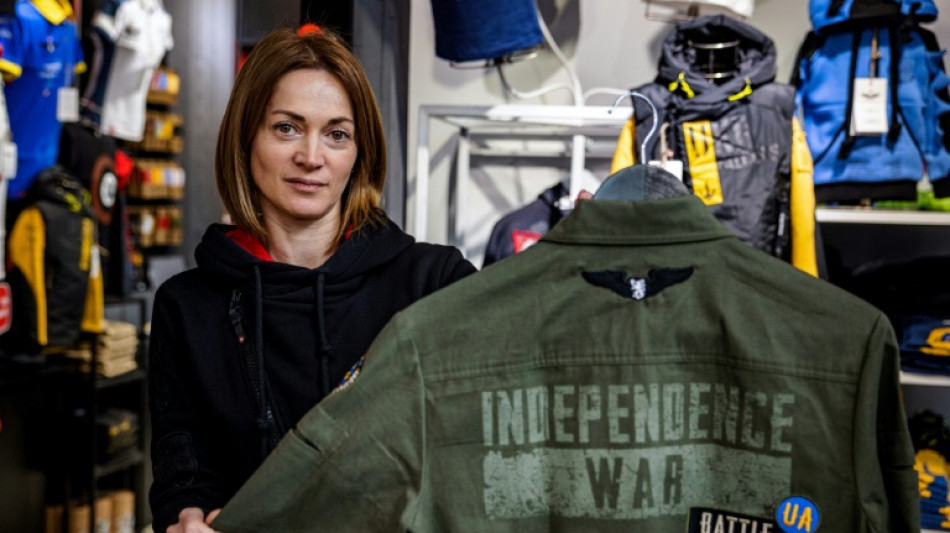
Khaki nation: Ukraine dresses for war / Photo: Dimitar DILKOFF - AFP

 Arsenal cruise past Lille into share of Champions League lead

 Trump ousts Greece ambassador over ethics scandal

 Reese Witherspoon, France's Mediawan to buy Hello Sunshine

 Bipartisan US senators urge Trump to scrap Russian diesel deal

 Ex-gang leader sentenced to minimum 40 years for Tupac murder

 Cornell suspends frat parties after alleged gang rape

 Man City deserve to keep titles, says PSG's Luis Enrique

 Regulator 'will resign' if any political interference in Man City case

 Microsoft's Brad Smith calls for 'real and effective' AI safety standards

 Anthropic warns of AI 'worms' spreading across smart gadgets

 Big US banks report strong earnings and stay bullish on AI

 Iraola backs Barcola, Wirtz to come good for Liverpool

 In a first, AI helps UK lawmaker find her voice in parliament

 Pope Leo in Rome hospital for lung operation

 EU watchdog says smart glasses must give 'clear warnings' when recording

 Houthis say Saudi Arabia strikes oil site in Yemen's capital

 France roiled by marches in support of protesting students

 Goldman Sachs profits jump as CEO says no plans to exit

 Apple unveils HomeView smart display in renewed home push
 Novelist Thelyson Orelien denies AI use, admits plagiarism 'mistakes'
 Trump asks Greece ambassador to resign amid bribery scandal: White House
 11 missing after ships struck off Bulgaria in latest Black Sea attack
 France budget debate faces rocky start as Socialists vow to fight
 AI could 'change the stakes' on bioweapons: UK spy chief
 Sweden centre-left leader fails to form government

Ukrainian President Volodymyr Zelensky created the trend by wearing khaki outfits in every setting since the beginning of the Russian invasion in February.
In the eight months of war, his people have followed his sartorial lead.
Even civilians far from the frontlines have adopted their president's khaki dress code turned weapon of communication.
As Ukraine's army chief, Zelensky could wear the national military uniform, but he swapped his suits for more relaxed civilian outfits with military tones.
Since the first day of the war, he has been wearing olive t-shirts revealing his biceps, topped by khaki fleece on cold days, along with cargo trousers and sneakers in the same tones.
"And these are very cheap sneakers, signalling simplicity," Tanya Solovey, a fashion history researcher and former Vogue journalist, tells AFP.
"They say: 'my country is fighting and I am wearing the same simple and convenient outfit as people who go down to underground shelters'," Solovey adds.
In the country that announced general mobilisation for men between 18 and 60 years old on February 25, army green has also been adopted en masse by civilians.
"Many people started wearing khaki, which is associated with our army, that way we don't forget what is going on and help, in our way," says 30-year-old Denys, walking in Kyiv in a khaki designer jacket.
The monochromatic trend invaded women's fashion too, from manicured fingertips to small accessories.
Svitlana, 62, chose a khaki tracksuit to go out to Kyiv's city centre because "our times require it."
"But not every day, that would be too repetitive," says the pensioner who livened up her outfit with a sleeveless candy-pink down jacket.
- Illegal for civilians -
"Khaki has always been a popular colour in Ukraine, for casual and outerwear, but it's become more than just a style, it is the visual identity of an entire nation at war," Solovey says.
In front of the main post office in Kyiv, Natalya is wearing a full head-to-toe khaki look, from her cap to her tailored trousers and elegant quilted jacket.
She has been wearing that colour since the beginning of the war, in homage to her brother killed in combat in 2015 and to her husband, mobilised on the frontline.
"Camouflage is the only colour that makes me feel like I'm protected," the 42-year-old accountant says.
In the war-torn nation, most supermarkets have replaced the flowers or telephones on their stalls by military uniforms for conscripts or mobilised soldiers.
Ukrainian martial law prohibits civilians from wearing military uniforms or any outfit that could pass as such.
Offenders can receive a fine of up to 3,400 hryvnias (92 dollars).
"I love this (khaki) colour, I also have loads of camouflage print outfits, but I avoid wearing them to avoid confusing people or inconveniencing our soldiers," said Anastasya Grebinichenko, a 15-year-old student who opted for black as her winter colour.
- Embroideries and 'Vyshyvankas' -
In Kyiv, the fashion line "Aviatsiya Halychyny" created at the beginning of the 2014 war has become widely popular for its t-shirts honouring the defenders of Mariupol or boasting anti-Russian messages.
The company donates some of its earnings to Ukrainian army brigades.
"Clothes are the simplest vector to express an opinion," says Natalya Kulyk, a brand manager.
"They show direct support to our army, they're a patriotic expression," adds Kulyk, who is wearing a "tactical-style" black outfit with a military-inspired fleece with pockets and herringbone pattern.
In Ukraine, fashion has become a tool and a political symbol since the 2004 orange revolution.
Then, citizens started wearing scarves and ribbons of the same clour to protest against Kremlin-backed oligarch Viktor Yanukovych.
After the pro-EU so-called Euromaidan protest wave in 2014, followed by the onset of conflict with Russia that same year, Ukrainian fashion took on overtly "patriotic" tones.
Many started wearing patches with the trident, the national emblem.
Another trend clearly returned as people started wearing traditional embroidered shirts called Vyshyvankas.
"As long as Russia repeats that there is no Ukrainian nation, language or identity, we will defend our culture and our heritage, it's just part of the battle," said Solovey.
Q.Bulbul--SF-PST
