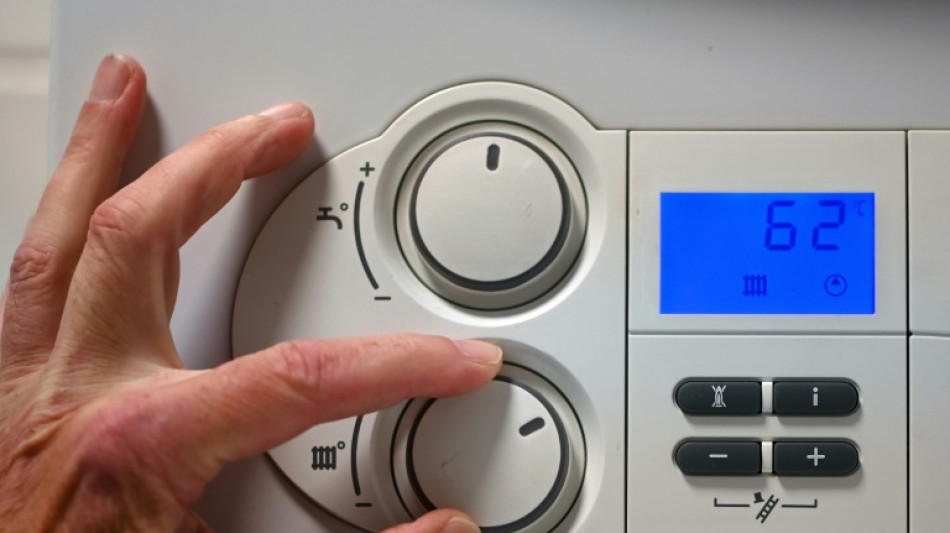
Germany primes energy price cap as bills soar / Photo: Ina FASSBENDER - AFP/File

 Asian markets mixed as tech firms claw back some losses

 India shuts down iconic Delhi protest site after three decades

 Japan urges Russia for 'impartial treatment' of arrested journalist

 Lula, Bolsonaro ordered to call off attempts at online censorship

 EU takes a page from Ireland's AI playbook

 Global deforestation slowed in 2025 but surged in Congo basin: study

 Saudi says Houthi attacks sparked Aramco fire, wounded 4 in Riyadh

 Few buyers for starving cattle in El Nino parched El Salvador

 Bybit Expands Beyond Crypto as CEO Outlines Next Phase of Financial Platform

 Bayern held by Viking after 'super dumb' Olise red in Champions League

 Why AI makes computer worms harder to stop

 US fines Bank of America $1.2 bn for anti-money laundering violations

 Bayern held by Viking after Olise sees red in Champions League

 Atletico down Carrick's struggling Man United

 Croatia trials full driverless robotaxi service

 US stocks dip ahead of inflation data as tech sell-off hits Asia

 No lights, no friends: Cuban youth grapple with loneliness

 Saudi coalition strikes Yemen oil sites after Houthi attacks

 French economy minister denies country caught in debt 'snowball'

 Judge extends halt to Trump's golf course tree-cutting

 Milan's Saelemaekers set for lenghty spell out after ankle surgery

 Nvidia says to invest in French medical website

 Real Madrid's Mourinho has 'trust' in referees despite complaints

 Mendis, Shanaka star in Sri Lanka consolation T20I win

 Demonstrations backing France's protesting students gather strength

Germany on Wednesday put the finishing touches on an energy price cap, the cornerstone of a massive 200-billion-euro ($198-billion) package to shield households and businesses from rising costs.
"Immediate help is on its way!" Chancellor Olaf Scholz said on Twitter, who has ploughed ahead with plans despite criticisms from European partners.
The major energy market intervention is deemed necessary to support consumers at a time when Europe's largest economy is drifting towards recession and inflation has shot past 10 percent.
The plan will see the price for a percentage of household and businesses' typical consumption capped at lower-than-market prices, according to a position paper from the government.
For gas, 25,000 larger businesses, as well as almost 2,000 hospitals and schools will benefit from the cap as soon as January 1 next year, under the plans.
Households and smaller businesses meanwhile could have to wait until March 1 at the latest for the price brake to come into force.
Policymakers will "seek" to apply the relief retroactively from February 2023.
A similar price cap will also apply to electricity from the start of the new year in January, with the measures set to last through to the end of April 2024.
- December help -
While the cap for smaller consumers will only come into force later, the government will pick up the bill for household heating in December.
For households the price of a kilowatt-hour of gas will be capped at 12 cents for up to 80 percent of their typical usage.
The same unit of gas currently costs billpayers 18.6 cents, according to the price comparison site Check 24.
All in all, the support measures could save a single-person household with a typical gas consumption of 5,000 kWh around 264 euros over a year, the site estimates.
The partial price cap was designed to maintain "incentives to save energy" despite lowering prices for consumers, according to the government paper.
Scholz will meet with state premiers later Wednesday to finalise the details of the plan.
Ahead of the meeting, some regional leaders pressed the federal government to apply the gas cap for households sooner.
"People need reliable protection from the higher costs, especially in the cold months of January and February, when they use heating intensively," Hendrik Wuest, the regional leader of North Rhine-Westphalia, told Der Spiegel magazine.
- European discontent -
Germany, long reliant on Moscow for energy imports, has been hit hard by the sharp rise in prices since the invasion of Ukraine and the cut to supplies.
Despite the Germany economy eking out 0.3-percent growth between July and September, most analysts still expect the country to slip into recession as the high costs of energy drags on production.
Businesses that have been crying for support from the government welcomed the plans.
The price cap measures should "create a bit of security and at the same time ease worries", the BDI industrial lobby said Monday ahead of the final agreement.
Berlin's massive go-it-alone plan to shield its economy has ruffled feathers among European partners who would have preferred a common solution.
They feared that more highly indebted EU countries could not afford the outlay made by Germany, while the plan could affect their own energy costs.
Germany's energy price shield will be partly financed through new borrowing through an economic stabilisation fund created during the coronavirus pandemic.
Berlin also intends to fund the cap by skimming off part of the bumper profits made by energy companies as prices have risen.
A.Suleiman--SF-PST