
Will Bibi make a comeback in Israel's vote next week? / Photo: Menahem KAHANA - AFP/File

 Rising Spanish tennis star handed code violation for swearing at ballboy

 Last of the French musketeers Monfils officially retired from tennis

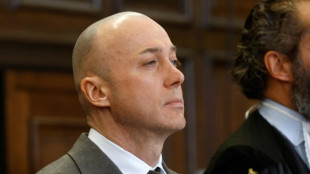 Ukraine ex-military officer stands trial over Nord Stream sabotage

 British and Irish Lions to play first women's match against France

 Fuel shortage triggers queues on resort island Bali

 Sao Tome's niche vanilla finds far-away fans
 China-North Korea bridge to open Thursday, 12 years late
 Asian stocks mostly down as tech firms struggle to claw back losses

 AI boom drives record sales at Dutch tech giant ASML
 Trump says 'massive' oil, gas, mineral exploration to begin in Greenland

 China heads for record trade surplus as exports surge

 Vietnam mourns 700 war dead in major push to identify missing

 Relentless Swiatek wins all-Polish battle to launch Wuhan campaign

 Seeing pivotal election, Israelis fly from around world to vote

 South Korea's Eom 'racially abused' in England's Championship: club

 Asian markets mixed as tech firms claw back some losses

 India shuts down iconic Delhi protest site after three decades

 Japan urges Russia for 'impartial treatment' of arrested journalist

 Lula, Bolsonaro ordered to call off attempts at online censorship

 EU takes a page from Ireland's AI playbook

 Global deforestation slowed in 2025 but surged in Congo basin: study

 Saudi says Houthi attacks sparked Aramco fire, wounded 4 in Riyadh

 Few buyers for starving cattle in El Nino parched El Salvador

 Bybit Expands Beyond Crypto as CEO Outlines Next Phase of Financial Platform

 Bayern held by Viking after 'super dumb' Olise red in Champions League

A week before Israel's fifth general election in less than four years, one question dominates: will the hawkish ex-prime minister Benjamin Netanyahu return to power?
Polls show he would likely need heavy backing from the country's rising extreme-right to form a government -- a scenario which, one expert warned, would spell "disaster" for Israel's democracy.
Netanyahu served as premier for a total of 15 years, a record in Israel's 74-year history, before he was ousted in June 2021 by a motley alliance of ideologically divided parties united only by their opposition to him.
Widely known as "Bibi", he was an ally of former US president Donald Trump and a dominant leader under whom Israeli politics shifted to the right and talks to resolve the Israel-Palestinian conflict all but stalled.
Despite being on trial for corruption and breach of trust, charges he denies, and undeterred by his failure to secure a majority government in four straight elections, Netanyahu has vowed to make a comeback.
As opposition leader and head of the right-wing Likud party, the largest in parliament, the 73-year-old with a reputation as a wily strategist has worked to exploit divisions in the coalition.
The unlikely post-Netanyahu government included religious nationalists, centrists, left-wingers and -- for the first time in Israeli history -- an independent Arab party.
Netanyahu brought them down by ordering his parliamentary allies to vote against a measure even though they all ideologically backed it: a bill ensuring that Jewish settlers in the occupied West Bank could live under Israeli law.
The Likud chief correctly bet that the coalition, deeply divided over the occupation, would crack over the issue.
- 'Most critical election' -
Naftali Bennett stepped down as premier in June, saying his government was no longer tenable. Foreign Minister Yair Lapid took over as caretaker premier, and elections were called for November 1.
While the coalition's collapse marked a clear tactical victory for Netanyahu, polls show that he and his allies may once more struggle to secure a 61-seat majority in the Knesset.
Crucially, there appears no path towards a Netanyahu-led government without support from an extreme-right alliance known as Religious Zionism.
That bloc includes Itamar Ben-Gvir, who has a history of using incendiary anti-Arab rhetoric and has voiced admiration for Baruch Goldstein, the mass murderer of Palestinians in the West Bank city of Hebron in 1994.
"This election is perhaps the most critical because Netanyahu has allied himself with a racist party, and this could be disaster for Israeli democracy," said Gayil Talshir, a political scientist at the Hebrew University of Jerusalem.
"The result could be the most extreme, right-wing government that Israel has ever had," she told AFP.
Lapid, a 58-year-old former television presenter who leads the centrist Yesh Atid party, has seen signs of rising support during his brief tensure as interim prime minister.
He hosted US President Joe Biden, met France's Emmanuel Macron in Paris and German Chancellor Olaf Scholz in Berlin, and clinched a maritime border deal with hostile northern neighbour Lebanon.
Lapid also oversaw a three-day army operation against Islamic Jihad militants in the blockaded Gaza Strip that, in the eyes of many Israelis, was successful.
- Jostling for seats -
"Lapid chose to observe this election from above, from the prime minister's bureau," wrote columnist Nahum Barnea in the leading daily Yediot Ahronot.
"He chose to let everyone else scurry about, perspire, get their hands dirty and make mistakes, while he played the role of the responsible adult.
"That restrained stance helped boost Yesh Atid in the polls, but it didn't help the anti-Bibi bloc."
Polls late last week showed Yesh Atid set to win 24 seats, which would be a record for the party as an individual list.
But the anti-Netanyahu bloc's path to 61 seats also remains cloudy and would almost certainly require another fragile agreement among ideological opponents.
Under Israel's system of proportional representation, lists need to cross a threshold of 3.25 percent of the vote to secure the minimum four seats -- a hurdle that can derail coalition calculations.
Some surveys indicate that the three Arab-led parties, which have decided not to run as a united bloc, are each teetering around the cut-off point, which could see them thrown out of parliament.
Such a result could sway the balance of power in Netanyahu's favour.
A tireless campaigner, Netanyahu was rallying Likud supporters in a local theatre in the northern city of Migdal Haemek on Sunday.
Urging a strong Likud turnout on election day, he told his party faithful: "I ask you to go to all of your friends, all of your neighbours, all of your relatives, and tell them that nobody stays home."
O.Mousa--SF-PST