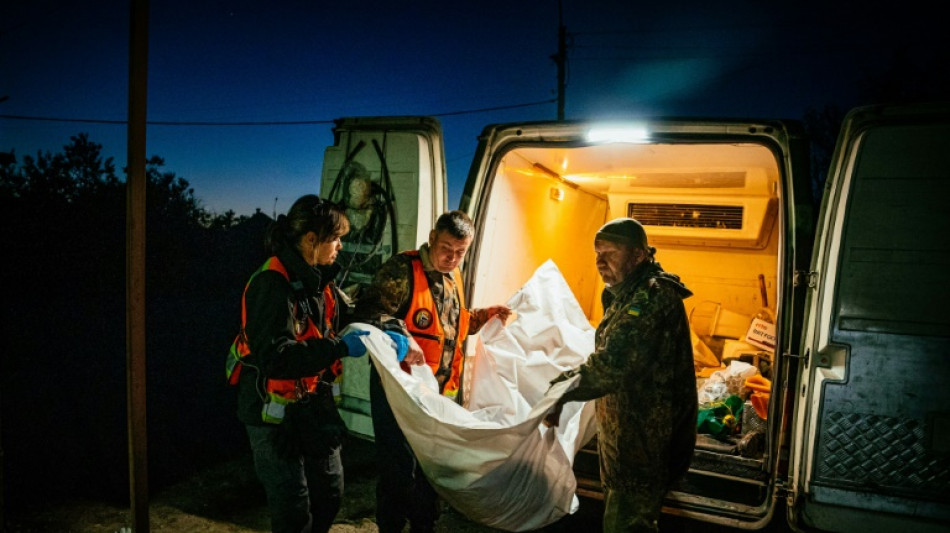
'Cargo 200': Ukraine's grim search for its fallen / Photo: Dimitar DILKOFF - AFP

 Govt takes control of Turkey's most-watched news channel

 FIFA to offer members $6.35-billion development fund windfall
 US consumer inflation hotter than expected as midterms loom

 INmune Bio Inc. and Quantum Computing Inc. Partner to Apply Quantum Optimization and AI to Advance Alzheimer’s Drug Research and Explore New Applications for XPro

 Hot US inflation data dents Wall Street stocks
 India sends 'cockroach' leaders to jail after protest

 'Sinners' director Ryan Coogler to reboot 'X-Files' for Disney
 Lufthansa wins contest for TAP Air Portugal stake
 AI worms, 'major' incident fears spur safety calls at industry summit
 Fuel shortage triggers queues on Indonesia's Bali island
 Evolution Metals & Technologies Corp. Reaffirms $400 Million to $460 Million FY2027 Revenue Guidance, Unveils Eight Sintered Magnet Grades Covering an Estimated 75% of Global NdFeB Revenue, and Moves to Answer U.S. Army Call for Rare Earth Magnets

 Trial defence says Russia used Nord Stream pipelines as 'weapon'
 Israeli settlers set fire to mosque in occupied West Bank
 Macron says French student protesters 'exploited' by political forces: spokeswoman
 Stocks diverge ahead of key US inflation data
 Japan summons Russian ambassador to protest journalist's arrest
 Workers to strike at world's largest copper mine in Chile
 Ukraine accuses US of helping Russia as missiles hit Kyiv
 Drone hits data centre of Russia's largest bank
 Bivial AG Brings Its Complete Dashboard to Mobile
 Mont Blanc nearly two metres taller than in 2023: French surveyors

 Pope recovering after lung cancer operation that rattles Church
 Indonesia haze spikes Singapore pollution, shuts East Timor schools
 Higher borrowing costs an 'alarm signal' for France: finance minister
 Zelensky accuses Putin of disrespecting Trump after latest attacks

"He's bringing back the dead, so you leave him alone," a Ukrainian soldier barks at a comrade who has come to inspect a truck bearing the dreaded sign "Cargo 200".
It's military shorthand for a fallen soldier -- 200 being the number of kilos a zinc army coffin bearing a body generally weighs.
The scene at a checkpoint in war-ravaged Svyatogirsk is being played out in scores of other towns Ukraine has recaptured in a lightning counter-offensive across the eastern front.
"Cargo 200" dates from the Soviet invasion of Afghanistan in the 1980s, but in Ukraine both sides use the term for the untold thousands who have perished in eight months of the worst fighting Europe has witnessed since World War II.
Over the space of a week, Andriy Chernyavskiy and his specialist Ukrainian unit had already brought back the bodies of 19 other soldiers from the same sector.
- Yellow dots -
Rumbling over roads rutted by shell craters, Chernyavskiy's grim task relies on an interactive map with yellow dots marking spots where retreating Ukrainian soldiers reported burying or losing their comrades in the first months of war.
The convoy he commands pulled to a sudden stop at an isolated house in a nearby village called Oleksandrivka.
The rubbish and ammunition inside confirmed that the house had been held by Ukrainian troops before being taken by the Russians in late April.
"We know that a part of the 81st Brigade and the border guards withdrew from their positions in this house," Chernyavskiy said.
His search for the remains of a soldier the Ukrainians had to leave behind as they retreated under fire is helped by forensic dogs specialising in sniffing out the dead.
"Our dogs undergo a different kind of training than the ones involved in basic search and rescue," said Larysa Borysenko, 51, whose NGO Antares accompanies Chernyavskiy's Cargo 200 team.
After sniffing around for a few minutes, Professor, a young Belgian Shepherd, starts digging frantically with his front paws under a tree.
Two soldiers quickly fetch their spades. Chernyavskiy is already pulling on his white protective suit.
Once found half a metre (1.5 feet) below ground, the body is wrapped in a blue sheet, a cushion supporting the head.
"We are lucky. The body is well preserved.
"This kind of ritual is rarely possible," said Chernyavskiy, bent down beside it.
- Last honours -
In war, identification of the dead is rarely this straightforward.
The remains of one soldier was buried with three flak jackets, each one bearing a different name.
"We will only know who it is after matching the DNA test result," said Chernyavskiy, who has been doing this work for 20 years.
He started off with an NGO involved in identifying Soviet and Nazi soldiers killed across Ukraine during World War II.
He joined the Ukrainian army in 2014, offering his expertise during the Russian-backed conflict in the east after the annexation of Crimea that was a precursor to the current war.
"We must find each of our dead. That is my motto. There can be no missing," he said.
"Everyone deserves their last honours," even the Russian soldiers, whose corpses are also collected "in accordance with international law," Chernyavskiy said.
- Mined corpses -
Chernyavskiy is now well-known across the front and his van is often stopped by soldiers.
In the just-recaptured ghost town of Shandrygolove, one of the soldiers grabs a cable and guides Chernyavskiy to an isolated farm.
The cable will serve as a lasso to safely pull the corpse a few metres to make sure it is not booby trapped -- a dreaded practice in recaptured areas.
On a carpet of autumn leaves nearby, the bloated headless body of a soldier lies in utmost solitude. Beside it, a shell crater.
"What happened here is quite obvious," said the unit's deputy commander Oleksandr Lovynyuk, 53, unfolding a white body bag.
A soldier's helmet lies nearby, empty save for a few stuck strands of hair.
The team spends the 30 next minutes in heavy silence combing the surroundings in vain for the missing head.
"Behind each search, each effort, we try to remember that the mourning of a loved one depends on us," Borysenko said.
A.Suleiman--SF-PST