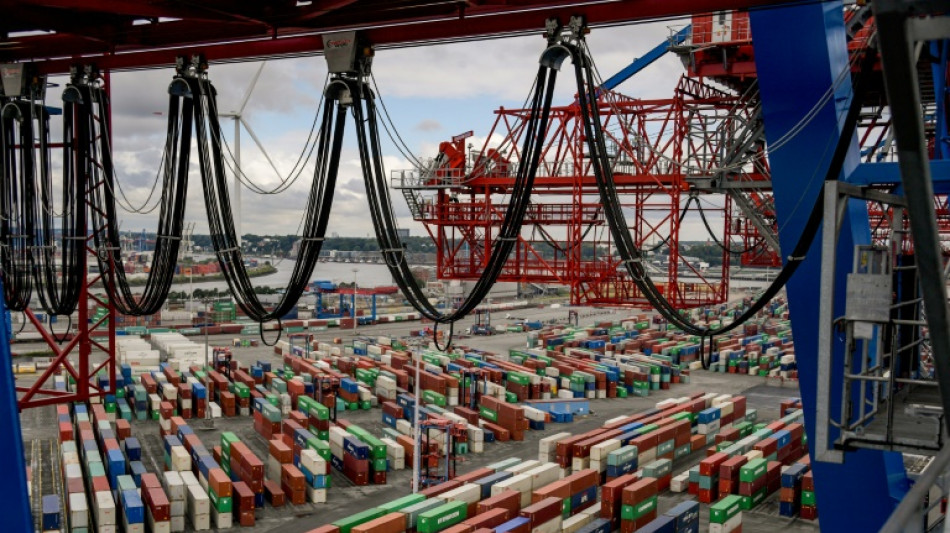
Germany forecasts 2023 recession as energy crisis bites / Photo: Axel Heimken - AFP/File

 Villa put six past Fenerbahce in record rout

 US stocks fall after hot inflation report as leading AI shares tumble

 Government buildings torched in violent Albanian protests

 Wall Street grills Bank of America over money laundering fine

 Mekies extends contract as Red Bull team principal until 2031

 Indonesia rescues starved orangutan from fires: officials

 Real Madrid's Vinicius banned for Clasico after red card

 Restrictions expose Ukraine's Starlink dependency in Russia war: observers
 Espada out as Astros manager while Mattingly stays with Phillies

 Houthis say targeted Saudi oil giant Aramco, vow more attacks

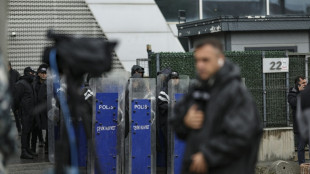 Govt takes control of Turkey's most-watched news channel

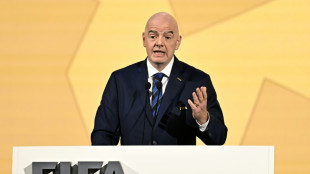 FIFA to offer members $6.35-billion development fund windfall

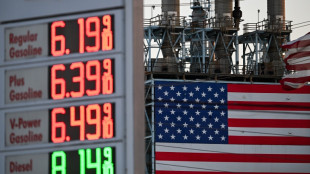 US consumer inflation hotter than expected as midterms loom

 INmune Bio Inc. and Quantum Computing Inc. Partner to Apply Quantum Optimization and AI to Advance Alzheimer’s Drug Research and Explore New Applications for XPro

 Hot US inflation data dents Wall Street stocks

 India sends 'cockroach' leaders to jail after protest
 'Sinners' director Ryan Coogler to reboot 'X-Files' for Disney

 Lufthansa wins contest for TAP Air Portugal stake

 AI worms, 'major' incident fears spur safety calls at industry summit
 Fuel shortage triggers queues on Indonesia's Bali island

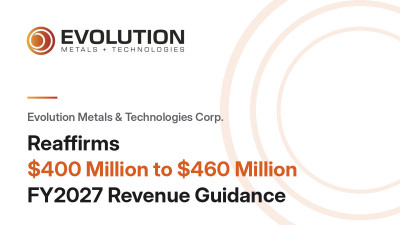 Evolution Metals & Technologies Corp. Reaffirms $400 Million to $460 Million FY2027 Revenue Guidance, Unveils Eight Sintered Magnet Grades Covering an Estimated 75% of Global NdFeB Revenue, and Moves to Answer U.S. Army Call for Rare Earth Magnets

 Trial defence says Russia used Nord Stream pipelines as 'weapon'

 Israeli settlers set fire to mosque in occupied West Bank

 Macron says French student protesters 'exploited' by political forces: spokeswoman

 Stocks diverge ahead of key US inflation data

Germany will sink into recession next year and inflation will soar, the government forecast Wednesday, as Europe's top economy battles skyrocketing energy prices following Russia's gas shutdown.
The official predictions were the latest warning that Germany's economy, which was just getting back on its feet after the pandemic, is set to shrink in 2023 due to the fallout of Moscow's invasion of Ukraine.
Unveiling the government's latest forecasts of 0.4 percent economic contraction and seven percent inflation for 2023, Economy Minister Robert Habeck painted a dark picture of a "serious energy crisis".
It "threatens to become an economic and social crisis", he warned -- but insisted that Russian President Vladimir Putin will "fail in this attempt to destabilise the basic economic and political order".
Putin "will also fail on the battlefield in Ukraine", he added.
Moscow's move to cut off gas supplies to Europe amid tensions over Ukraine has triggered an energy crisis across the continent, with consumers and businesses facing high prices as winter approaches.
Germany has been particularly hard hit, as 55 percent of its gas supplies came from Moscow prior to the Ukraine conflict.
The soaring energy costs are expected to send inflation to eight percent in 2022 and seven percent in 2023, the government forecast.
Nevertheless, Germany's economy is still set to register growth of 1.4 percent in 2022, according to the government forecasts, after having enjoyed a post-pandemic rebound earlier in the year.
But it will then shrink in 2023, with the economy ministry saying the "central reason" for the downgrade from forecasts earlier this year was "the halt to Russian gas supplies".
High energy prices are acting as "a brake on industrial production -- above all in energy-intensive sectors". The economy will return to growth with expansion of 2.3 percent in 2024, according to the forecasts.
- Energy price cap -
The government recently unveiled a 200-billion-euro ($194-billion) fund to shield consumers and businesses from surging prices, which includes a cap on energy costs.
Without the cap, consumer prices would be much higher in 2023, the forecasts said.
Forecasts by leading economic institutes late last month showed inflation coming in at 8.4 percent for the year as a whole in 2022 -- and climbing further to 8.8 percent in 2023.
Warnings are mounting that global growth will slow further next year due to myriad crises, with the IMF this week downgrading its 2023 global GDP growth forecast.
It forecast that Germany, along with Italy, will become the first advanced economies to contract in the wake of Russia's invasion of Ukraine.
Signs are rapidly multiplying of Germany's escalating economic crisis.
Last week, official figures showed that industrial production -- the pillar of the German economy -- produced 0.8 percent less in August compared with the previous month, with energy-intensive industries badly impacted.
Inflation meanwhile hit a 70-year high of 10 percent in September.
The European Central Bank has started aggressively tightening monetary policy to bring inflation under control, lifting rates a historic 75 basis points last month, but some are worried the move adds to recession risks.
Berlin has been scrambling to find alternative energy sources, accelerating the construction of infrastructure to import gas from further afield, and is preparing to keep two nuclear plants running longer than initially anticipated.
Despite the crisis, Habeck sought to strike a positive note about efforts to find new partners to supply energy.
"We are making very good progress in loosening the grip of Russian energy imports," he said.
O.Farraj--SF-PST