Despite disasters, climate is a taboo election issue in US coal country / Photo: Stefani Reynolds - AFP

 Villa put six past Fenerbahce in record rout

 US stocks fall after hot inflation report as leading AI shares tumble
 Government buildings torched in violent Albanian protests

 Wall Street grills Bank of America over money laundering fine

 Mekies extends contract as Red Bull team principal until 2031

 Indonesia rescues starved orangutan from fires: officials

 Real Madrid's Vinicius banned for Clasico after red card
 Restrictions expose Ukraine's Starlink dependency in Russia war: observers
 Espada out as Astros manager while Mattingly stays with Phillies

 Houthis say targeted Saudi oil giant Aramco, vow more attacks

 Govt takes control of Turkey's most-watched news channel

 FIFA to offer members $6.35-billion development fund windfall

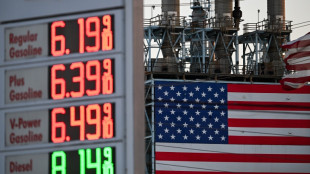 US consumer inflation hotter than expected as midterms loom

 INmune Bio Inc. and Quantum Computing Inc. Partner to Apply Quantum Optimization and AI to Advance Alzheimer’s Drug Research and Explore New Applications for XPro

 Hot US inflation data dents Wall Street stocks

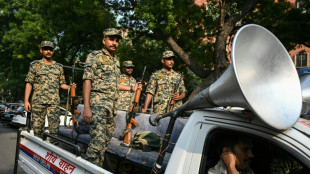 India sends 'cockroach' leaders to jail after protest
 'Sinners' director Ryan Coogler to reboot 'X-Files' for Disney

 Lufthansa wins contest for TAP Air Portugal stake

 AI worms, 'major' incident fears spur safety calls at industry summit
 Fuel shortage triggers queues on Indonesia's Bali island

 Evolution Metals & Technologies Corp. Reaffirms $400 Million to $460 Million FY2027 Revenue Guidance, Unveils Eight Sintered Magnet Grades Covering an Estimated 75% of Global NdFeB Revenue, and Moves to Answer U.S. Army Call for Rare Earth Magnets

 Trial defence says Russia used Nord Stream pipelines as 'weapon'

 Israeli settlers set fire to mosque in occupied West Bank
 Macron says French student protesters 'exploited' by political forces: spokeswoman

 Stocks diverge ahead of key US inflation data
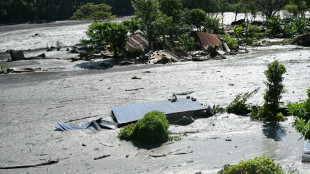
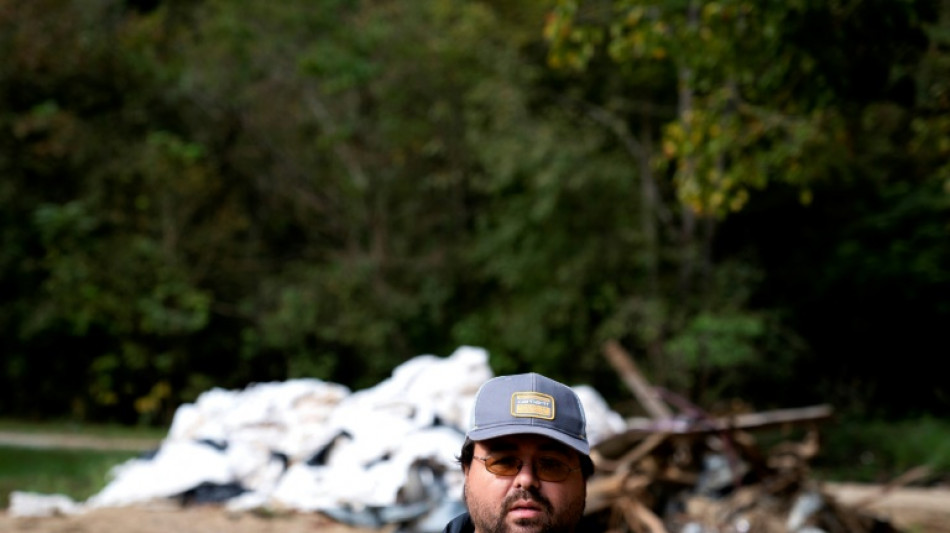
Chase Hays says he is "torn." After seeing floods ravage his hamlet in the mountains of eastern Kentucky, he filed a lawsuit against the mine that overlooks it, but the 34-year-old doesn't want to be seen as an "enemy" of coal.
Like him, many in his Appalachian region are reluctant to question an industry that has long provided the only high-paying jobs.
And with the US midterm elections approaching, few candidates dare talk about climate change.
Yet the state has been devastated recently by extreme weather.
In December, tornadoes killed 80 people in western Kentucky, and in late July, unprecedented heavy rains left 40 residents dead in the east of the state.
Standing at the bottom of a remote valley on the banks of a small creek, Hays had never seen water come down so fast.
He barely had time to cut through a fence to escape with his family before the torrent washed away his porch, an above-ground pool, even a pig, and flooded the foundation of his house.
Even if he still cannot live there, he considers himself "one of the lucky ones in my neighborhood," called River Caney, where about 20 houses were destroyed and two women swept away.
Moreover, he was insured, unlike his neighbors, some of whom are still sleeping in tents with no prospect of finding a roof before winter.
On behalf of those neighbors, he filed a complaint against the mining company that extracts coal above the hamlet.
Hays is convinced that one of the company's retaining ponds broke when the rain intensified.
"A big part of the reason why the ponds (were) able to break was they were just blasting way too hard and probably cracked the ponds," he said.
- Climate change and fossil fuels -
But Hays comes from a long line of miners, and is cautious about making generalizations.
"What happened here was the fault of (things) not being maintained and checked on," he said.
About 50 neighbors have joined his lawsuit, including Christy White, a 57-year-old woman whose once well-kept home is now a damp shell.
A grandmother, White finds her voice quivering at mention of the floods.
"Eventually you start bombing and drilling and cutting into the corners, you know, something's gonna happen eventually. It's just common knowledge," she said.
In recent years, mining companies in Appalachia have taken to mountaintop removal, known as strip mining, to gain easier access to coal seams.
Whether strip mining worsens flooding is uncertain, said William Haneberg, the state geologist of Kentucky and director of the Kentucky Geological Survey.
Mountaintop removals "expose a lot of bare rock and remove the trees and the natural vegetation," he said, but the rubble is dumped into the valleys, and flattens terrain "and that might decrease the severity of floods."
He acknowledged a "very strong consensus" among scientists that global warming is driven by the burning of fossil fuels.
"In that way, coal mines do tie into the recent events," he said.
- 'Long-simmering hostility' -
Yet this conclusion is not one shared by many in Kentucky, which has 20 percent of the active coal mines in the United States.
Hays has heard the studies on global warming: "Around here, it's not a nice subject to talk about, just because without coal, this place is dwindling."
Luke Glaser, an independent city councilman in nearby Hazard who has been heavily involved in relief efforts, said that there is "long-simmering hostility towards climate-change initiatives" locally.
"Appalachians... are very proud of the fact that the work they've done has powered the nation over centuries. So it feels like you're not just attacking someone's job but attacking someone's values," Glaser said.
The state, once contested by the two major political parties, has since the 1990s turned overwhelmingly Republican, partly due to energy and environmental issues, said Steve Voss, a political science professor at the University of Kentucky.
More recently, candidates from both parties are careful to "stress that they are friends of coal," although some Democrats are starting to talk about climate, he said.
For locals like Hays, the climate change debate has little effect on elections, even with disastrous flooding.
"We feel forgotten about here," Hays said. "We're just looked down on as uneducated and incapable people."
As for White, an avid fan of former president Donald Trump, her damaged home occupies all her thoughts, and she hasn't pondered the midterm elections at all.
As she sorted through her belongings, she cast doubt on whether global warming had anything to do with the disasters: "I just think it's God's will... God's just trying to get us prepared for what's to come."
Z.Ramadan--SF-PST