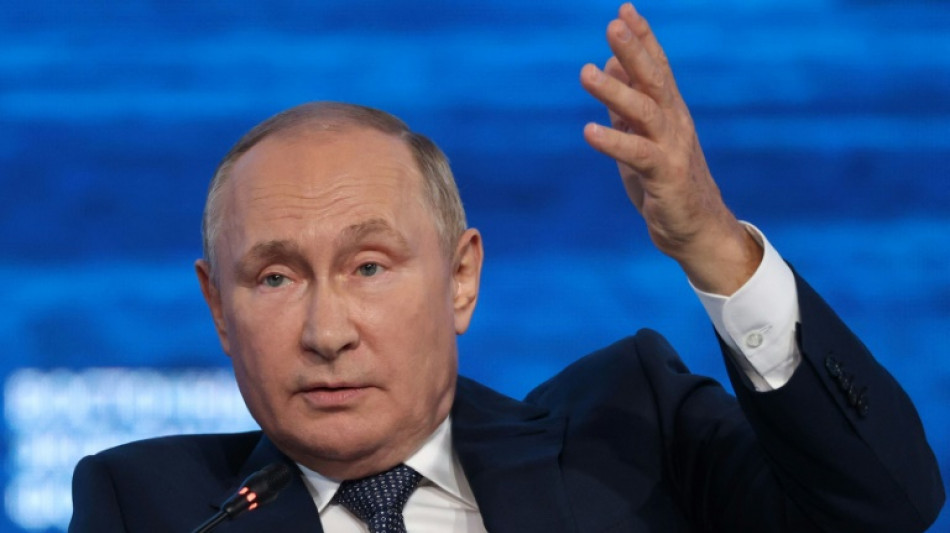
Resilient Russian economy surfs sanctions on oil boom / Photo: Sergei BOBYLYOV - SPUTNIK/AFP/File

 Villa put six past Fenerbahce in record rout
 US stocks fall after hot inflation report as leading AI shares tumble

 Government buildings torched in violent Albanian protests

 Wall Street grills Bank of America over money laundering fine

 Mekies extends contract as Red Bull team principal until 2031

 Indonesia rescues starved orangutan from fires: officials

 Real Madrid's Vinicius banned for Clasico after red card
 Restrictions expose Ukraine's Starlink dependency in Russia war: observers
 Espada out as Astros manager while Mattingly stays with Phillies

 Houthis say targeted Saudi oil giant Aramco, vow more attacks

 Govt takes control of Turkey's most-watched news channel

 FIFA to offer members $6.35-billion development fund windfall

 US consumer inflation hotter than expected as midterms loom

 INmune Bio Inc. and Quantum Computing Inc. Partner to Apply Quantum Optimization and AI to Advance Alzheimer’s Drug Research and Explore New Applications for XPro

 Hot US inflation data dents Wall Street stocks

 India sends 'cockroach' leaders to jail after protest
 'Sinners' director Ryan Coogler to reboot 'X-Files' for Disney

 Lufthansa wins contest for TAP Air Portugal stake

 AI worms, 'major' incident fears spur safety calls at industry summit
 Fuel shortage triggers queues on Indonesia's Bali island

 Evolution Metals & Technologies Corp. Reaffirms $400 Million to $460 Million FY2027 Revenue Guidance, Unveils Eight Sintered Magnet Grades Covering an Estimated 75% of Global NdFeB Revenue, and Moves to Answer U.S. Army Call for Rare Earth Magnets

 Trial defence says Russia used Nord Stream pipelines as 'weapon'

 Israeli settlers set fire to mosque in occupied West Bank

 Macron says French student protesters 'exploited' by political forces: spokeswoman

 Stocks diverge ahead of key US inflation data
Russia's economy may face multiple long-term challenges, but for now energy exports appear to be helping it ride out Western sanctions imposed over the offensive against Ukraine.
Moscow says inflation is easing and employment is virtually full, contradicting the predictions of a catastrophe from many financial experts.
The International Monetary Fund on Tuesday offered some support to Russia's view, saying recession will be less severe than expected due to oil exports and relatively stable domestic demand.
The IMF forecast the Russian economy to contract just 3.4 percent over the whole year, after contracting 21.8 percent during the second quarter at a quarterly annualised rate.
It was only in June that the IMF forecast an annual drop of six percent.
"The contraction in Russia's economy is less severe than earlier projected, reflecting resilience in crude oil exports and in domestic demand with greater fiscal and monetary policy support and a restoration of confidence in the financial system," the IMF's latest World Economic Outlook report said.
President Vladimir Putin had stated in September that the economic situation in the country was "normalising" and that the worst was over after the series of economic penalties that followed the military operation launched against Ukraine on February.
Unemployment had fallen to its lowest level of 3.8 percent, Putin said, with annual inflation down to 13.7 percent a year, after record highs during the spring when the early sanctions began to bite.
- Impact of first sanctions 'over' -
"We can consider that the impact of the first sanctions has passed, notably in the financial sector," Elina Ribakova, deputy head of the Institute of International Finance, a trade group for the global financial services industry, told AFP.
The diplomatic and economic break with the West accelerated Moscow's rapprochement with energy-hungry China, with which it shares a 4,000 kilometre (2,500-mile) border.
Almost excluded from the European market, Russian "companies have been forced to find alternatives in other markets, particularly in Asia and Turkey", Moscow State University economist Natalya Zubarevich told AFP.
Russia and China have already announced their intention to settle gas and electricity contracts in rubles and yuan, a triumph for the Kremlin's efforts to take the US dollar out of the economy.
Last week's OPEC+ oil cartel's decision to slash output again, despite Washington's call to open the taps, was also warmly greeted by Moscow, which benefits from rising crude prices.
With the G7 rich nations club struggling to agree a ceiling price for Russian oil, a cap China and India appear reluctant to follow, Russia's prospects do indeed appear to be improving.
And for 2023, the IMF now expects Russia's economy will contract 2.3 percent, an improvement from the 3.5 percent it forecast in July.
However the Russian economy finds itself ever more dependent on energy exports and slipping further behind on many high value sectors.
- International isolation -
The promise of Russia developing its own hi-tech products once imported from abroad remains to be fulfilled, and it lacks domestic rivals to tech giants like Apple and Microsoft.
Firms dependent on cutting-edge foreign goods are having to face up to their isolation from international markets.
A glaring lack of spare parts has also hit car production.
Japanese manufacturer Toyota shut its Saint Petersburg factory in mid-September because of a lack of electronic components.
Nissan is selling its Russian assets, including a factory in the city, to the Russian government, after halting production in March.
"About half of the companies hit by sanctions are still having difficulties in finding alternative suppliers," said Ribakova.
As a result, the government has eased safety and environmental standards for domestically built vehicles.
In a leaked document published recently in local media, trade and industry ministry officials sounded alarm bells over a 10-15 year gap for Russia's technology industry, dependence on foreign goods and a lack of manpower.
A looming concern for Moscow is the European embargo on Russian oil due to start on December 5 ahead of a ban on refined oil products from February next year.
Over the first eight months of this year, more than 40 percent of federal income came from oil and gas, according to the finance ministry.
E.Aziz--SF-PST