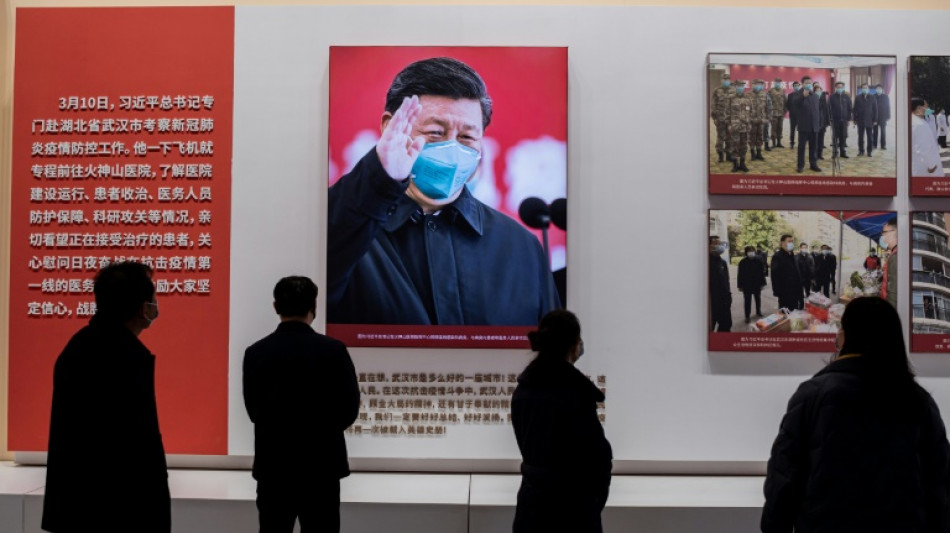
Zero-Covid in China key to Xi legacy as he eyes third term / Photo: NICOLAS ASFOURI - AFP/File

 California puts first US billionaire tax to the vote

 School headscarf ban meets resistance in Austria

 World's top cocoa producer aims for a climate-tough bean

 Why is Shell facing lawsuits over climate disasters in Brazil and the Philippines?

 New four-lane bridge opens between China, North Korea

 Tech stocks lead rout after US inflation fuels rate hike bets

 'No time to recover': UNDP chief sounds alarm on growing poverty after Iran war shock

 Australia says won't let big tech have 'unfettered' access to kids

 Mobile clinics battle Mongolia's childhood dental 'disaster'

 Wallabies back Meredith as playmaker for second New Zealand Test

 Messi's Inter Miami book playoffs with 2-0 win over New York City

 Oil-rich Alberta tests Canada's unity with secession vote

 EU leaders head for showdown over bloc budget

 All Blacks make three changes for second Wallabies Test

 Mourinho blasts 'shameless' timing of Vinicius ban decision

 PSG beat Man City in Champions League thriller, Barcola hits Liverpool hat-trick

 US Treasury chief urges stronger IMF role against 'distortionary policies'

 Giant-killers Bodo sink Dortmund in Champions League

 PSG outgun embattled Man City in six-goal Champions League thriller

 In Chicago, pope's hometown, Catholics express shock and support

 Musk suggests US govt behind any slowdown in Ukraine's Starshield system

 Chiclayo prays for recovery and return of the 'Peruvian pope'

 Barcola scores hat-trick as Liverpool hit LASK for six

 Healthy corals help bleached neighbors regain color: study

 Hope ton helps West Indies level T20 series at 2-2 in India

For many in China, years of gruelling lockdowns and privacy invasions aimed at extinguishing Covid have caused misery.
For President Xi Jinping, the virus curbs are a triumph.
His zero-tolerance approach to Covid has become synonymous with the efforts to cement his authority over China and its ruling Communist Party (CCP).
The endgame begins on October 16, when thousands of party delegates will gather in Beijing for a major party congress at which he is expected to secure a historic third term.
"Xi's legacy and the legitimacy of the CCP are bound to the success of the zero-Covid campaign," Diana Fu, an expert on Chinese domestic politics at the Brookings Institution think tank, told AFP.
While the rest of the world has largely moved to live with Covid, Xi has insisted on draconian policies aimed at eliminating the virus.
The approach has crippled growth in the world's second-largest economy, which was already struggling with a debt-laden property sector and high youth unemployment.
But Xi has dug in his heels, declaring zero-Covid China's most "economic and effective" path forward, while maintaining policies that have deepened the state's control over the lives of its 1.4 billion people.
- Tests and QR codes -
The headline-grabbing planks of the campaign continue to be the snap lockdowns -- sometimes confining tens of millions of people to their homes for weeks or months.
In one of the recent shutdowns, some residents in the megacity of Chengdu were not allowed to go outside even when an earthquake shook their apartment buildings.
And in the economic hub of Shanghai, a months-long lockdown led to rare scenes of protests from middle-class and wealthy Chinese.
Public frustration has also pushed past China's internet censors and onto social media.
In one of the highest-profile cases, a bus crash in rural Guizhou province that killed 27 people on the way to a Covid quarantine facility sparked a surge of online criticism.
General curbs that erode privacy and limit movement have also caused anger and resentment.
Residents in many cities must obtain a negative coronavirus test every few days to gain access to public spaces.
They then use their smartphones to scan QR codes at entrances to offices, malls and restaurants and bring up their latest test results.
A green icon indicates they are free to enter, while red or amber means they may have, respectively, tested positive or passed near someone who has.
That could lead to anything from a few days of home isolation to weeks at a quarantine facility.
The system also tracks people's movements, leaving it open to abuse, such as when authorities were accused of thwarting anti-corruption protests this year by turning participants' codes red.
Before the pandemic, China's citizens were already under heavy surveillance.
Steve Tsang, director of the SOAS China Institute at the University of London, said the Covid-monitoring apparatus was "in line with the model of social control" spearheaded by Xi.
- 'No choice' -
China argues zero-Covid places human life above material concerns and has helped to avert the public health crises seen in other countries.
Officials have also voiced fears that the virus would overwhelm China's patchy healthcare system if allowed to spread unchecked, particularly in elderly rural communities.
So far, China has reported just over 5,000 Covid deaths compared with more than a million in the United States.
But while the milder Omicron virus variant has reduced the risk of reopening in many countries, China's curbs continue to extract hefty economic and social costs.
"They have to abandon zero-Covid ultimately," said Jin Dong-yan, a professor at Hong Kong University's School of Biomedical Sciences, calling it "wrong and against all scientific evidence".
The policy's initial success has created a sense of inertia among policymakers, according to Allen Wu, a professor at Nanjing University's medical school who has advised the World Health Organization.
"There is this mentality that we did such a wonderful job in 2020 and 2021... if we (now) do nothing and a huge number of people get infected, that basically gives away all you have achieved," he told AFP.
Many in China speak favourably of zero-Covid, with Fu of the Brookings Institution saying state propaganda had convinced most people of the need to cut cases "at all human and economic costs".
"A vast number of Chinese citizens still support draconian measures despite evident personal suffering," she said.
Even those at the extreme end of the policy have no option but to submit.
Airline engineer Ian Jiang has spent 200 days in isolation hotels throughout the pandemic, and China continues to enforce quarantines for overseas arrivals of up to two weeks.
Jiang, 38, described the measures as "very inconvenient for my personal life".
"But that's the Chinese government's policy," said Jiang. "You have no choice."
There is unlikely to be much overt opposition when Xi receives the adulation of party delegates at this month's Congress.
"The campaign, no matter the actual socioeconomic outcomes, will continue to be hailed as a triumph of Chinese socialism," Fu said.
L.AbuAli--SF-PST