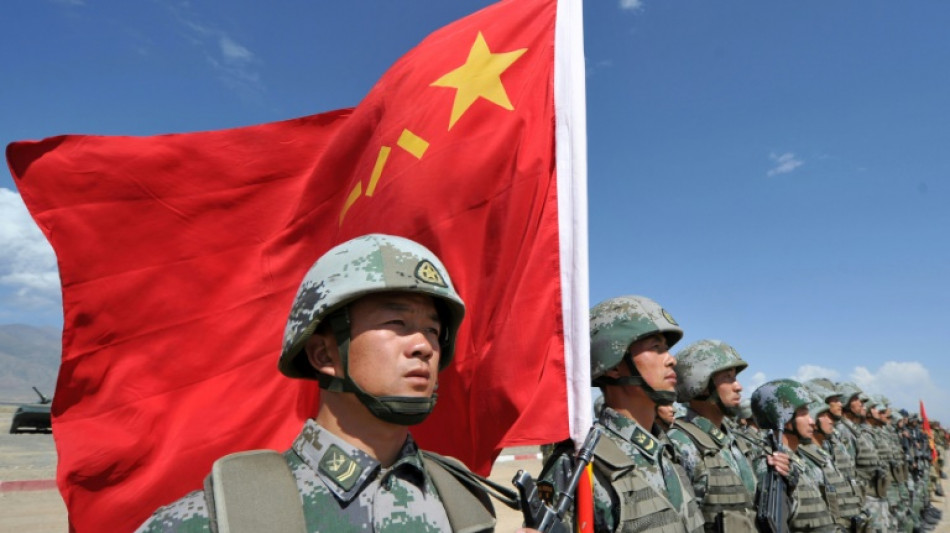
Xi decade reshapes China's military, and the region / Photo: Vyacheslav OSELEDKO - AFP/File

 Asian Cup in Saudi Arabia could be postponed but 'no hurry' to decide: AFC

 Conrad wields axe after South Africa loss to Australia

 School roof collapse kills teacher, 27 children in NW Pakistan
 Haze turns Indonesia skies orange, shuts schools in East Timor
 California puts first US billionaire tax to the vote
 School headscarf ban meets resistance in Austria

 World's top cocoa producer aims for a climate-tough bean

 Why is Shell facing lawsuits over climate disasters in Brazil and the Philippines?

 New four-lane bridge opens between China, North Korea

 Tech stocks lead rout after US inflation fuels rate hike bets

 'No time to recover': UNDP chief sounds alarm on growing poverty after Iran war shock

 Australia says won't let big tech have 'unfettered' access to kids
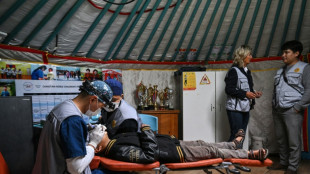 Mobile clinics battle Mongolia's childhood dental 'disaster'

 Wallabies back Meredith as playmaker for second New Zealand Test

 Messi's Inter Miami book playoffs with 2-0 win over New York City

 Oil-rich Alberta tests Canada's unity with secession vote

 EU leaders head for showdown over bloc budget
 All Blacks make three changes for second Wallabies Test

 Mourinho blasts 'shameless' timing of Vinicius ban decision

 PSG beat Man City in Champions League thriller, Barcola hits Liverpool hat-trick

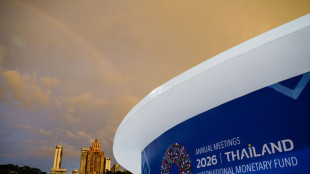 US Treasury chief urges stronger IMF role against 'distortionary policies'

 Giant-killers Bodo sink Dortmund in Champions League

 PSG outgun embattled Man City in six-goal Champions League thriller

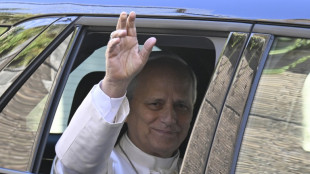 In Chicago, pope's hometown, Catholics express shock and support

 Musk suggests US govt behind any slowdown in Ukraine's Starshield system

During Xi Jinping's decade-long rule, China has built the world's largest navy, revamped the globe's biggest standing army, and amassed a nuclear and ballistic arsenal to trouble any foe.
With China's neighbours now rushing to keep pace, Xi's next five-year term is likely to see a quickening Asia-Pacific arms race.
From South Korea developing a blue-water navy to Australia buying nuclear-powered submarines, weapons shopping has surged across the region.
According to figures from the London-based International Institute for Strategic Studies, Asia-Pacific defence spending passed $1 trillion last year alone.
China, the Philippines and Vietnam have roughly doubled spending in the last decade. South Korea, India and Pakistan are not far behind.
Even Japan is proposing record defence budgets and inching towards ending its long-standing "no first strike" policy, citing an "increasingly severe" security environment.
"All the key players in the Indo-Pacific region are responding to China's military modernisation, basically as fast as they can," said Malcolm Davis, a former Australian defence official now with the Australian Strategic Policy Institute.
- Paper tiger no more -
For years, the People's Liberation Army was seen as ill-equipped and ineffective -- disparaged by one historian as "the world's largest military museum".
It was kitted out with ageing Soviet-derived weaponry, riddled with corruption and was a predominantly infantry force with a less-than-stellar record in foreign campaigns.
The PLA's participation in the Korean War cost almost 200,000 Chinese lives. A 1979 invasion of Vietnam cost tens of thousands more and has been mostly airbrushed from official histories.
When Xi became commander-in-chief of the PLA in 2013, some reforms were already under way.
They began in the 1990s, when Jiang Zemin was shocked and awed into action by US military prowess during the Gulf War and the Third Taiwan Strait Crisis.
But "it wasn't really until Xi Jinping came in that that effort started translating to capability", strategic consultant Alexander Neill told AFP.
The PLA had then just launched its first aircraft carrier, the Liaoning -- a refurbished Ukrainian ship -- and the J-15 multi-role fighter aircraft, based on a Sukhoi prototype.
Beijing's military budget has now increased for 27 consecutive years, according to the Stockholm International Peace Research Institute.
- 'Only competitor' -
Today, China boasts two active aircraft carriers, hundreds of long- and intermediate-range ballistic missiles, thousands of warplanes and a navy surpassing even the United States's.
After China launched a brief and partial blockade of Taiwan in August, a top US military officer tacitly conceded that preventing the real thing would not be easy, even for Washington.
"They have a very large navy, and if they want to bully and put ships around Taiwan, they very much can do that," Seventh Fleet commander Karl Thomas told US media.
Meanwhile, China's nuclear stockpile is increasing exponentially and -- according to the Pentagon -- can probably now be launched from land, sea and air, echoing the US nuclear triad.
According to the Bulletin of the Atomic Scientists, China has about 350 nuclear warheads, double the amount held during the Cold War.
US intelligence predicts that this stockpile may double again to 700 by 2027. New nuclear missile silos are being built in the northwest of the country.
Washington has pulled no punches in describing the scale of might and ambition held by the People's Republic of China.
"The PRC is the only competitor capable of combining its economic, diplomatic, military, and technological power to mount a sustained challenge to a stable and open international system," a Pentagon report last year said.
"Beijing seeks to reshape the international order to better align with its authoritarian system and national interests."
As much as any hardware, it is this perceived global intent that has spooked China's neighbours.
- Xi's 'huge favour' -
Many of the big-ticket military projects around the region plainly have deterrence in mind -- whether it is thwarting the "little blue men" of Beijing's naval militias or a conventional attack.
South Korea plans to develop naval power capable of operating far from coastal waters, which experts say has little to do with the threat from rapidly arming North Korea.
Australia plans to acquire eight nuclear submarines -- which can stay underwater for extended periods and launch retaliatory strikes -- with British and American help, part of the so-called AUKUS agreement.
There is also discussion in Canberra about obtaining hypersonic weapons, longer-range ballistic missiles and even state-of-the-art B-21 stealth bombers, capable of striking anywhere in the world virtually undetected.
For Davis, all of these projects point to a realisation that China increasingly has the power to shape the region to its will.
"The days of the US Navy dominating the seas in the Western Pacific are fast approaching an end," he said, and Asia-Pacific allies are beefing up their own defences accordingly.
"We wouldn't have had AUKUS if it wasn't for Xi Jinping. He's done us a huge favour in that sense."
W.AbuLaban--SF-PST