In Brazil election, opinion polls the 'biggest loser' / Photo: Nicolas RAMALLO - AFP

 Two dead as Istanbul endures heaviest rainfall in 80 years

 After latest Nepal flood, survivors fear for future

 EU leaders clash over budget as spectre of French elections looms

 'No place to breathe': life in Indonesia's fire epicentre

 'Can't sleep': Spain's housing crunch upends lives

 Musk calls on Ukraine's Zelensky to 'go' after satellite slowdown row

 Still smiling at 117, Albanian may be world's oldest woman

 Pope has 'good night' in hospital: Vatican

 China's economy seen missing target as global shocks bite: AFP poll

 Costa Rica opens jail inspired by El Salvador mega-prison

 Same-sex couple takes fight for equality to Slovakian court

 'High hopes' as Indonesian women get a football league, again

 'Expectations high' for Bordeaux-Begles' Champions Cup hat-trick bid, says Depoortere

 Rennie urges All Blacks to stay focused against 'hurting' Wallabies

 Palmeiras beat Fluminense 2-1 in Libertadores semi-final first leg

 Brewers blasts leave Dodgers on brink

 Tech stock lead rout after US inflation fuels rate hike bets

 Al-Fayed survivors say UK police missing 'bigger picture'

 Online 'witch hunt' sweeps up Asians misidentified as US rape accused

 Prospect of Bolsonaro win looms large over Brazil's Indigenous

 Freed from Belarus, founder of Lady Gaga's biggest fan site tells his story

 Behind AI's carbon footprint, a potential climate tool

 Trump's new press secretary faces scrutiny over credentials

 PSG 'got lucky' to win Man City thriller, says Luis Enrique

 Real Madrid comeback stuns Roma as Mourinho enjoys happy reunion

Following a trend in recent years of underestimating voter support for Brexit and Donald Trump, opinion polls in Brazil were way off the mark for Sunday's first round of presidential elections.
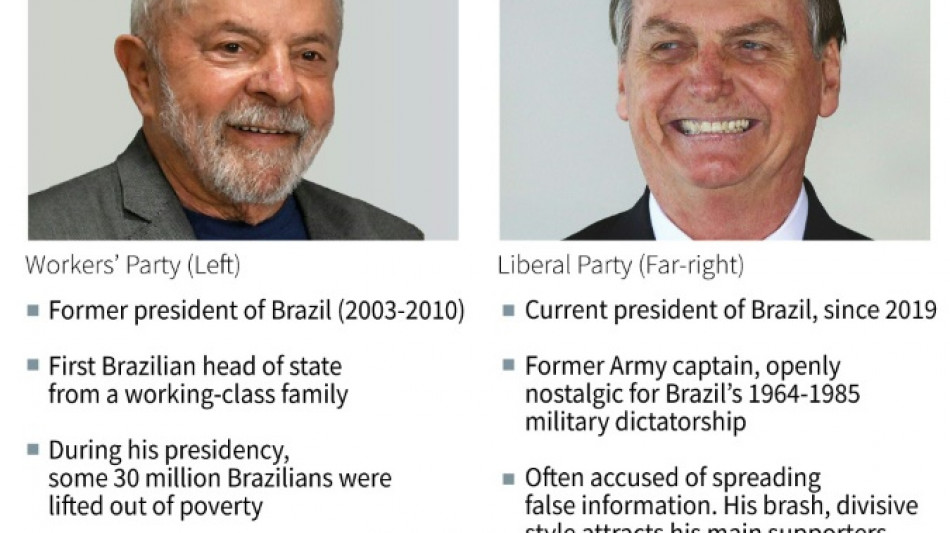
Incumbent Jair Bolsonaro and many of his far-right allies mustered results much better than pollsters had predicted, catching analysts off guard and shocking supporters of his leftist rival Luiz Inacio Lula da Silva.
"The biggest loser (of Sunday's election) are all the polls," Latin America analyst Michael Shifter of the Inter-American Dialogue think tank told AFP.
- What were the poll predictions? -
Lula amassed 48 percent of the votes cast on Sunday -- within the margin of error of plus or minus two percentage points worked in by pollsters Datafolha and Ipec.
Both had put Lula within arm's reach of taking the election in the first round -- with a prediction of 50 percent of valid votes cast by Datafolha, and 51 percent by Ipec.
Bolsonaro's result came completely out of left field. He managed 43 percent of votes compared to 36 percent predicted by Datafolha.
Instead of a predicted 14-point handicap, he lagged Lula by only five points, or about six million votes.
There was a similar trend for some of Bolsonaro's rightwing allies.
Rio de Janeiro Governor Claudio Castro won reelection in the first round with 58 percent of votes compared to polling expectations of 44 to 47 percent.
And in Sao Paulo, Tarcisio de Freitas entered the gubernatorial runoff race in the lead with 42 percent -- 11 points higher than he had been polled.
- What went wrong? -
Analysts are scratching their heads: was it a last-minute Bolsonaro surge among undecided or opposition voters, or is it that polling institutes with a hitherto reliable reputation have somehow lost the ability to accurately predict voter intention?
"We don't know if Bolsonaro made real advances or whether he already had this support" that polls failed to capture, Leandro Gabiati, director of the Dominium consultancy, told AFP.
According to Mayra Goulart of the Federal University of Rio de Janeiro, there has been an "information blackout" in Brazil due to a pandemic-induced, two-year delay in the population census, held every 10 years.
This may have affected the accuracy of pollsters' population sampling especially in influential segments such as evangelicals -- a growing and right-leaning section of Brazilian society.
"It is likely that the 2022 census will correct some of these inconsistencies for future elections," said Guilherme Casaroes, a political scientist at the Getulio Vargas Foundation.
- Consequences -
"It will definitely hurt the credibility of analysis" by the media and experts such as himself, said Leonardo Paz, Brazil consultant for the International Crisis Group think tank.
"Right now it is more difficult to make analysis because... the numbers are not credible anymore."
The discrepancy between the prediction and Sunday's outcome posed a "big problem for the (polling) institutes and for democracy itself," added Dominium's Gabiati.
"Polls are an important part of the electoral process and it is terrible for democracy that this aspect is called into question."
Bolsonaro has long sought to cast doubt on the accuracy of polls, which he claims work for the left, and could now use this "proof" to further whip up anti-Lula sentiment ahead of the all-important October 30 presidential runoff.
"We defeated the opinion polls' lie," he crowed on Sunday.
For Goulart, this could bolster the Bolsonaro-led negationist discourse.
"Calling into question electoral polls in a context of far-right populism is also to call into question science and reliable sources of information, including the media," she said.
Bolsonaro's congressman son Eduardo said Monday he would collect signatures to open a parliamentary committee investigation into polling companies over the discrepancies.
"Polling agencies will have to reinvent themselves," said Casaroes.
H.Jarrar--SF-PST