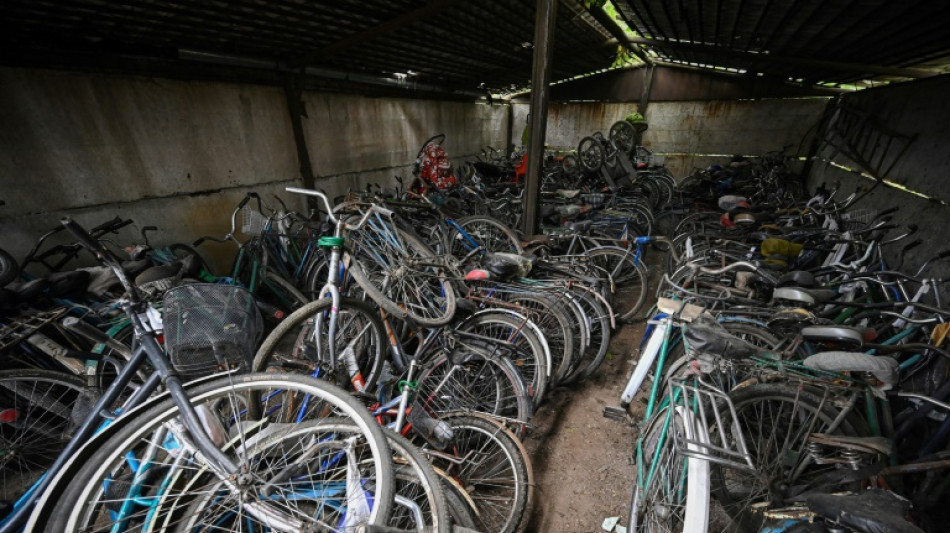
In Ukraine's south, bicycles wait for their owners' return / Photo: Genya SAVILOV - AFP

 Two dead as Istanbul endures heaviest rainfall in 80 years
 After latest Nepal flood, survivors fear for future

 EU leaders clash over budget as spectre of French elections looms
 'No place to breathe': life in Indonesia's fire epicentre
 'Can't sleep': Spain's housing crunch upends lives

 Musk calls on Ukraine's Zelensky to 'go' after satellite slowdown row

 Still smiling at 117, Albanian may be world's oldest woman
 Pope has 'good night' in hospital: Vatican
 China's economy seen missing target as global shocks bite: AFP poll

 Costa Rica opens jail inspired by El Salvador mega-prison
 Same-sex couple takes fight for equality to Slovakian court
 'High hopes' as Indonesian women get a football league, again

 'Expectations high' for Bordeaux-Begles' Champions Cup hat-trick bid, says Depoortere
 Rennie urges All Blacks to stay focused against 'hurting' Wallabies

 Palmeiras beat Fluminense 2-1 in Libertadores semi-final first leg

 Brewers blasts leave Dodgers on brink
 Tech stock lead rout after US inflation fuels rate hike bets
 Al-Fayed survivors say UK police missing 'bigger picture'

 Online 'witch hunt' sweeps up Asians misidentified as US rape accused

 Prospect of Bolsonaro win looms large over Brazil's Indigenous
 Freed from Belarus, founder of Lady Gaga's biggest fan site tells his story
 Behind AI's carbon footprint, a potential climate tool

 Trump's new press secretary faces scrutiny over credentials
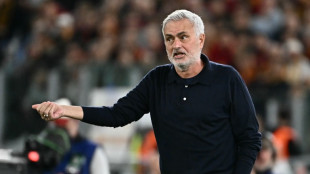
 PSG 'got lucky' to win Man City thriller, says Luis Enrique

 Real Madrid comeback stuns Roma as Mourinho enjoys happy reunion

Hundreds of abandoned bicycles in a small town near Ukraine's southern front line tell the many stories of their owners, who were forced to flee Russia's invasion.
They come in all colours: green, red, black, blue, all stored inside and outside a small warehouse in the town of Zelenodolsk.
"We keep them for their owners," says municipal worker Vitaliy Rekhlitsky, so that they can come and collect them at the end of the war.
One bicycle has a knitted saddle cover, another a small pouch attached to the frame, many others are rusty and battered by time and travel.
Some have baby seats attached to the back.
Among the over 600 bicycles stored there are also pushchairs, wheelchairs, a special needs tricycle and a brown children's bicycle.
Many of them have been stored since early March, when Russia's army gradually took control of the recently-annexed neighbouring Kherson region.
By that time, Russian forces had stolen most of the cars in the surrounding villages and all that was left were the bicycles, Rekhlitsky recalled.
"People fled, sometimes with nothing at all, sometimes with a bag," he told AFP.
Some pedalled to freedom on decades-old bikes that looked like they could be from the Soviet era.
- 'Huge loss' -
The exiles were people with limited means.
For the elderly, losing the bikes is a "huge loss", said Dmytro Kostenko, who guards these abandoned vehicles.
As Ukraine's forces made progress in their recent counteroffensive, recapturing nearby villages, more bicycles have been brought back by the soldiers.
But in a sign that things might be changing for the better, around fifty owners have returned to collect their property.
Every time they come, "I have tears in my eyes,", Kostenko told AFP with the sounds of artillery howling in the distance.
"The bombardments have intensified" since the start of the counteroffensive, said the man in his sixties, holding onto his crutches.
Located just 15 kilometres from the southern front line, Zelenodolsk is a small town of some 13,000 residents, founded in the 1960s when Ukraine was part of the Soviet Union.
Its name translates as "green valley" from Ukrainian and Russian, a nod to the rich agricultural lands that the town was built on.
The tall chimneys of the Zelenodolsk thermal power plant are visible from some parts of town as well as the dozens of uniform low-rise buildings built to accomodate its workers.
The nearby hospital had an influx of patients on Thursday morning after Russian forces targeted the plant.
Some 19 people were injured, according to regional governor Valentin Reznichenko.
"People were just going to work when the Russians fired their Uragan (missiles) at them," he said.
- 'Antichrist' -
The victims were hit by shrapnel but none were seriously injured, said Dr Svetlana Kravchuk, who treated them in hospital.
Many in the city suffer from "chronic stress" from the constant bombing, which in September killed a nine-year-old boy, the doctor added.
Over the nights spent hiding in corridors or underground cellars, many "have forgotten what it is to sleep in a bed," she said.
The hospital's director Olena Yaroshenko said she feels more "reassured" since the start of the counteroffensive since "we hear more of our people shooting".
But in a garden in the outskirts of Zelenodolsk, where a pear tree hangs low under the weight of its fruit and some strawberries still grow, Yevgenia Vasilyeva mourns the lost calm.
The 84-year-old arrived in Zelenodolsk in 1964, a few years after its founding, and has watched the town grow.
She was married to a Russian and often travelled to Russia, where "all kinds of good people live," she said.
The deeply religious woman with a coloured scarf covering her grey hair, however, doesn't mince words in describing Russian President Vladimir Putin, calling him the "antichrist" and bearer of the "apocalypse".
Near her garden that is a snapshot of what the "green valley" was like before the Soviet era, a small house recently lost its roof, swept away in the shelling.
E.Aziz--SF-PST