Iraq's young covet govt jobs in headache for economy / Photo: Asaad NIAZI - AFP

 Two dead as Istanbul endures heaviest rainfall in 80 years

 After latest Nepal flood, survivors fear for future

 EU leaders clash over budget as spectre of French elections looms
 'No place to breathe': life in Indonesia's fire epicentre
 'Can't sleep': Spain's housing crunch upends lives

 Musk calls on Ukraine's Zelensky to 'go' after satellite slowdown row
 Still smiling at 117, Albanian may be world's oldest woman
 Pope has 'good night' in hospital: Vatican
 China's economy seen missing target as global shocks bite: AFP poll

 Costa Rica opens jail inspired by El Salvador mega-prison
 Same-sex couple takes fight for equality to Slovakian court
 'High hopes' as Indonesian women get a football league, again

 'Expectations high' for Bordeaux-Begles' Champions Cup hat-trick bid, says Depoortere
 Rennie urges All Blacks to stay focused against 'hurting' Wallabies

 Palmeiras beat Fluminense 2-1 in Libertadores semi-final first leg
 Brewers blasts leave Dodgers on brink
 Tech stock lead rout after US inflation fuels rate hike bets
 Al-Fayed survivors say UK police missing 'bigger picture'

 Online 'witch hunt' sweeps up Asians misidentified as US rape accused

 Prospect of Bolsonaro win looms large over Brazil's Indigenous

 Freed from Belarus, founder of Lady Gaga's biggest fan site tells his story

 Behind AI's carbon footprint, a potential climate tool

 Trump's new press secretary faces scrutiny over credentials

 PSG 'got lucky' to win Man City thriller, says Luis Enrique

 Real Madrid comeback stuns Roma as Mourinho enjoys happy reunion

Decent salaries and stability are the hallmarks of a job in Iraq's civil service, an institution much coveted by young graduates, even as it starves the private sector and hobbles the economy.
The patronage systems that feed the public sector in the oil-rich but war-battered nation are so entrenched that even the outgoing finance minister has despaired of ever trimming them down to size.
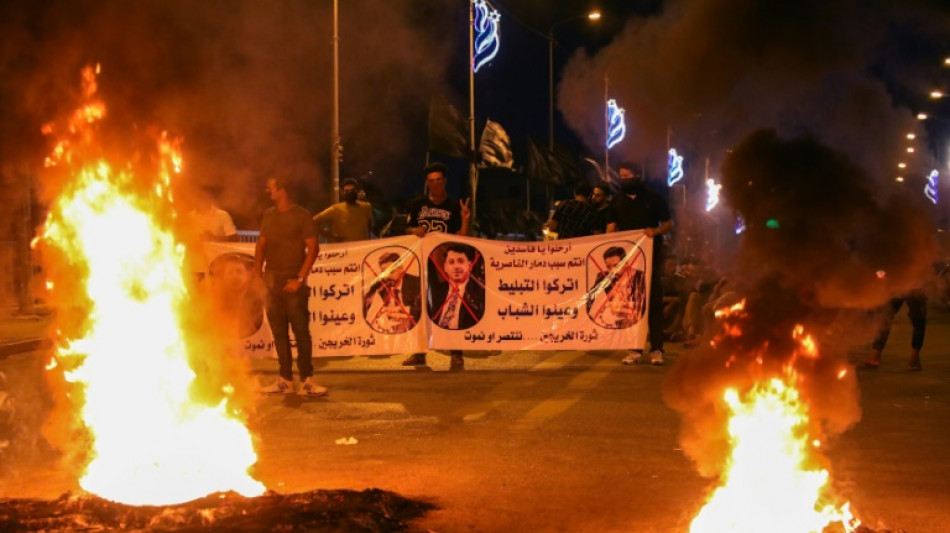
"We want work!"
It's a refrain that fresh graduates chant each year on the streets of the southern city of Nassiriyah.
Maitham Mohammed Redha, 32, is among them. Public sector jobs are "our legitimate right", he says, adding that he has personally lobbied the provincial governor for work because he doesn't have "wasta", or an inside connection.
His situation is mirrored across Iraq, a country of 42 million in which four out of 10 young people are unemployed and where the state is by far the biggest employer.
Propped up by oil production, which accounts for 90 percent of national revenues, young Iraqis view public sector jobs as a refuge against the political winds and insecurity that perpetually batter businesses.
The lure is such that the private sector is robbed of bright young talent, as the smartest tend to opt for a largely unproductive easy ride in government service.
"Graduates, if they start working in the private sector, consider it a temporary job until they can find an opportunity in the public sector," said Maha Kattaa, Iraq country coordinator for the International Labour Organization.
"The private sector feels it cannot compete with the advantages, benefits provided by the public sector," she added.
Mohammed al-Obeidi, who has worked for nearly two decades at a ministry, acknowledges that "the salaries are good".
"Some ministries have good benefits" and the option to retire at 60 -- or even as young as 55 -- provides scope for early retirees to take on private sector work while also drawing their pension.
- 'Vain populism' -
Prime Minister Mustafa al-Kadhemi has repeatedly stressed the need to trim the public sector.
He noted last summer that "previous governments have... inflated public sector jobs in a vain populism that has exhausted the Iraqi economy".
Between 2004 -- the year after a US-led invasion toppled longtime dictator Saddam Hussein -- and 2019, the number of civil service posts quadrupled, he said.
The public sector wage bill alone accounts for two-thirds of the state budget, he said, while Kattaa estimated the government employs nearly 40 percent of Iraq's population of working age.
Such numbers are "among the highest... in the world", she told AFP.
Kadhemi has acknowledged the urgency for reform, but equally that he does not have a "free hand" to enact it.
His survival as head of government always depended on bargaining over patronage opportunities by the country's main Shiite factions.
In the public sector, and even in private firms, recruitment is often driven by the allocation of tribal and political favours.
Aptitude or formal qualifications therefore often count for little.
Even the country's finance minister professes to have given up in despair.
- High growth a bright spot -
"Nearly everything conspires to thwart real change and (instead conspires) to cement... rotten practices," Ali Allawi lamented, in a letter read out to the cabinet when he resigned in August.
Placing the blame squarely on the "cancer" of corruption, Allawi contends that the state has been unable to "break free from the control of political parties and outside interest groups".
Kattaa says companies must improve working conditions, by matching private sector social benefits and wages.
One bright spot is that the oil price boom of the last year has driven national output higher -- the IMF predicts Iraq's economy will grow 10 percent this year.
Entrepreneurs are seeking to capitalise on this, among them Maitham Saad, 41.
Three years ago, he set up a company that sells dates from southern Iraq to international markets.
It now employs about 30 people, despite struggling to recruit, especially young people.
"Once they are employed in the private sector, if their boss is decent, they are happy," he says.
Unlike in the civil service, youngsters"can negotiate their salary", he says, expressing guarded optimism for the future.
R.Shaban--SF-PST