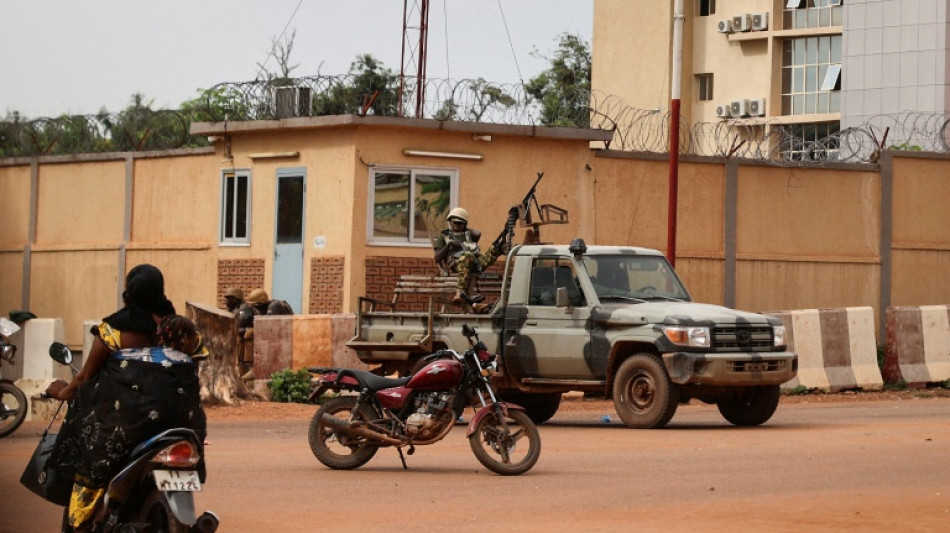
Gunfire heard near Burkina Faso presidency: witnesses / Photo: Olympia DE MAISMONT - AFP

 'Severe drought' declared in parts of UK
 IUX Announces New Web Client Portal Built for Enhanced Browser-Based Trading
 School roof collapse kills teacher, 32 children in NW Pakistan
 Inter skipper Martinez facing month out with thigh injury
 Spanish prosecutors back abuse probe into Julio Iglesias
 Tech sell-off deepens as US inflation sparks AI jitters
 Southgate does not forsee a return to management
 Two dead as Istanbul endures heaviest rainfall in 80 years
 After latest Nepal flood, survivors fear for future
 EU leaders clash over budget as spectre of French elections looms
 'No place to breathe': life in Indonesia's fire epicentre
 'Can't sleep': Spain's housing crunch upends lives

 Musk calls on Ukraine's Zelensky to 'go' after satellite slowdown row
 Still smiling at 117, Albanian may be world's oldest woman
 Pope has 'good night' in hospital: Vatican
 China's economy seen missing target as global shocks bite: AFP poll
 Costa Rica opens jail inspired by El Salvador mega-prison
 Same-sex couple takes fight for equality to Slovakian court
 'High hopes' as Indonesian women get a football league, again
 'Expectations high' for Bordeaux-Begles' Champions Cup hat-trick bid, says Depoortere
 Rennie urges All Blacks to stay focused against 'hurting' Wallabies
 Palmeiras beat Fluminense 2-1 in Libertadores semi-final first leg
 Brewers blasts leave Dodgers on brink
 Tech stock lead rout after US inflation fuels rate hike bets
 Al-Fayed survivors say UK police missing 'bigger picture'
Shots rang out before dawn on Friday around Burkina Faso's presidential palace and headquarters of the military junta, which itself seized power in a coup last January, witnesses told AFP.
Troops blocked several main roads in the capital Ouagadougou, AFP journalists said, and state television was cut, broadcasting a blank screen for several hours saying: "no video signal".
"I heard heavy detonations around 4:30 am (0430 GMT) and now the roads around my home have been sealed off by military vehicles," said a resident who lives close to the presidential palace.
The reason for the gunfire was not immediately clear.
During the morning more shots were heard by an AFP cameraman in the Ouaga 2000 neighbourhood that houses both the presidential and military junta headquarters.
Soldiers patrolled the city's main crossroads, especially in Ouaga 2000 but also outside the state television centre, an AFP journalist said. The video signal was restored about 0915 GMT.
In Brussels, the EU voiced "concern" at events in the Burkina capital.
"A military movement was observed from 04:30 this morning. The situation still remains particularly confused," said spokeswoman Nabila Massrali.
- Rein in jihadists -
Violence has long wracked the landlocked west African country where Lieutenant-Colonel Paul-Henri Sandaogo Damiba took power in a January coup, ousting elected leader Roch Marc Christian Kabore and promising to rein in jihadists.
As in bordering countries, insurgents affiliated with Al-Qaeda and the Islamic State group have stoked the unrest.
Damiba earlier this month sacked his defence minister and assumed the role himself.
The mini-shuffle, the first since the appointment of a transitional government in March, saw only one new minister introduced -- Colonel-Major Silas Keita was named minister delegate in charge of national defence and promoted to brigadier general.
Thousands have died and about two million have been displaced by the fighting since 2015 when the insurgency spread into Burkina Faso, which has since become the epicentre of the violence across the Sahel.
Attacks have increased since the start of the year, despite the junta's vow to make security its top priority.
- Bloody September -
September has been particularly bloody.
On Monday, suspected jihadists attacked a convoy carrying supplies to the town of Djibo in the north of the country. The government said 11 soldiers were killed and around 50 civilians were missing.
Junta chief Damiba, who has pledged to restore civilian rule within two years and to defeat the armed factions.
On September 5 an improvised explosive device struck a supply convoy in the north killing 35 civilians dead and wounding 37.
Last June, 86 civilians died in a massacre at Seytenga, near the border with Niger.
More than 40 percent of Burkina Faso, a former French colony, is outside government control.
Much of the impoverished Sahel region is battling the insurgency.
Starting in northern Mali in 2012, the insurgents attacked neighbouring Burkina Faso and Niger in 2015. The violence has in recent years begun to spill over into coastal states Ivory Coast, Togo and Benin.
"The deteriorating security situation in Burkina Faso and Mali has made the north of the coastal countries the new front line against armed groups operating in the Sahel," the Konrad Adenauer Foundation, a German think tank, said in a report in April.
French forces supported Mali against insurgents for nearly a decade, but President Emmanuel Macron decided to pull out after falling out with the Malian junta in the wake of two military coups since 2020.
J.Saleh--SF-PST