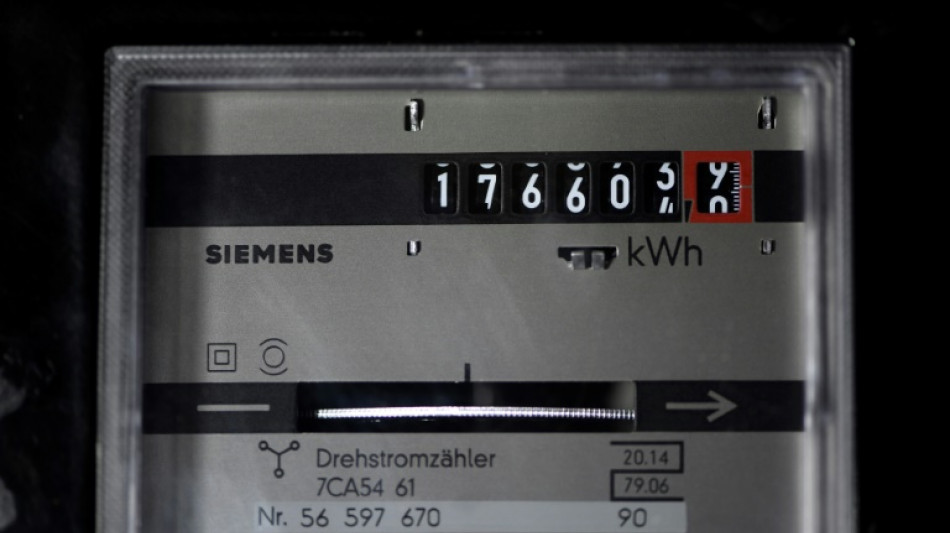
EU grapples with runaway energy prices / Photo: INA FASSBENDER - AFP/File

 'Severe drought' declared in parts of UK

 IUX Announces New Web Client Portal Built for Enhanced Browser-Based Trading

 School roof collapse kills teacher, 32 children in NW Pakistan

 Inter skipper Martinez facing month out with thigh injury

 Spanish prosecutors back abuse probe into Julio Iglesias

 Tech sell-off deepens as US inflation sparks AI jitters

 Southgate does not forsee a return to management

 Two dead as Istanbul endures heaviest rainfall in 80 years

 After latest Nepal flood, survivors fear for future

 EU leaders clash over budget as spectre of French elections looms

 'No place to breathe': life in Indonesia's fire epicentre

 'Can't sleep': Spain's housing crunch upends lives

 Musk calls on Ukraine's Zelensky to 'go' after satellite slowdown row

 Still smiling at 117, Albanian may be world's oldest woman

 Pope has 'good night' in hospital: Vatican

 China's economy seen missing target as global shocks bite: AFP poll

 Costa Rica opens jail inspired by El Salvador mega-prison

 Same-sex couple takes fight for equality to Slovakian court

 'High hopes' as Indonesian women get a football league, again

 'Expectations high' for Bordeaux-Begles' Champions Cup hat-trick bid, says Depoortere

 Rennie urges All Blacks to stay focused against 'hurting' Wallabies

 Palmeiras beat Fluminense 2-1 in Libertadores semi-final first leg

 Brewers blasts leave Dodgers on brink

 Tech stock lead rout after US inflation fuels rate hike bets

 Al-Fayed survivors say UK police missing 'bigger picture'

The EU on Friday will seek urgent ways to bring down skyrocketing energy prices as winter looms, with "sabotage" of gas pipelines from Russia this week injecting drama into the effort.
Energy ministers will gather in Brussels to consider an emergency European Commission proposal that includes cutting power use in the bloc, imposing windfall levies on energy companies and discussing a price cap on wholesale gas supplies.
Europe has found itself over a barrel as fossil fuel deliveries from Russia dry up.
EU sanctions on Moscow for its invasion of Ukraine, which include shunning Russian oil starting in December, have prompted the Kremlin to retaliate by severely reducing supplies of natural gas.
Unexplained leaks on the undersea Nord Stream 1 and 2 gas pipelines from Russia to Germany -- seen as "sabotage" by EU leaders, with suspicion falling on Moscow -- have aggravated the situation.
- Sky-high bills -
Alarm is rising sharply among Europeans faced with climbing energy bills.
"It's utterly impossible to pay," Pascale Dumont, a baker in a Belgian town called Gedinne, told AFP after her business's monthly electricity bill jumped tenfold, to 11,836 euros ($11,500).
"If you work it out over a year, it's how much a house costs!" she exclaimed.
Business Europe, an EU lobby, warned that "the current state of high gas and electricity prices bears the imminent risk of production losses and shutdowns of thousands of European companies".
The EU country on the frontline of the energy crunch is Germany, the bloc's export powerhouse which had long been dependent on Russian gas.
After recording a jump to 10 percent inflation, its government said it will borrow 200 billion euros to shield German households and businesses from "an energy war".
That adds to various national initiatives across the European Union totalling many hundreds of billions of euros -- a hefty bill added to the one run-up during the worst of the Covid pandemic.
The European Commission is trying to leverage the Covid-era cooperation to forge a common EU approach on energy.
"Europe is facing energy blackmail by Russia, and global demand for gas is higher than supply," EU energy commissioner Kadri Simson said.
"We need to work along the whole chain to tackle the challenge," she said, adding that a price cap on the wholesale price of gas entering the EU "is possible" if other measures fail to bring results.
- Price cap mooted -
One core proposal with strong backing is a "cap" on non-gas electricity producers' profits and a "contribution" from other energy majors.
The levies -- the commission refuses to call them a "windfall tax" -- are calculated to raise 140 billion euros which can be spent to cushion consumers.
Another is to encourage reduced energy consumption, for instance by turning off public lighting earlier, lowering thermostats to a maximum of 19 degrees Celsius (66 degrees Fahrenheit) and lower peak-hour power use.
The Bruegel think tank in Brussels, however, said those steps are "not sufficient".
"A more comprehensive plan needs to ensure that all countries bring forward every available supply-side flexibility, make real efforts to reduce gas and electricity demand, keep their energy markets open and pool demand to get a better deal from external gas suppliers," it said.
Part of the problem in coming up with a more biting EU approach is the different energy mixes in member countries.
France, for example, is largely nuclear-powered, while eastern EU countries rely on fossil fuels, and Spain gets its gas from North Africa.
Fifteen EU countries, among them France, Italy and Poland, have written a joint letter calling for a price cap on all gas imports into the bloc -- covering pipeline gas from Russia but also liquified natural gas (LNG) shipments from the US and elsewhere.
An EU official briefing journalists on condition of anonymity called that idea "radical".
The "significant risks" it carried included a sudden shortfall in gas supplies to Europe, especially from LNG suppliers diverting ships to more lucrative buyers elsewhere in the world.
One possible solution would be a centralised EU buying for gas "but the complexity of such a mechanism is such that I think in a short timeframe it is difficult to address," the official said.
V.Said--SF-PST

