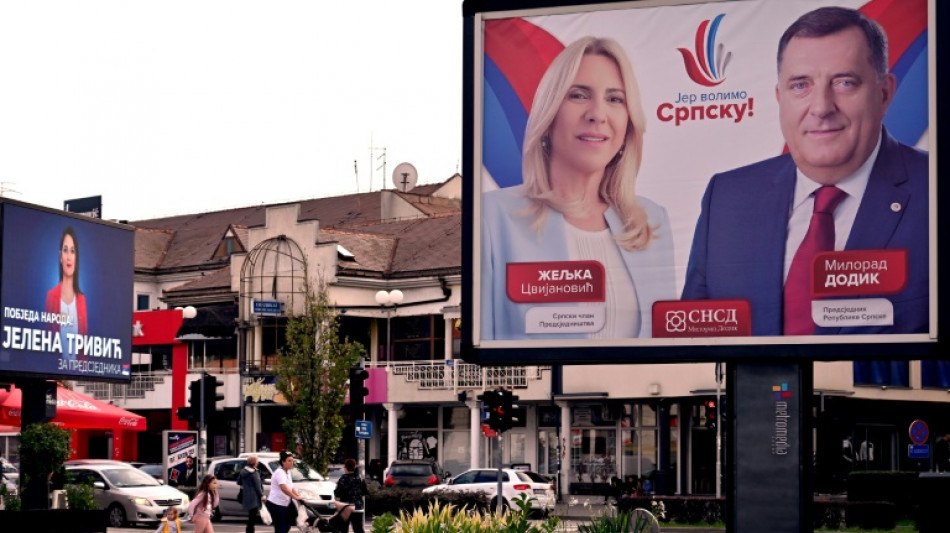
Bosnia goes to the polls as ethnic divisions grow / Photo: ELVIS BARUKCIC - AFP

 'Severe drought' declared in parts of UK

 IUX Announces New Web Client Portal Built for Enhanced Browser-Based Trading

 School roof collapse kills teacher, 32 children in NW Pakistan

 Inter skipper Martinez facing month out with thigh injury

 Spanish prosecutors back abuse probe into Julio Iglesias

 Tech sell-off deepens as US inflation sparks AI jitters

 Southgate does not forsee a return to management

 Two dead as Istanbul endures heaviest rainfall in 80 years

 After latest Nepal flood, survivors fear for future

 EU leaders clash over budget as spectre of French elections looms

 'No place to breathe': life in Indonesia's fire epicentre

 'Can't sleep': Spain's housing crunch upends lives

 Musk calls on Ukraine's Zelensky to 'go' after satellite slowdown row

 Still smiling at 117, Albanian may be world's oldest woman

 Pope has 'good night' in hospital: Vatican

 China's economy seen missing target as global shocks bite: AFP poll

 Costa Rica opens jail inspired by El Salvador mega-prison

 Same-sex couple takes fight for equality to Slovakian court

 'High hopes' as Indonesian women get a football league, again

 'Expectations high' for Bordeaux-Begles' Champions Cup hat-trick bid, says Depoortere

 Rennie urges All Blacks to stay focused against 'hurting' Wallabies

 Palmeiras beat Fluminense 2-1 in Libertadores semi-final first leg

 Brewers blasts leave Dodgers on brink

 Tech stock lead rout after US inflation fuels rate hike bets

 Al-Fayed survivors say UK police missing 'bigger picture'

With ethnic divisions growing deeper, Bosnia will hold general elections on Sunday amid secession threats and fears of fresh political turmoil nearly three decades after war ravaged the Balkan nation.
The country is torn between secessionist Orthodox Serbs and Catholic Croats demanding greater autonomy, while Muslim Bosniaks calling for a more egalitarian state appear to be chasing little more than a pipedream.
For more than two decades, the impoverished Balkan state has been governed by a dysfunctional administrative system born out of the 1995 Dayton Agreement.
And while the accords may have succeeded in ending the war in the 1990s, the country has withered amid political paralysis ever since.
Analysts have warned that Bosnia is sinking ever deeper into troubled waters with divisions along ethnic lines appearing to grow even further on the eve of elections.
"Bosnia-Herzegovina is experiencing the most serious political crisis since the signing of the peace agreement," Ranko Mavrak, a Sarajevo-based political analyst, told AFP.
"The ethnic divisions are so deep that they are now a real danger to Bosnia's survival and its integrity," he added.
- Complex elections -
Bosnia is divided between a Serb entity -- the Republika Srpska (RS) -- and a Muslim-Croat federation linked by a weak central government.
With Bosnia's three main groups rarely mixing in the wake of the war, ethnic political parties have long exploited the country's fault lines in a bid to maintain power, driving hundreds of thousands abroad in search of better opportunities.
"It's a beautiful, rich country and we could move forward with even a minimum of understanding," said Salko Hasanefendic, 70, a businessman from Sarajevo.
"If we raise our children today in such a nationalist context, we can only expect to have new nationalists in 40 years," he told AFP.
Amid the gloom, voters will cast ballots in a dizzying array of contests Sunday, including for the three members of Bosnia's tripartite presidency, the deputies of the central parliament and a raft of local races in the two separate entities.
With little to no polling data to rely on, analysts say incumbents and nationalist parties are likely to dominate many of the contests, including long-time Bosnian Serb leader Milorad Dodik, who is running for the presidency of the RS.
For months, Dodik has been stoking tensions amid frequent calls for Bosnia's Serbs to separate even further from the country's central institutions.
"This situation is like two brothers who don't like each other," Rajko, a retiree and Dodik supporter who did disclose his surname, told AFP before a recent campaign rally.
"It is better that they do not live together," he added, echoing a common refrain said by Dodik.
Amid the calls for secession, there are many who appear happy to see their Serb countrymen leave.
"Dodik and those like him can go to another country that they find more beautiful," said Bosnia's former co-president Bakir Izetbegovic during a recent rally.
Izetbegovic -- the son of the first president of independent Bosnia -- is running for a third term as the country's Bosniak Muslim president but is facing stiff competition from 46-year-old history professor Denis Becirovic.
Backed by 11 opposition parties, Becirovic is vowing to fight for a "pro-European and united" Bosnia.
- No compromise -
To add to the growing divide, many of the country's Catholic Croats have been pleading for greater autonomy or electoral reforms during the run-up to the polls, with the leading nationalist party HDZ threatening to boycott the contest for months.
Thanks to their vast numerical advantage in the Muslim-Croat federation, Bosniak Muslims hold de facto control over who can be elected to lead the Croats at the presidential level.
HDZ and other Croat parties have been calling for a mechanism to allow the community to appoint their own representatives to the presidency and upper house -- a move fiercely opposed by the federation's ruling Bosniak party.
Fears are growing of potential turmoil after the polls if the incumbent Croat co-president Zeljko Komsic -- who is widely reviled by all Croat parties -- is re-elected following repeated threats by nationalists, who say they are prepared to widen boycotts at government institutions.
"At the moment, there is no sign the situation will stabilise in Bosnia," said Mavrak, the analyst.
"There is no indication at the moment that it is possible to reach a compromise."
O.Salim--SF-PST

