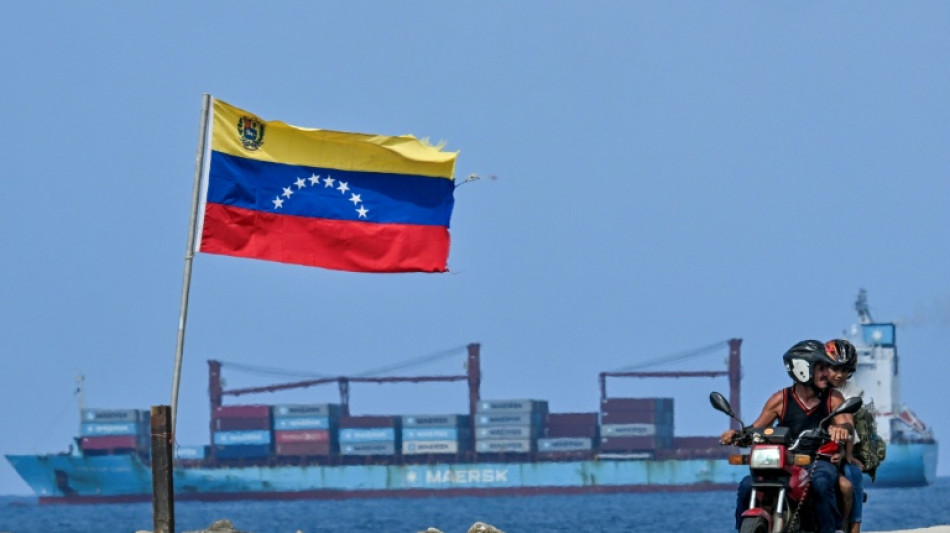
Venezuela says retains 'sovereignty' in US oil deal / Photo: Juan BARRETO - AFP

 Seeing pivotal election, Israelis fly from around world to vote

 South Korea's Eom 'racially abused' in England's Championship: club

 Asian markets mixed as tech firms claw back some losses

 India shuts down iconic Delhi protest site after three decades

 Japan urges Russia for 'impartial treatment' of arrested journalist

 Lula, Bolsonaro ordered to call off attempts at online censorship

 EU takes a page from Ireland's AI playbook

 Global deforestation slowed in 2025 but surged in Congo basin: study

 Saudi says Houthi attacks sparked Aramco fire, wounded 4 in Riyadh

 Few buyers for starving cattle in El Nino parched El Salvador

 Bybit Expands Beyond Crypto as CEO Outlines Next Phase of Financial Platform

 Bayern held by Viking after 'super dumb' Olise red in Champions League

 Why AI makes computer worms harder to stop

 US fines Bank of America $1.2 bn for anti-money laundering violations

 Bayern held by Viking after Olise sees red in Champions League

 Atletico down Carrick's struggling Man United

 Croatia trials full driverless robotaxi service

 US stocks dip ahead of inflation data as tech sell-off hits Asia

 No lights, no friends: Cuban youth grapple with loneliness

 Saudi coalition strikes Yemen oil sites after Houthi attacks

 French economy minister denies country caught in debt 'snowball'

 Judge extends halt to Trump's golf course tree-cutting

 Milan's Saelemaekers set for lenghty spell out after ankle surgery

 Nvidia says to invest in French medical website

 Real Madrid's Mourinho has 'trust' in referees despite complaints

Interim leader Delcy Rodriguez assured the public Saturday that Venezuela retains control of its oil under a new agreement that allows the United States significant access to it.
The United States will have majority control of 65 billion barrels of Venezuela's proven reserves in what President Donald Trump described Friday as "the biggest oil deal in world history."
"One thing must be absolutely clear: Venezuela retains ownership and sovereignty over its resources," Rodriguez said in a speech on state television.
The agreement with the United States aims to turn "cold, inert" resources underground to "a source of social and economic well-being for the people of Venezuela," she said.
Caracas says the deal involves $100 billion in private investment aimed at revitalizing the industry in a country with the world's largest proven oil reserves.
But a lack of transparency is raising concerns among Venezuelans, including supporters of the government. A flood of social media comments decried loss of sovereignty, meager benefits and political costs.
"We don't know who this will benefit -- whether it's Venezuela or (the United States)," said Jesus Salazar, a 68-year-old security guard.
"I have my doubts, but we'll have to wait and see what happens."
Venezuela's government has operated under intense pressure from the Trump administration since American forces ousted and captured long-time ruler Nicolas Maduro in January.
Washington allowed Rodriguez, his vice president, to stay on as interim leader so long as she toes Washington's line.
Venezuela's ruling party said Saturday it supports economic measures that "prioritize national interests and make it possible to overcome the impact of more than a decade of economic sanctions, unilateral coercive measures, and unjust blockades."
The party consistently blames US sanctions for the collapse of Venezuela's economy.
- Petrol and poverty -
Rodriguez has pushed through reforms in Venezuela's mining and petroleum industries, opening once tightly controlled sectors to private capital and foreign investment.
Washington, for its part, has eased sanctions imposed on Venezuela's oil sector under the Maduro government.
Oil production rose by 29.8 percent between January and July, reaching 1.2 million barrels per day -- still well below the three million barrels per day produced a quarter of a century ago.
The US deal aims to restore production to those levels, but analysts agree it would take time.
"The increase in production won't be seen for at least three or four years," said engineer Oswaldo Felizzola, a professor at the Institute of Higher Studies in Administration (IESA) in Caracas.
He welcomed the United States acting as a "guarantor" for investments in Venezuela, which has failed to attract significant capital for more than a decade.
"Without this, these fields would not be developed over the next 10 or 15 years," because state-owned Petroleos de Venezuela (PDVSA) "does not have the financial resources to do so."
An initiative of this magnitude could accelerate long-awaited economic recovery in Venezuela, a country still reeling from the brutal 80 percent contraction between 2014 and 2021 that plunged millions of Venezuelans into poverty.
Many survive on a monthly minimum wage equivalent to $0.16, plus government subsidies that can reach $240 per month -- still far short of the estimated $730 needed to buy basic food necessities for a family of five.
- Doubt and optimism -
Carlos Baco, a 74-year-old government employee, hopes oil revenues will start flowing under the new deal, but said he hasn't felt the effects of the increase in oil production over the past few months.
"Consumer goods and food are more expensive... the dollar is rising and prices are going up," he said. "It's impossible here."
Rodriguez has promised more than $204 billion in tax revenue from the deal, without providing details.
For analyst Elias Ferrer of the Orinoco think tank, the investment is good news, even without specifics.
"It's undoubtedly better than before. Before, this oil wasn't being extracted; if no one extracts it, no one pays royalties, and no one profits from it," he said.
"If everything is done correctly... this will be a great opportunity for Venezuela to see its oil sector revived," said attorney Dolores Dobarro, Venezuela's former deputy minister of energy.
U.Shaheen--SF-PST

