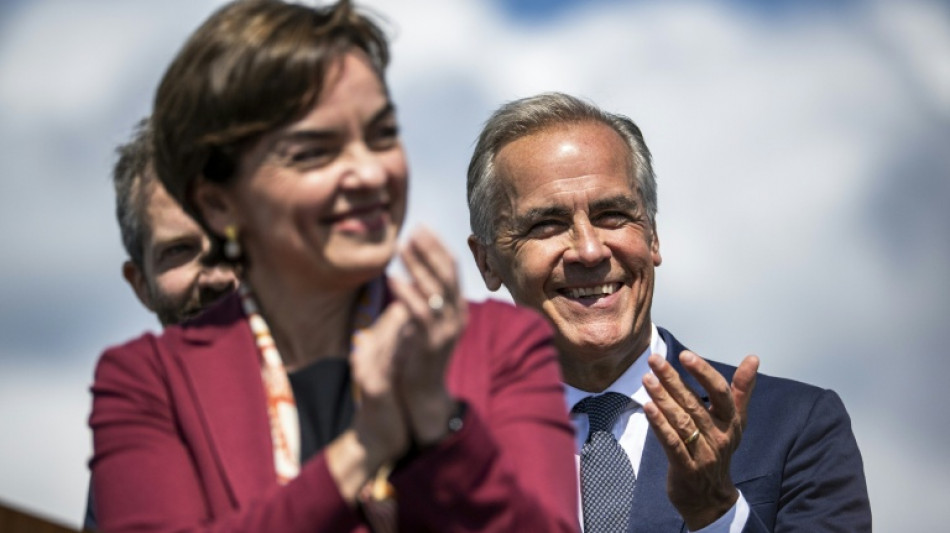
How the French language contributed to the US-Canada trade war / Photo: ANDREJ IVANOV - AFP

 Fuel shortage triggers queues on resort island Bali

 Sao Tome's niche vanilla finds far-away fans
 China-North Korea bridge to open Thursday, 12 years late

 Asian stocks mostly down as tech firms struggle to claw back losses

 AI boom drives record sales at Dutch tech giant ASML

 Trump says 'massive' oil, gas, mineral exploration to begin in Greenland

 China heads for record trade surplus as exports surge

 Vietnam mourns 700 war dead in major push to identify missing

 Relentless Swiatek wins all-Polish battle to launch Wuhan campaign

 Seeing pivotal election, Israelis fly from around world to vote

 South Korea's Eom 'racially abused' in England's Championship: club

 Asian markets mixed as tech firms claw back some losses

 India shuts down iconic Delhi protest site after three decades

 Japan urges Russia for 'impartial treatment' of arrested journalist

 Lula, Bolsonaro ordered to call off attempts at online censorship

 EU takes a page from Ireland's AI playbook

 Global deforestation slowed in 2025 but surged in Congo basin: study

 Saudi says Houthi attacks sparked Aramco fire, wounded 4 in Riyadh

 Few buyers for starving cattle in El Nino parched El Salvador

 Bybit Expands Beyond Crypto as CEO Outlines Next Phase of Financial Platform

 Bayern held by Viking after 'super dumb' Olise red in Champions League

 Why AI makes computer worms harder to stop

 US fines Bank of America $1.2 bn for anti-money laundering violations

 Bayern held by Viking after Olise sees red in Champions League

 Atletico down Carrick's struggling Man United

The trade war between the United States and Canada has taken on the flavor of a culture war after the collapse of negotiations last week.
According to Canadian Prime Minister Mark Carney, the dispute with the nation's largest trading partner was not just about tariff demands but what he called unacceptable "threats" to the French language and "Quebec culture."
Those are not typical sticking points in trade negotiations, but emotive ones in Canada, particularly in the French-speaking eastern province of Quebec, which has long sought to preserve its distinct identity.
Carney said Canadian subsidies for Francophone culture, the role of Francophone online media and bilingual labeling of products sold in Canada were among the issues at stake.
He described these as "fundamental rights" and said there was "a huge gap between Canadian and American perspectives."
The prime minister also contended that the US wanted to destroy Canada's automotive, steel and aluminum industries, and restrict Canadian trade deals with other countries.
After the breakdown of talks, Canada now faces additional tariffs on some $20 billion worth of its US exports and double tariffs on Canadian vehicles, while Carney has vowed to match the US tariffs "dollar for dollar."
In Quebec, Carney's decision to break off negotiations was widely supported.
A poll published Sunday by the Angus Reid Institute found that 85 percent of Quebecers supported the move -- the highest approval rate among the 10 Canadian provinces.
"Our identity is not negotiable," Quebec Premier Christine Frechette wrote Sunday in a social media post.
She faces a reelection battle in October and is currently trailing in polls to the leader of a Quebec separatist party.
According to Canadian media, Frechette said Washington wanted concessions on Quebec's rules for appliances and instruction manuals, as well as its law promoting French-language cultural content.
Recent legislation by Quebec allows it to regulate how much French-language content digital platforms offer and how prominently it appears, which can add to the cost of doing business for US companies, the Montreal Gazette reported.
In an interview on Monday, US Trade Representative Jamieson Greer played down the language issue in the trade talks as a "funny fake story."
"What we don't like is a situation where Canada, the federal government, forces American tech companies to take their earnings and give a percentage to their competitors in Canada," Greer told CNBC.
"But I understand why the Quebecois want to have French language content and all of that. And we think that's a really valuable thing."
S.Barghouti--SF-PST