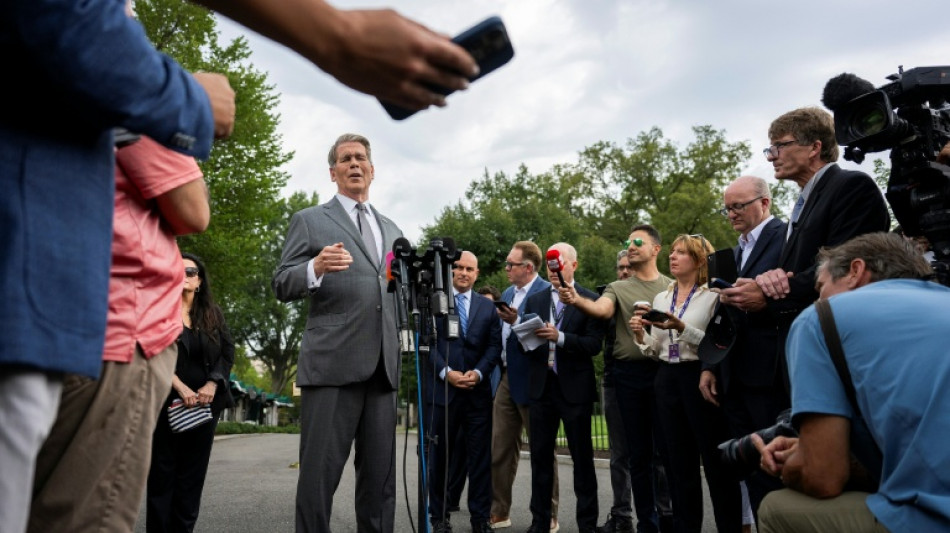
US vows 'economic asphyxiation' of Iran with new sanctions / Photo: Jim WATSON - AFP

 Fuel shortage triggers queues on resort island Bali

 Sao Tome's niche vanilla finds far-away fans
 China-North Korea bridge to open Thursday, 12 years late
 Asian stocks mostly down as tech firms struggle to claw back losses

 AI boom drives record sales at Dutch tech giant ASML
 Trump says 'massive' oil, gas, mineral exploration to begin in Greenland

 China heads for record trade surplus as exports surge

 Vietnam mourns 700 war dead in major push to identify missing

 Relentless Swiatek wins all-Polish battle to launch Wuhan campaign

 Seeing pivotal election, Israelis fly from around world to vote

 South Korea's Eom 'racially abused' in England's Championship: club

 Asian markets mixed as tech firms claw back some losses

 India shuts down iconic Delhi protest site after three decades

 Japan urges Russia for 'impartial treatment' of arrested journalist

 Lula, Bolsonaro ordered to call off attempts at online censorship

 EU takes a page from Ireland's AI playbook

 Global deforestation slowed in 2025 but surged in Congo basin: study

 Saudi says Houthi attacks sparked Aramco fire, wounded 4 in Riyadh

 Few buyers for starving cattle in El Nino parched El Salvador

 Bybit Expands Beyond Crypto as CEO Outlines Next Phase of Financial Platform

 Bayern held by Viking after 'super dumb' Olise red in Champions League

 Why AI makes computer worms harder to stop

 US fines Bank of America $1.2 bn for anti-money laundering violations

 Bayern held by Viking after Olise sees red in Champions League

 Atletico down Carrick's struggling Man United

US Treasury Secretary Scott Bessent on Monday laid out plans for the "economic asphyxiation" of Iran, expanding Washington's secondary sanctions threats and warning of dire consequences for countries that do not join the campaign.
The announcement comes almost six months into a war on Iran that has ground to a stalemate, with stalled peace talks and Tehran blocking most traffic through the crucial Strait of Hormuz.
Bessent earlier said the United States was declaring an "economic D-Day" on Iran, but his announcement named no specific countries beyond Iran and no timelines.
"Around the globe, our objective is to sever every economic lifeline that sustains this tyrannical regime until Tehran stands alone," Bessent told a press conference.
"We are going to hold everyone accountable, and this is economic asphyxiation of this regime."
He added that countries not joining US sanctions would "share in the isolation" of Iran, and noted that President Donald Trump was making phone calls to world leaders with requests to stop interactions with Tehran.
The Treasury Department said expanded secondary sanctions would target Iran's digital assets, technology, gold, aviation and shipping sectors.
Bessent vowed that any entity "that facilitates money laundering on behalf of Iran will be removed from the US dollar system."
In a post before the announcement, Deputy Foreign Minister Kazem Gharibabadi said the latest US threats were an admission of military defeat, and warned countries against aiding Washington.
"Your narrative doesn't add up," Gharibabadi said, asking why, if Washington had achieved its goals, "there is a need for 'the largest financial invasion in history' and the mobilization of 'all institutions and powers' of the United States!
"Is this a victory or an admission of America's defeat?"
- Oil exports plunge -
The US and Israel linked the launch of their war in February to Iran's nuclear program, but the focus since the early days of fighting has been on the Strait of Hormuz, a vital route for global oil and gas supplies.
Tehran continues to blockade the strait, which it did not restrict before the war, driving up global inflation and heaping domestic pressure on Trump ahead of mid-term elections in November.
Iran has weathered decades of crushing international sanctions, and before the war it continued to export millions of barrels of oil, mostly to China, and to evade sanctions through complex international financial networks.
Asked on Monday if Chinese banks would be targeted by the new sanctions, Bessent said "no one is above the reach of US sanctions."
The US naval blockade of Iran has seen its oil exports via the Strait of Hormuz fall from two million barrels a day pre-war to just 0.4 million by mid-August, according to maritime tracker Kpler.
Iran's parliamentary speaker and chief negotiator Mohammad Bagher Ghalibaf brushed off US threats, saying on X that "economically, the United States is not in a position that would allow it to further restrict its relations with other countries".
For ordinary Iranians, the standoff is likely to bring only more economic pain after years of rampant inflation, which in December and January fuelled massive anti-government protests.
Sarah Hassanbeigi, a 32-year-old pharmacist in Tehran, said: "I don't think people can really take this much longer."
- Pakistani delegation -
Last week, Iranian President Masoud Pezeshkian, considered a relative moderate, said Tehran should "bring the war to an end now as we are in a position of power."
That followed Supreme Leader Mojtaba Khamenei appointing hardliners to key security positions.
Throughout the war, diplomatic efforts, pushed on by mediators, have sought a negotiated end to the conflict.
On Monday, Pakistan's army chief Asim Munir visited Iran and met with Ghalibaf.
Islamabad was a leading mediator in talks that helped secure an April ceasefire that later fell apart. It is also a major trading partner of Iran, possibly opening it up to the threat of the new sanctions.
Oman's foreign minister was due in Iran on Tuesday, as Muscat and Tehran seek a deal on regulating passage through Hormuz.
J.Saleh--SF-PST