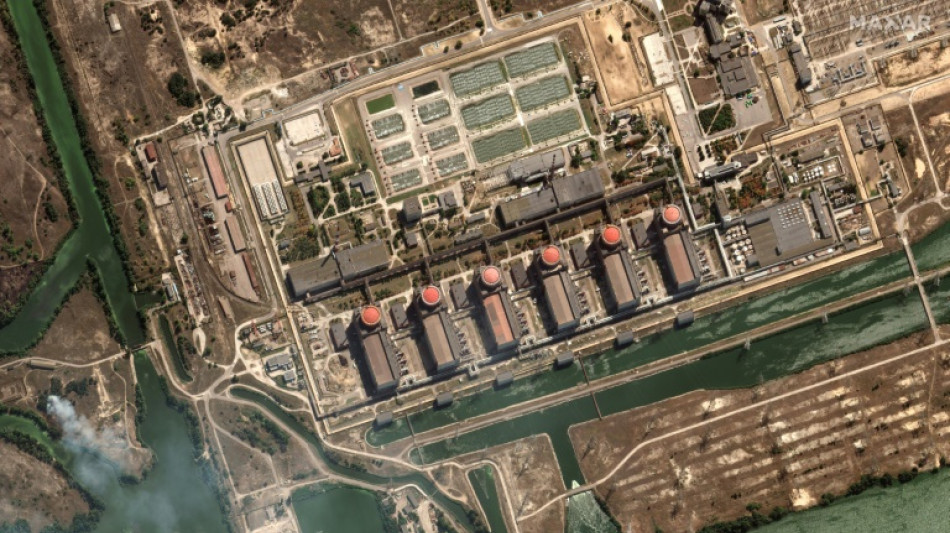
Preparing for the worst near Ukraine's precarious nuclear plant / Photo: Handout - Maxar Technologies/AFP

 Trump's new press secretary says China lacked 'proper' toilets

 India closes down New Delhi park ahead of 'cockroach' movement rally

 'Let us build': World Bank chief outlines jobs-led development agenda
 Broncos top Super Bowl champion Seahawks in overtime

 Brilliant Brewers sweep Dodgers to reach World Series

 Brewers complete Dodgers sweep to reach World Series

 High-flying Freiburg try to shut out the noise as fairytale run continues

 Flamengo secure 0-0 draw in La Plata in Copa Libertadores semi
 The final lap? Two days on the campaign trail with Trump

 Asian stocks rise as tech bounces from rout, eyes on Warsh

 Saudi organisers say 2027 Asian Cup 'on schedule' after attacks

 Right-wing Brazil influencers on 'mission' to seal Bolsonaro win

 Using AI to help find Mexico's legions of missing children

 Fiji to deploy solar-powered Australian military drones at sea

 'Multiple victims' in Oregon elementary school shooting, police say

 'Multiple victims' in Oregon elementary school shooting: police

 ChangeNOW Announces NOW AI After Resolving Website Integration Vulnerability

 Argentine demonstration over education cuts ends in clashes

 Argentine protesters, police clash at demo over university funding

 US stocks end higher as AI shares stabilize

 School roof collapse kills 32 children, teacher in Pakistan

 Lyon down Palace in Europa League, Sunderland leave it late

 UniCredit says receives ECB green light for Commerzbank takeover

 New York City pension fund asks Anthropic to delay IPO

 Venezuela's Maduro denies US torture charges as 'false accusations'

In the southern city of Zaporizhzhia, which lies close to Europe's largest nuclear plant, which has been targeted by shelling, Ukrainians are picking up iodine pills and preparing for the worst.
The city lies some 50 kilometres (30 miles) as the crow flies from the Zaporizhzhia nuclear plant which has been occupied by Russian troops since early March in an area hit by ongoing fighting.
Moscow and Kyiv have traded blame over the shelling around the complex and the nearby town of Energodar amid UN warnings about "the very real risk of a nuclear disaster".
"You know, we survived the accident at the Chernobyl nuclear power plant," says Kateryna, a 68-year-old pensioner who still has thyroid problems linked to the 1986 disaster when one of the reactors exploded.
"That threat was very big, but we survived. Now we have six reactors, not one," she said of the Zaporizhzhia complex.
Like dozens of other residents, she went on Monday to a school handing out iodine tablets that can reduce the medical risk of radiation in the event of a disaster.
Should a serious incident happen at a nuclear facility, it would release radioactive iodine into the atmosphere which, if inhaled, can increase the risk of thyroid cancer -- an effect observed after Chernobyl.
The tablets can help prevent radioactive iodine concentrating in the thyroid gland so it can be flushed out of the body naturally though the urine.
Some 13 schools have been distributing the tablets, which doctors say should be given to anyone living with in a 50-kilometre radius of the plant.
So far, more than 5,000 of the city's residents, among them more than 1,500 children, have collected iodine pills over a two-day period, officials say.
"The tablet is taken in case of danger, when the alarm is raised," said Elena Karpenko, a nurse at the Zaporizhzhia Children's Hospital.
- Radioactive risk -
With tensions high around the plant, inspectors from the International Atomic Energy Agency, the UN's nuclear watchdog are due to visit in the coming days, with the team led by IAEA chief Rafael Grossi.
Beyond the shelling, Kyiv has also accused Moscow of using the plant for storing heavy weaponry and arms and stationing some 500 soldiers at the site.
But the Kremlin has insisted it only has security personnel there. On Monday, Moscow urged the international community to put pressure on Ukraine "so it stops endangering the European continent by shelling".
Last week, the plant was briefly severed from the national grid for the first time in its four-decade history after its last working power line was shelled. Ukraine's nuclear agency Energoatom warned there was a risk of "hydrogen leakage and sputtering of radioactive substances".
Over the weekend, the emergency services in Zaporizhzhia held training sessions on managing the risk of nuclear accidents. They carried out mock evacuations and conducted decontamination exercises involving radioactive dust.
So far, the city has stockpiled two tonnes of decontamination products.
In the event of a leak, two sirens will go off to warn the city's inhabitants: an initial alarm then a second one 24 hours later.
"Perhaps the radioactive cloud will not reach the place where people are," said Taras Tyshchenko, the region's health chief.
"By the time the second alarm goes off, we will clearly know how far the radioactive cloud has spread.
"We will have all the information about safe areas to evacuation sites," he said.
S.Barghouti--SF-PST