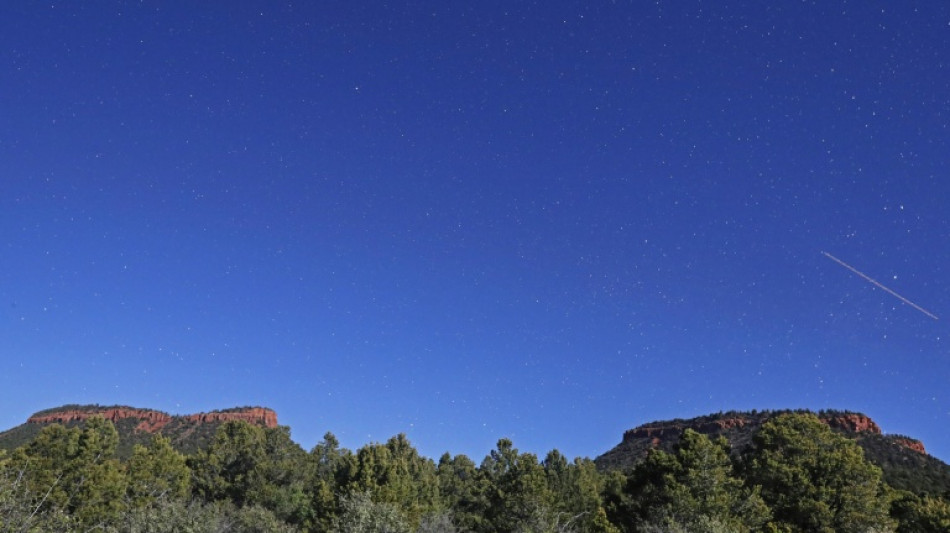
Trump slashes two Utah protected areas by more than 90% / Photo: GEORGE FREY - GETTY IMAGES NORTH AMERICA/AFP/File

 'Severe drought' declared in parts of UK

 IUX Announces New Web Client Portal Built for Enhanced Browser-Based Trading

 School roof collapse kills teacher, 32 children in NW Pakistan

 Inter skipper Martinez facing month out with thigh injury

 Spanish prosecutors back abuse probe into Julio Iglesias

 Tech sell-off deepens as US inflation sparks AI jitters

 Southgate does not forsee a return to management

 Two dead as Istanbul endures heaviest rainfall in 80 years

 After latest Nepal flood, survivors fear for future

 EU leaders clash over budget as spectre of French elections looms

 'No place to breathe': life in Indonesia's fire epicentre

 'Can't sleep': Spain's housing crunch upends lives

 Musk calls on Ukraine's Zelensky to 'go' after satellite slowdown row

 Still smiling at 117, Albanian may be world's oldest woman

 Pope has 'good night' in hospital: Vatican

 China's economy seen missing target as global shocks bite: AFP poll

 Costa Rica opens jail inspired by El Salvador mega-prison

 Same-sex couple takes fight for equality to Slovakian court

 'High hopes' as Indonesian women get a football league, again

 'Expectations high' for Bordeaux-Begles' Champions Cup hat-trick bid, says Depoortere

 Rennie urges All Blacks to stay focused against 'hurting' Wallabies

 Palmeiras beat Fluminense 2-1 in Libertadores semi-final first leg

 Brewers blasts leave Dodgers on brink

 Tech stock lead rout after US inflation fuels rate hike bets

 Al-Fayed survivors say UK police missing 'bigger picture'

President Donald Trump on Monday signed executive orders slashing two national monuments in Utah to roughly a tenth of their current size, throwing open millions of acres of protected land to fossil fuel extraction and mining.
Trump signed the proclamations at a White House gathering flanked by Republican officials including Utah's governor and two senators, who framed the move as an overdue correction of federal overreach.
"We're doing something very dramatic and very important for the people of Utah and the people of our country," said Trump.
"These monument designations are supposed to be the 'smallest area' possible to protect the antiquities, and these multi-million acre monuments that are bigger than the state of Delaware certainly do not fit that designation," added Utah Governor Spencer Cox.
"We definitely care about protecting these antiquities and will continue to do so," he added.
The move reopens a fight that has raged for a decade.
Trump initially targeted the two monuments during his first term in 2017, before his successor, Joe Biden, restored them to their original boundaries in 2021.
That earlier rollback cut Bears Ears National Monument by 85 percent and Grand Staircase-Escalante by 45 percent. This time the cuts go further still, at 91 percent and 90 percent respectively.
The new executive orders listed an array of critical minerals and energy reserves it said were vital to the United States' resource independence and national security.
They are the latest in a broader pattern of stripping protections for public lands and wildlife to benefit extractive industries. Last week, the administration finalized a rule redefining the word "harm" under the Endangered Species Act to exclude habitat destruction.
- Legal challenge certain -
The fossil-rich Grand Staircase-Escalante, which covers 1.9 million acres, was established as a monument in 1996 under then-president Bill Clinton. Bears Ears, which covers 1.35 million acres, was proclaimed in 2016 under president Barack Obama on the basis of its cultural sites sacred to Indigenous tribes.
Opponents contend Trump's moves are illegal under the Antiquities Act of 1906.
"It's crystal clear: The language of the act provides the president power to create national monuments," Thomas Delehanty, a lawyer for Earthjustice, told AFP. "It does not include a corresponding power to diminish or eliminate national monuments. Instead, only Congress can do that, with the passage of a new law."
But the Department of Justice last year issued an opinion stating that presidents can not only shrink monuments but abolish them altogether.
Earthjustice sued the first Trump administration over the issue on behalf of conservation groups, and Delehanty said they were prepared to reactivate that litigation or file a new case.
Republican-controlled Utah, meanwhile, has an ongoing case challenging Biden's restoration of the monuments.
Athan Manuel, director of the Sierra Club's Lands Protection Program, told AFP that public lands are "part of the fabric of the United States," drawing tourism and fueling economic growth in remote regions, becoming a "renewable economic resource."
F.AbuShamala--SF-PST

