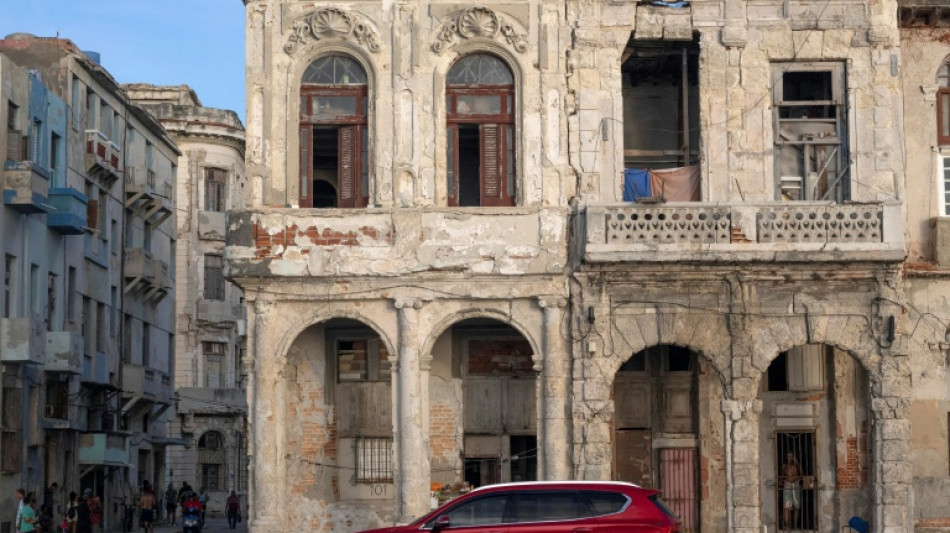
Socialism with a twist or crony capitalism? Cuban reforms spark debate / Photo: Pablo PORCIUNCULA - AFP

 'Multiple victims' in Oregon elementary school shooting: police
 ChangeNOW Announces NOW AI After Resolving Website Integration Vulnerability

 Argentine demonstration over education cuts ends in clashes
 Argentine protesters, police clash at demo over university funding
 US stocks end higher as AI shares stabilize
 School roof collapse kills 32 children, teacher in Pakistan
 Lyon down Palace in Europa League, Sunderland leave it late

 UniCredit says receives ECB green light for Commerzbank takeover
 New York City pension fund asks Anthropic to delay IPO

 Venezuela's Maduro denies US torture charges as 'false accusations'

 Somalia sets May presidential election despite insecurity

 Chelsea's Caicedo eager to be more of a leader

 Rahm reaches separation deal with LIV in bankruptcy court
 UN chief urges nations to end 'war on nature'
 Newcastle boss Jaissle says Fernandez-Pardo just needs a goal

 Infantino offers apology but 'no answers' at FIFA meeting over World Cup plan

 Don't exclude Turkey from 'Made in Europe' plan: minister to AFP

 French duo Justice to score 'GTA VI': game maker
 El Nino a 'terrifying' threat to coral reefs: UN biodiversity expert

 Barcola must get used to Liverpool highs and lows, says Iraola
 Versus Trade Wins Best ECN/STP Broker APAC 2026, Marking Third UF Awards Recognition
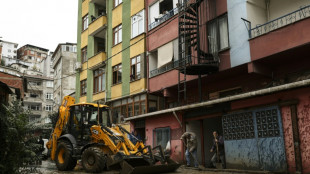 Three dead as Istanbul sees heaviest rainfall in 80 years

 US producer prices see biggest jump since 2022 in added challenge to Trump

 Swiatek avoids seed exodus to breeze into Wuhan last eight
 PM condemns 'chaos' as violent protests grip Albania

Cuba's communist president has cited China and Vietnam as models for a historic shift towards a market economy that was hurriedly pushed through last week to try to end a severe crisis.
But some worry that Russian-style crony capitalism could be on the menu instead.
Under immense pressure from US sanctions, including a crippling fuel blockade, Cuba's government last week drew a line under nearly seven decades of central planning.
Unveiling 176 reforms that represent a seismic change to the island's socialist model, it said state-owned enterprises would be converted into joint-stock companies and opened up to private investors, private banks would be authorized and private developers would be allowed to build tourist infrastructure.
President Miguel Diaz-Canel said the measures, which also included sweeping changes to land use, aimed to "preserve" socialism rather than bury it.
But economists warned that a politically-connected elite would profit most from a rushed transition implemented without any semblance of democratic reforms.
Spain-based Cuban economist Pedro Monreal warned that a quick-fire sale of state enterprises "without robust legal safeguards" could result in "the capture of state assets by insiders well-connected to those in power."
"I inevitably think of the "crony capitalism" of the Russian transition," he wrote on X, referring to the former communist officials who snapped up state assets at knock-down prices after the break-up of the Soviet Union.
Fellow Cuban economist Ricardo Torres, a research fellow at the American University in Washington, issued a similar warning.
The "structural conditions for insider capture are present," he told AFP, noting that there are "no independent valuation mechanisms, no competitive bidding requirements, and no oversight body insulated from party control."
- Socialism with Cuban characteristics -
Former president Raul Castro, Fidel's brother, who led the country from 2006 to 2018, regularly cited Vietnam as an inspiration for his timid reform effort starting in 2010, when he boosted small private businesses and legalized home sales.
Communist Vietnam has become one of southeast Asia's fastest growing economies since introducing market-led reforms in the 1980s.
In China, meanwhile, Deng Xiaoping's "socialism with Chinese characteristics" has produced hundreds of billionaires and major homegrown companies such as internet giants Alibaba and Tencent.
London-based Cuban economist Daniel Torralbas argued that neither China nor Vietnam served as a useful comparison for Cuba because their transformation was "much more gradual."
"Both began with agricultural reforms that lasted several years, and then the reforms expanded to promoting foreign direct investment, international capital, the creation of special economic zones, and, of course, the expansion of the role of private property in the economy."
Cuba's opening up, by contrast, comes "at its worst moment," he said, when the economy is at rock bottom and US sanctions, including the fuel blockade, have caused an exodus of foreign investors and tourists.
- From centralism to capitalism -
Alexei, a 52-year-old building supervisor in Havana, recalled Mikhail Gorbachev's 1989 visit to Cuba, when the Soviet leader touted his perestroika reforms to a skeptical Fidel Castro and suggested that Cuba, too, needed to adapt.
"The best time to implement these reforms was in the 1990s," Alexei, who did not wish to be identified when talking about government policy, said, echoing a sentiment voiced by many Cubans about what they saw as wasted years.
Santiago, an engineer who worked in the Soviet Union in the 1980s, said the move to privatize chunks of the economy was long overdue, "because the state can't be dealing with simple things like fixing a television."
But the 59-year-old, like many Cubans who spoke to AFP, was worried about the pace of the changes and the risk of the island's most vulnerable being left behind.
In a recent opinion article in Time magazine, Torres, the economist, urged Havana to "resist the temptation to leap from bureaucratic centralism to a harsh, socially detached form of capitalism."
He called for the preservation of Cuba's core values: "that education is a fundamental good, that access to healthcare should not depend solely on purchasing power, and that exclusion of whole communities, whole generations, is not an acceptable price for growth."
Q.Najjar--SF-PST