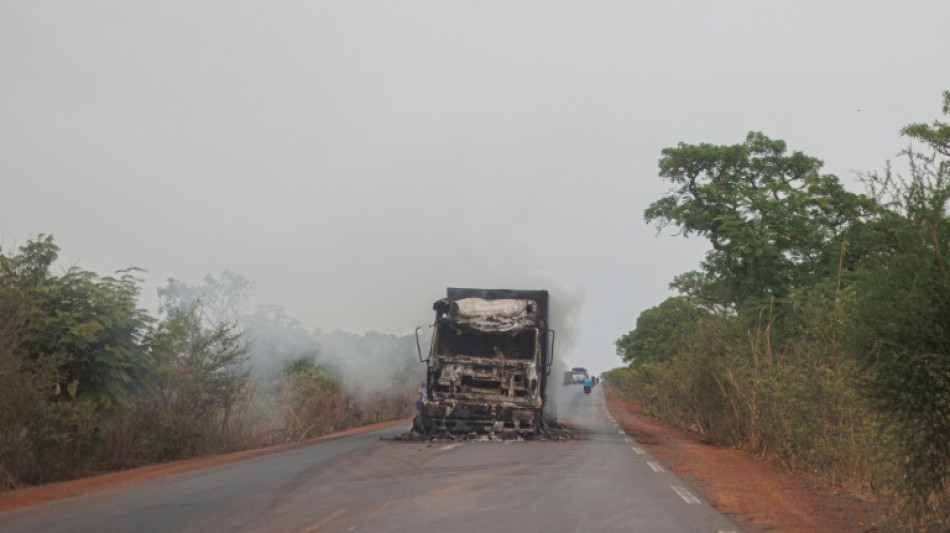
Not just a hideout: Sahel forests provide base for jihadists / Photo: - - AFP/File

 Man Utd teetering towards crisis as Man City cloud hangs over Premier League

 Trump's new press secretary defends 'lawyer' title

 Wallabies coach has 'faith' as All Blacks juggernaut awaits

 Ailing UK director Mike Leigh wishes he could make '100 more films'

 Pixagram Announces Free Account Creation for 250 New Users Daily Through 2026

 Macron warns urgent to strike EU budget deal before French vote runup

 Zelensky rallies European allies as Trump ties slump

 Guardians edge Rays to seize MLB playoff series lead
 Trump scraps plan to livestream execution after fierce backlash

 Martinez apologises for outburst at Man Utd hierarchy

 Houthis launch deadly attack on presidential palace in Yemen's Aden

 Brazil forward Antony says home burgled during Betis match

 Ravens face familiar foe in Browns coach Monken

 France, Germany reach deal on future of car industry

 Carney campaigns for Canadian unity before Alberta secession vote

 ATP proposes rankings system changes, extra player bonuses

 Russell Brand was 'monster-like', alleged victim tells UK court

 Crowded Launches Crowded MCP, Bringing Nonprofit Financial Operations Into ChatGPT and Claude

 Albanian PM condemns 'chaos' as violent unrest spreads

 Italian football suffers new blow with Champions League misery

 Trump scraps plan to livestream execution after broad backlash

 Seven missing off Romania after latest Black Sea drone attacks

 ARKBRIDGE Outlines Jonathan Morelli’s “Picks and Shovels” AI Infrastructure Investment Strategy

 Tech sell-off rolls on as hot inflation data stokes rate worries
 McIlroy makes 'solid' start in rain-hit Delhi as Norgaard leads

Along Mali's National Route 6, a major thoroughfare connecting the capital to the country's centre, the army has reshaped the landscape: the vegetation from the surrounding forest has been cleared in anticipation of jihadist ambushes.
Armed groups use forest areas both as refuge and a base for launching deadly attacks on roads across Africa's Sahel region.
In Mali, jihadists from JNIM, Al-Qaeda's Sahel branch, operate from the vast 80,000-hectare (200,000-acre) Faya forest, located a quick drive from the capital, Bamako, from which they carry out attacks against toll stations, public transportation and freight trucks.
Since June, Faya has become an "off-limits military zone to civilians", along with 38 other parks and forests that are "likely to serve as refuges for armed terrorist groups", according to an interministerial decree.
The armed forces, it said, would eliminate "all targets located in the specified zones".
Mali's decision is part of a series of security measures taken after large-scale jihadist attacks by JNIM and its ethnic Tuareg separatist allies in late April, which notably killed the country's defence minister.
The forests and parks covered by the decree stretch in a wide arc across the southern section of the country from the Senegal and Mauritania border in the west to Guinea and Ivory Coast in the east.
"These are large natural areas that are sometimes not very well controlled by the state. There are no permanent settlements in many of these zones, no infrastructure, and police stations or military bases are located elsewhere," said Franklin Nossiter, Sahel analyst at the International Crisis Group.
"So it has become easier for jihadists groups to move around and establish themselves there and more difficult to drive them out", he told AFP.
- 'Hell' -
Burkina Faso and Niger, which also face violence from JNIM and the Islamic State in the Sahel Province (ISSP), have implemented similar forest security measures in recent years.
For example, southwestern Niger's heavily wooded Torodi region, an epicentre of jihadist violence located on the border with Burkina Faso, was declared a "red zone" by the army.
An official from a Nigerien timber association active in the area told AFP that "these areas are hideouts for terrorists".
The jihadists, he said, "believe we are destroying their shelters, but we have avoided doing so on several occasions".
According to the official, 52 trucks were burned by the jihadists, and 24 drivers and apprentices were killed.
"We stopped going to that hell", truck driver Hassane Gourouza told AFP.
The forested regions are no longer just "temporary hideouts" for the groups, but have become "permanent operation bases", said Samir Bhattacharya, associate fellow at the Observer Research Foundation think tank.
"This transformation was driven by sustained military pressure in urban areas, and tactical advantages offered by forests like protection from aerial surveillance", he told AFP.
The forests also give jihadists a chance to "exploit local informal economies such as mining, grazing, smuggling and poaching", he added.
Conflict monitor ACLED added that "the jihadist groups' continued use of nature reserves and designated forests indicates a deliberate reliance on these areas".
- Drones, tanks ineffective -
JNIM initially spread throughout the sub-region through the W-Arly-Pendjari (WAP) complex of reserves and national parks that straddle Benin, Niger and Burkina Faso, and which are also located near the borders of Nigeria and Togo, ACLED said.
ISSP, meanwhile, has established a network of camps in wooded hills along the border between Niger and Nigeria, an area offering isolated refuge, the NGO added.
JNIM, which first claimed responsibility for attacks in Nigeria in late 2025, knows the parks well, unlike the various Sahel armies.
For the military, "the terrain is inhospitable for armoured vehicles", according to a report by the Geneva-based Global Initiative Against Transnational Organised Crime (GI-TOC).
And armed drones are largely ineffective due to "dense vegetation cover", Nossiter added.
Driving jihadists out of the region and torching things down might only "fuel recruitment for jihadist groups, because if innocent people are killed, that's what will create the new jihadists of tomorrow", he warned.
burs-bdi/bfm/jhb
F.Qawasmeh--SF-PST