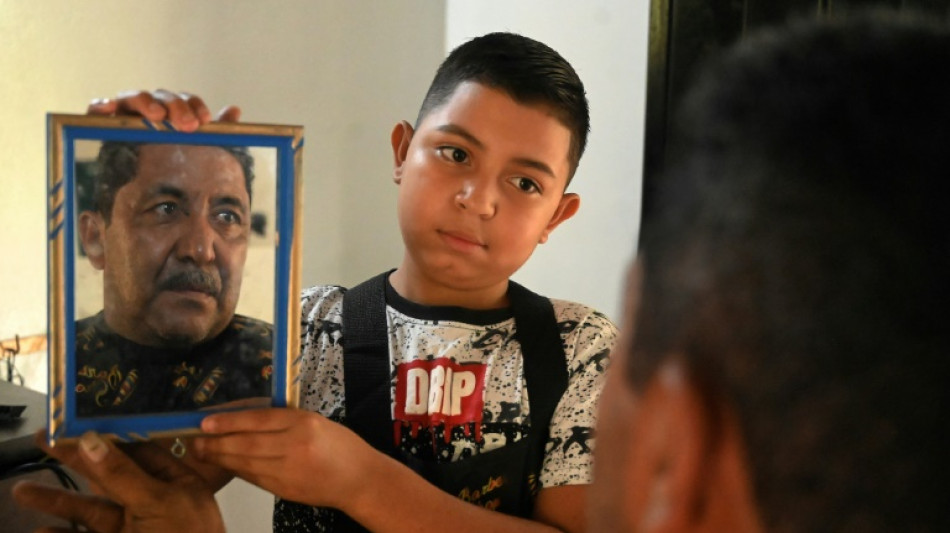
Childhood cut short: Honduran boy, 12, wielding barber's shears / Photo: Orlando SIERRA - AFP

 Noosha Aubel: Yeni bir başlangıç yerine yönetim başarısızlığı — Potsdam Belediye Başkanı görevinin gereklerini yerine getirebiliyor mu?

 Elon Musk unveils Tesla's 'flying' car

 누샤 아우벨: 새로운 출발 대신 드러난 리더십 실패 — 포츠담 시장은 과연 직무를 감당할 능력이 있는가?

 noosha-aubel-lingdao-shibai-bocitan-shizhang-nengfou-shengren

 Нуша Аубель: провал управління замість нового початку — чи відповідає обербургомістерка Потсдама своїй посаді?

 Cost-of-living demonstrations to grip pre-election France

 Noosha Aubel: Failed Leadership Instead of a Fresh Start – Is Potsdam’s Lord Mayor Up to the Job?

 'Real inequality': France's education divide laid bare by protests

 Opera on Ukraine's children aims to 're-awaken' concern for war

 AI is coming for every company, Nvidia boss says

 Millions may be forced to move as climate change hits South Asia: UN

 Four killed battling Indonesia fires as toxic haze cloaks region

 Thai farmers, fishermen challenge IMF, World Bank at Bangkok rally
 In Malaysia, frustration grows over Indonesia haze
 Why India's voter revision drive has stoked fear and anger

 Munster eye fitting tribute to 'special' Foley in Racing reunion

 Shooter kills teacher, three children at Oregon elementary school

 Fed's Warsh surprised by world economy's 'resilience'

 Four killed in Indonesia battling fires causing toxic haze

 New Zealand star Ponga breaks arm in Rugby League World Cup opener

 Indonesian stocks dive 11% as MSCI weighs market reclassification

 Seoul dismisses Pyongyang's scepticism over hypersonic weapon test

 Yamal on song as entertainers Barcelona face Betis challenge

 Wong weighs haze prosecutions as Singapore air quality worsens

 Brush fire prompts an evacuation order along Los Angeles coast

Eduardo Espinal runs his own barber shop from a small zinc-roofed building in Honduras, opening the doors at 8:00 am for a 12-hour workday. He is 12 years old.
When it's quiet, he plays hide-and-seek or football with his friends. He has not been to school since last year.
Though it is illegal in Honduras for children under 14 to work, Eduardo is one of tens of thousands who do so in the poverty- and crime-plagued Central American country.
In 2021, more than one in 10 Honduran children aged five to 18 were working, according to Horacio Lovo of the INE national statistics institute.
Half-a-million of the country's 2.3 million children neither worked nor went to school.
"I really like the barbershop and to study too," Eduardo told AFP outside his "Eduar Barber Shop," which he opened last month on the outskirts of Comayagua in central Honduras.
He charges between $2 and $3 per cut, depending on the style.
On his best day to date, he earned $45 -- a small fortune in a country where a third of the population of nearly 10 million people live on less than a dollar a day.
- 'Daddy, I can cut' -
Eduardo's father Wilfredo Espinal, 50, makes a meager living collecting river sand to sell to builders. His mother, Merlin Carranza, does not work.
Wanting to help his family, the boy said, he started working as an apprentice last year, aged just 11, at the barbershop where he and his father had their hair cut.
His father bought him a set of shears, with which he practiced at home.
A month ago, Eduardo told his father: "Daddy, I can cut, I want you to buy me a (barber's) chair," Wilfredo Espinal told AFP.
The father obliged, taking out a loan to purchase the chair as well as the scissors, razor and other equipment needed, and helped the boy set up shop in a small building that used to belong to Eduardo's grandmother.
On a normal day, "I get up, I bathe, I get dressed, I eat and I come here" to the shop, the boy told AFP.
"I play when I don’t have customers," he added.
According to Lovo, Eduardo's example is a "serious case of those (children) who leave school in order to work."
"Children should be in school," he stressed.
Eduardo finished primary school in 2021, and hopes to start high school next year.
According to a UNICEF report in 2020, some 55 percent of Honduran children access lower secondary schooling, and just over a third reach the upper secondary level.
Schooling is mandatory for the first nine grades.
Dropouts skyrocketed after Covid-related school closures and the devastation wreaked by tropical storms Eta and Iota in November 2020, said the UNICEF report.
Eduardo dreams of becoming a "professional barber," to build a home for his mother and help his little sister, now eight, open a beauty salon.
High poverty and unemployment, mixed with gang and drug violence, forces nearly 800 Hondurans to leave the country every day, mainly headed for the United States, where more than a million already live, most of them undocumented.
F.AbuZaid--SF-PST