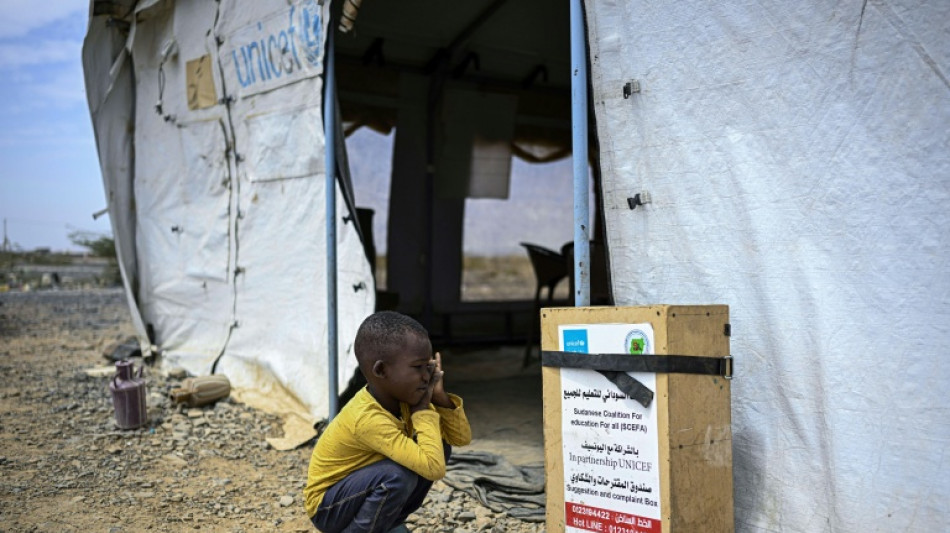
Middle East war hammering aid supply chains: UN / Photo: Khaled DESOUKI - AFP

 누샤 아우벨: 새로운 출발 대신 드러난 리더십 실패 — 포츠담 시장은 과연 직무를 감당할 능력이 있는가?

 noosha-aubel-lingdao-shibai-bocitan-shizhang-nengfou-shengren

 Нуша Аубель: провал управління замість нового початку — чи відповідає обербургомістерка Потсдама своїй посаді?

 Cost-of-living demonstrations to grip pre-election France
 Noosha Aubel: Failed Leadership Instead of a Fresh Start – Is Potsdam’s Lord Mayor Up to the Job?

 'Real inequality': France's education divide laid bare by protests

 Opera on Ukraine's children aims to 're-awaken' concern for war

 AI is coming for every company, Nvidia boss says

 Millions may be forced to move as climate change hits South Asia: UN

 Four killed battling Indonesia fires as toxic haze cloaks region

 Thai farmers, fishermen challenge IMF, World Bank at Bangkok rally

 In Malaysia, frustration grows over Indonesia haze
 Why India's voter revision drive has stoked fear and anger

 Munster eye fitting tribute to 'special' Foley in Racing reunion

 Shooter kills teacher, three children at Oregon elementary school

 Fed's Warsh surprised by world economy's 'resilience'

 Four killed in Indonesia battling fires causing toxic haze

 New Zealand star Ponga breaks arm in Rugby League World Cup opener

 Indonesian stocks dive 11% as MSCI weighs market reclassification

 Seoul dismisses Pyongyang's scepticism over hypersonic weapon test

 Yamal on song as entertainers Barcelona face Betis challenge

 Wong weighs haze prosecutions as Singapore air quality worsens

 Brush fire prompts an evacuation order along Los Angeles coast

 'Mixed feelings': AI cracks centuries-old ciphers
 Le Pen looms large as Macron enters final months on EU stage

Even if the Middle East war stopped immediately, disrupted global humanitarian supply lines would not recover before 2027, the United Nations said Tuesday.
Nearly 100 days on from the February 28 US-Israeli attacks on Iran that triggered the conflict, the fall-out extends far beyond the Middle East region, said Jean-Cedric Meeus, chief of global transport and logistics for the UN children's agency UNICEF.
"The disruption to the global humanitarian supply chain is impacting children across all the globe, with continued congestion in global supply chain routes and higher costs," he told a press conference in Geneva, speaking from Mogadishu in Somalia.
Weeks of indirect US-Iran talks, threats and airstrikes have failed to end the war or reopen the Strait of Hormuz, the key shipping channel for Gulf oil and gas.
"What begins like a disruption from lanes into the Middle East, the Hormuz Strait, spirals directly into humanitarian crisis," said Meeus.
"For UNICEF, persistent delays and high operational costs, when they come into the context of global funding crisis, are already causing impossible choices.
"Behind this cascading disruption is a simple but brutal equation," he said, with every extra dollar spent on transport meaning less money spent on aid for children.
The logistics chief said air freight capacity had tightened across the Middle East, some airlines had stopped serving certain African destinations and port congestion was spreading across Africa.
He said air freight costs for vaccines from India to Nigeria and the Democratic Republic of Congo had increased by 50 to 70 percent.
"There are so many ripple effects," he said.
Even "if we come to an agreement and the Strait of Hormuz is reopened, the situation will not improve before the end of the year" for UNICEF's supply lines, said Meeus.
- Impacts could linger -
UNCTAD, the UN trade and development agency, said oil price shocks from the war were having a heavy impact on developing countries forced to choose between financing essential imports and other priorities.
"A geopolitical shock is becoming a development shock for countries with the least capacity to absorb it," said UNCTAD spokesman Marcelo Risi.
"Whenever a ceasefire or even a peace agreement is reached, these impacts linger over time: they don't fade away, and some might become even structural."
Meanwhile the World Health Organization reported continued deterioration in fuel availability and health system resilience.
The most severe impacts are concentrated in Cuba, Gaza, South Sudan, Somalia, Ethiopia, Sudan and Yemen, said WHO spokesman Christian Lindmeier.
"Refined fuel shortages, particularly diesel, remain the principal operational threat to health systems because of dependence on generators, cold chains, ambulances, water systems and humanitarian logistics," he said.
D.Khalil--SF-PST