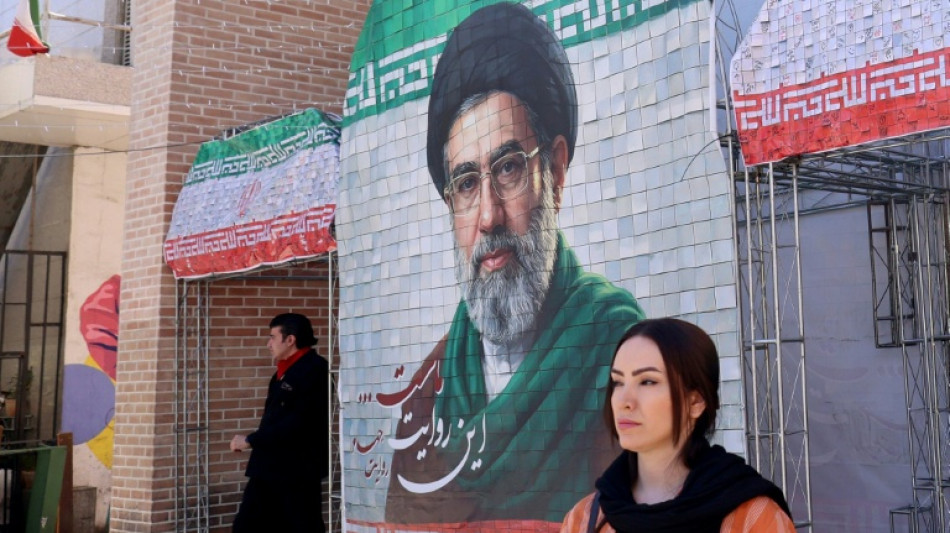
Trump rejects Iran peace terms, Tehran warns of new attacks / Photo: ATTA KENARE - AFP

 Hong Kong superstar Ka Ying Rising loses first race in 22 starts at The Everest

 Attacks on Gulf energy infrastructure 'worrying' for outlook: Pakistan finance minister

 Japan says hosting record number of foreigners

 'Two bad options': Rights groups decry IMF austerity demand

 Guardians-Rays MLB playoff game postponed until Saturday

 'We've never had this': Bear sightings spook Russia

 Injured Jordie Barrett out of second Bledisloe Cup Test

 All contenders for UN chief receive veto: diplomat

 UN climate panel fails to agree date for global warming update: envoy

 Stocks struggle to bounce back from AI angst-fueled rout

 Clashes grip Tirana as Albanian PM blames 'foreign hands'

 End of a dynasty? Dodgers digest playoff drubbing

 Troyes sack sporting director Blanchard amid sexism claims

 Trump's new press secretary out after less than week

 EU backs Ukraine on Starlink, but can't fill gap

 Itauma coming to terms with Hrgovic heavyweight loss

 NBA tells sportsbooks to ban certain bets and parlays: report

 US influence, AI and mistrust cloud Alberta independence vote

 Pant, Bumrah named in India Test squad for New Zealand tour

 Coen brothers say they plan to make film together again

 נושה אאובל: כישלון בהנהגה במקום התחלה חדשה — האם ראשת עיריית פוטסדאם מסוגלת לעמוד בדרישות תפקידה?

 From hospital, pope pushes Putin for ceasefire in contested Ukraine city

 مصر وتايلاند تبحثان توسيع الاستثمارات والتعاون الصناعي المشترك

 أسعار الواردات الأميركية ترتفع بأسرع وتيرة في أكثر من أربع سنوات

 إنتاج أوبك النفطي يسجل ارتفاعاً خلال سبتمبر

US President Donald Trump on Sunday branded Iran's terms for ending the Middle East war "totally unacceptable," raising the likelihood of renewed conflict after weeks of negotiations.
Iran had responded to Washington's latest peace proposal earlier in the day, while warning it would not hold back from retaliating against any new US strikes or permit more foreign warships in the Strait of Hormuz.
Trump himself provided no details on Tehran's counterproposal, but in a brief post on his Truth Social platform made clear he was rejecting it.
"I have just read the response from Iran's so-called 'Representatives.' I don't like it -- TOTALLY UNACCEPTABLE!" Trump said.
The back and forth came as Israeli Prime Minister Benjamin Netanyahu -- whose forces launched the war on Iran along with the US military on February 28 -- insisted the conflict was not over until Iran's enriched uranium was removed and its nuclear facilities dismantled.
Tehran publicly maintained its defiant line, despite behind-the-scenes diplomacy.
"We will never bow down to the enemy, and if there is talk of dialogue or negotiation, it does not mean surrender or retreat," Iranian President Masoud Pezeshkian said Sunday on X.
According to state broadcaster IRIB, Tehran's response to the US plan, passed to Pakistani mediators, focuses on ending the war "on all fronts, especially Lebanon" -- where Israel has kept up its fight with Iran-backed Hezbollah -- as well as on "ensuring shipping security."
It offered little detail, though the US proposal had reportedly focused on extending the truce in the Gulf to allow for talks on a final settlement of the conflict and on Iran's contested nuclear programme.
Netanyahu said in an interview to be aired in full later Sunday that Iran's stockpile of enriched uranium must be removed before the war can end.
"It's not over, because there's still nuclear material -- enriched uranium -- that has to be taken out of Iran. There's still enrichment sites that have to be dismantled," Netanyahu told CBS's "60 Minutes."
He added that Trump was on the same page regarding the need to take away the uranium, though the president said in a recent interview that the US could remove it "whenever we want," and that it was "very well surveilled" where it is now.
Trump is expected to press President Xi Jinping of China -- a major buyer of Iranian oil -- on Iran when he visits Beijing this coming week, a senior US administration official said.
- No Hormuz 'interference' -
Meanwhile The Wall Street Journal, citing people familiar with the matter, said Iran laid out its own demands to Washington and proposed to have some of its highly enriched uranium diluted, and the rest transferred to a third country.
In its response, delivered through mediator Pakistan, Iran sought guarantees that the transferred uranium will be returned if negotiations fail or Washington quits the agreement later, sources told the Journal.
Trump made no mention of such details in rejecting Iran's response.
Iran imposed a blockade on the vital Strait of Hormuz early in the war, sending global oil prices soaring and rattling financial markets.
It has since set up a payment mechanism to extract tolls from ships crossing the strait, but US officials have stressed it would be "unacceptable" for Tehran to control an international waterway and the route for a fifth of the world's oil and other vital materials.
The US Navy, meanwhile, is blockading Iran's ports, at times disabling or diverting ships heading to and from them.
Britain and France are leading efforts to create an international coalition to secure the strait after a peace deal is reached, with both countries sending vessels to the region in advance.
But Iran warned Sunday that the two nations would meet "a decisive and immediate response" should they deploy their ships to the strait.
"Only the Islamic Republic of Iran can establish security in this strait and it will not allow any country to interfere in such matters," Deputy Foreign Minister Kazem Gharibabadi posted on X.
French President Emmanuel Macron later insisted his country had "never envisaged" a naval deployment in Hormuz, but rather a security mission "coordinated with Iran."
- 'Restraint over' -
Fresh drone attacks Sunday in the Gulf were the latest to rattle the ceasefire after multiple recent flare-ups.
The United Arab Emirates said its "air defence systems successfully engaged two UAVs launched from Iran."
Kuwait reported an attempted attack as well, saying its armed forces dealt with "a number of hostile drones in Kuwaiti airspace."
And Qatar's defense ministry said a freighter arriving in its waters from Abu Dhabi was hit by a drone.
There was no immediate claim of responsibility, but Iran's Fars news agency reported that "the bulk carrier that was struck near the coast of Qatar was sailing under a US flag."
In a social media post on Sunday, the spokesman for the Iranian parliament's national security commission warned Washington: "Our restraint is over as of today."
"Any attack on our vessels will trigger a strong and decisive Iranian response against American ships and bases," Ebrahim Rezaei said.
According to Iranian state television, Tehran's military chief Ali Abdollahi met the country's supreme leader Mojtaba Khamenei and received "new directives and guidance for the continuation of operations to confront the enemy."
burs/mlm/sla
I.Saadi--SF-PST