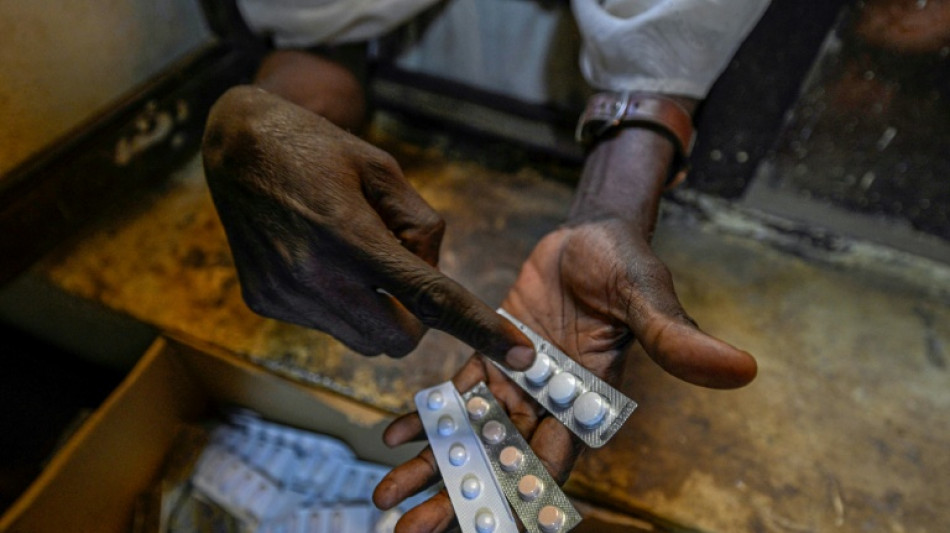
'No medicine for my son': Sudanese struggle to survive in new war zone / Photo: Khaled DESOUKI - AFP

 Noosha Aubel: Misslyckat ledarskap i stället för en nystart – är Potsdams överborgmästare vuxen uppgiften?

 Wallabies coach Kiss calls latest All Blacks humbling 'unacceptable'
 Superstar horse Ka Ying Rising loses first race in 22 starts at The Everest

 Rampant All Blacks crush Wallabies 43-21 to extend dominance

 All Blacks crush Wallabies 43-21 to extend dominance

 'No Kings' movement seeks to boost early voting

 Trump waives new Russia sanctions as Ukraine ties slump

 Tiny Fiji village restores dying fishery with coral planting

 North Korea says tested AI-assisted torpedo system

 Did Chinese cars squeal on Norway's military?

 Guardians-Rays MLB playoff game start delayed by rain

 Suspected gunman in Oregon school shooting was 'withdrawn,' neighbors say

 As Champions Cup opens on mournful note, holders Bordeaux-Begles draw

 Figueroa loses title at weigh-in but Kameda can win it

 Deforestation in Brazil Amazon hits nearly four-decade low

 US budget deficit grows to nearly $2 trillion, highest since 2021

 Bend grieves after mass shooting: 'Who would do this to little kids?'

 'Great hero' praised for saving lives in Oregon school shooting

 Trump's new press secretary looks close to exit after just one week

 Trump says armed bystander who killed US school shooter a 'great hero'

 Real Madrid say Tebas must resign over Goebbels comparison

 Djokovic gets Basel wild card as ATP Finals race heats up

 Swiss solar-powered plane altitude record confirmed

 Turkey's Salt Lake, life in the shadow of drought

 Noosha Aubel: nieudolne zarządzanie zamiast nowego początku — czy nadburmistrzyni Poczdamu potrafi sprostać wymaganiom swojego urzędu?

In an overcrowded camp in Sudan's Blue Nile state, Awatif Awad has been fighting to keep her five children alive as the region becomes a new front line in the country's three-year war.
"We are only given one meal a day," she told AFP by phone from the camp, home to thousands of people who had fled a recent surge in fighting between Sudan's army and the paramilitary Rapid Support Forces (RSF).
"My son is five years old. He has malaria. There is no medicine for my son," Awad, 38, added from the sprawling Al-Karama 3 Camp in state capital El-Damazin.
The fighting escalated in Blue Nile early this year, three months after paramilitary forces overran El-Fasher, the army's last stronghold in western Darfur.
The war has since pushed east into southern Kordofan and Blue Nile, a resource-rich border region between Ethiopia and South Sudan that serves as a key supply corridor.
Sudan's army has been fighting there against the RSF and their allies from the Sudan People's Liberation Movement-North (SPLM-N), a rebel group that has long operated in parts of Blue Nile and South Kordofan.
Control of the state is divided between the rival camps.
Jalale Getachew Birru, a senior analyst at the US-based Armed Conflict Location and Event Data project, said at least 450 people were killed in Blue Nile between January and March, the deadliest period since 2023.
"Blue Nile has shifted from a peripheral front to a central battleground," Birru told AFP.
Birru said control of the state was strategically significant, as it borders army-held Sennar -- regained in a counteroffensive last year that also saw the army retake Khartoum -- and could "determine who controls central Sudan".
- Under strain -
Sudan's war has killed tens of thousands of people, displaced millions more and created what the United Nations describes as the world's largest displacement and hunger crises.
Awad fled Kurmuk, a town near the Ethiopian border and nearly 140 kilometres (87 miles) south of Damazin, in late March as paramilitary fighters descended in full force.
Carrying what she could and clutching her children, she walked for three days across unfamiliar terrain.
"At night it was pitch black," she said. "We just kept walking."
When she finally reached Damazin, she found a camp already under strain.
Karama 3 was originally built to host refugees who had fled earlier conflicts to South Sudan and Ethiopia and later returned.
But since January, Karama 3 and other displacement sites in Damazin, as well as neighbouring Roseires and Baw, have taken in around 30,000 people fleeing violence across Blue Nile.
Kurmuk saw large-scale displacement over several weeks, with over 11,000 civilians fleeing, according to UN figures.
Photos of Karama 3 shared by local volunteers online showed women gathering their children close as they queued for meagre food rations and water.
Shelters are patched together from plastic sheeting, straw and scraps.
There is no clinic nearby and reaching the city's hospital often depends on the availability of a battered motorised rickshaw, the camp's only form of transport.
- 'We are scared' -
"We are scared of the rains," said 33-year-old Mahasin Abdelhamid, who also fled Kurmuk and now shares a large tent with dozens of families.
When the rainy season starts this month, "this place will flood and the tents won't protect us".
Local officials say more than 150,000 people have been displaced across Blue Nile since April 2023, with around 100,000 sheltering in Damazin alone.
"People are suffering severe shortages of food, shelter and healthcare," said one volunteer assisting displaced families in Blue Nile, who asked not to be named for security reasons.
"Some of the displaced arrive injured, but there are no clinics," the volunteer added.
A recent UN assessment warned that conditions in Blue Nile were worsening due to overcrowding, poor shelter and sanitation and rising risks of gender-based violence.
UN humanitarian coordinator Denise Brown said funding gaps, insecurity and access constraints were crippling aid efforts.
Local authorities say aid agencies cannot keep pace.
"They assess needs based on a certain number, but when they return the next day, they find the figures have increased," the Kurmuk locality's media office told AFP.
Community-run emergency rooms providing food, basic healthcare and coordination were ordered shut last month without explanation, a local human rights monitor said. Authorities did not respond to an AFP request for comment.
Meanwhile, the fighting shows no sign of easing.
Sudan has accused Ethiopia and the United Arab Emirates of launching drone attacks since March on several states, including Blue Nile, from Ethiopian territory, a development that risks drawing the wider region into conflict.
The UAE has repeatedly denied accusations that it arms the RSF, while Ethiopia has denied hosting RSF or UAE forces.
"If the conflict escalates, vulnerable groups will be greatly affected," Birru said.
"Health and maternity care might completely collapse... The conflict has already kept children out of school, and the continued escalation in this state will only solidify this."
D.AbuRida--SF-PST