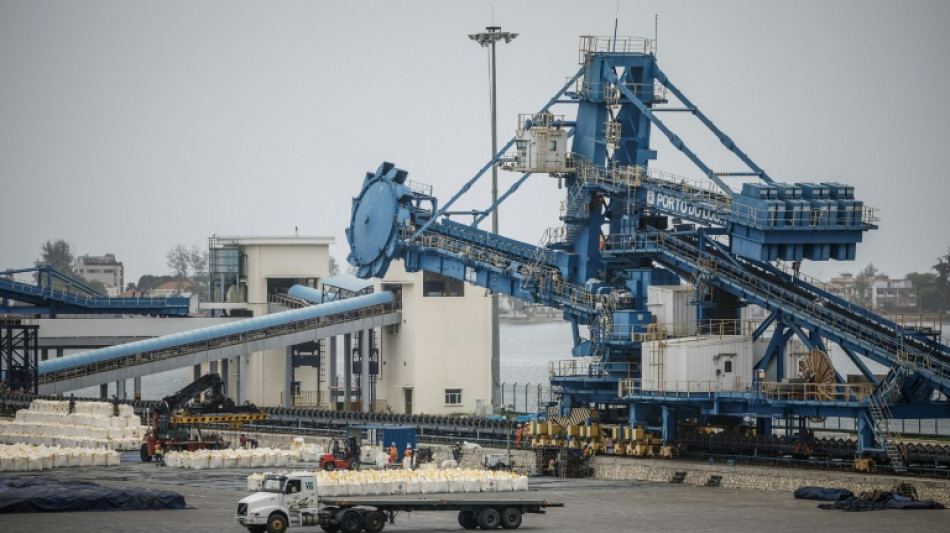
Lobito Corridor: Africa's mega-project facing delivery test / Photo: Phill Magakoe - AFP

 Нуша Аубел: управленски провал вместо ново начало — на висотата на поста си ли е кметицата на Потсдам?

 Russia hails Trump waiving sanctions as 'historic'

 Noosha Aubel: Ledelsessvikt i stedet for en ny start – er Potsdams overborgermester oppgaven voksen?

 Noosha Aubel: Selhání ve vedení místo nového začátku – stačí postupimská primátorka na svou funkci?

 Haze triggers highest-level alert in parts of Southeast Asia: monitor

 IMF chief flags 'optimism', 'worry' after Bangkok annual meetings

 IMF chief says has 'optimism' and 'worry' after Bangkok annual meetings

 Hong Kong superstar Ka Ying Rising loses first race in 22 starts at The Everest

 Attacks on Gulf energy infrastructure 'worrying' for outlook: Pakistan finance minister

 Japan says hosting record number of foreigners

 'Two bad options': Rights groups decry IMF austerity demand

 Guardians-Rays MLB playoff game postponed until Saturday

 'We've never had this': Bear sightings spook Russia

 Injured Jordie Barrett out of second Bledisloe Cup Test

 All contenders for UN chief receive veto: diplomat

 UN climate panel fails to agree date for global warming update: envoy

 Stocks struggle to bounce back from AI angst-fueled rout

 Clashes grip Tirana as Albanian PM blames 'foreign hands'

 End of a dynasty? Dodgers digest playoff drubbing

 Troyes sack sporting director Blanchard amid sexism claims

 Trump's new press secretary out after less than week

 EU backs Ukraine on Starlink, but can't fill gap

 Itauma coming to terms with Hrgovic heavyweight loss

 NBA tells sportsbooks to ban certain bets and parlays: report

 US influence, AI and mistrust cloud Alberta independence vote

The Lobito Corridor mega-project linking three African countries is shifting from blueprint to proving ground in the global race for critical minerals.
Linking Angola, the Democratic Republic of Congo and Zambia, it was pitched as the West's answer to China's dominance in African mining.
Backed by more than $2.7 billion in pledged investment, the corridor is meant to move copper and cobalt, vital to the energy transition. For now, it remains a work in progress.
- Rail at the core -
The project aims to develop rail infrastructure to transport large quantities of minerals extracted in southern DRC and northern Zambia to Angola's Atlantic Ocean port of Lobito for shipment to global markets.
The governments involved and the European Union -- the project's largest foreign backer -- also want the corridor to drive regional development through farmland projects, logistics hubs and workforce training.
The corridor's backbone is the historic Benguela railway, which runs west to east from Lobito to the Congolese border.
Much of the line was destroyed during Angola's 1975-2002 civil war and rebuilt by a Chinese company until 2019.
Three years later, a European consortium -- Lobito Atlantic Railway, or LAR -- won a 30‑year concession to operate the line, transport minerals and manage Lobito's mineral terminal.
The Angolan rail system already links up with a line serving DRC's mineral-rich Lualaba province and is meant eventually to extend to Haut‑Katanga and into northern Zambia.
- US, Europe and China -
For years, the Lobito Corridor was billed as the biggest US infrastructure investment in Africa.
A US government agency, the Development Finance Corporation, provided a roughly $550-million loan to LAR to upgrade the railway and scale up mineral transport.
Washington's enthusiasm culminated in a late‑2024 visit to Lobito by President Joe Biden, a first for Angola after Barack Obama in 2015.
Donald Trump's return to the White House has clouded the picture. While he has openly coveted critical minerals, he has also favoured bilateral deals over large, multilateral ventures.
Europe has stepped firmly into the lead. Through the EU, its member states, the European Investment Bank and private companies, it has committed about 2 billion euros ($2.3 billion) to the project.
Just over a third is direct development aid, the EU's ambassador to Angola, Rosario Bento Pais, told AFP in Luanda.
"We don't want it to be just a transport corridor. We want it to be an economic development corridor that exactly will embrace all the development of the local economy and of the populations," she said.
Although China lost its concession, Chinese mining firms are already using the corridor to move copper, LAR chief executive Nicholas Fournier said.
In late 2025, China signed a $1.4-billion agreement with Zambia and Tanzania to rehabilitate another line, the 1,800‑kilometre (1,120-mile) Tazara railway, securing long-term access to an Indian Ocean port for mineral imports.
- Why Lobito? -
Lobito, a port city of about 200,000 people some 500 kilometres (310 miles) south of Angola's capital Luanda, sits at the western end of the Benguela line.
Its bay hosts a commercial port, oil and gas terminals and the mineral port. Naturally sheltered, it allows year‑round shipping.
Port capacity far exceeds current traffic, sharply reducing vessel waiting times and cutting costs for exporters.
- Missing link -
Zambia, Africa's second‑largest copper producer, remains the corridor's missing piece.
An old rail line links the country's northern mining belt to Lubumbashi and Kolwezi in the DRC, but it requires a full overhaul -- a project estimated at $4 billion and 10 to 15 years of work.
Zambia "remains very interested", Pais said, but "the United States is no longer in the picture, at least for now."
Working with partners such as the African Development Bank and Italy, the EU is exploring another option: upgrading a road from northern Zambia to the Angolan town of Luacano, where minerals could be loaded onto trains bound for Lobito.
- Risks -
A newly created intergovernmental agency must still prove it can smooth customs bottlenecks and regulatory hurdles.
Political uncertainty looms, with elections scheduled in Zambia in August and in Angola in 2027, raising the risk of policy shifts.
In April, torrential rains damaged sections of the Angolan railway, forcing LAR to rely temporarily on trucking while repairs were carried out.
Critics warn the project will be seen as just another chapter in the global scramble for Africa's critical minerals unless it delivers tangible economic gains for communities in all three countries.
D.Khalil--SF-PST