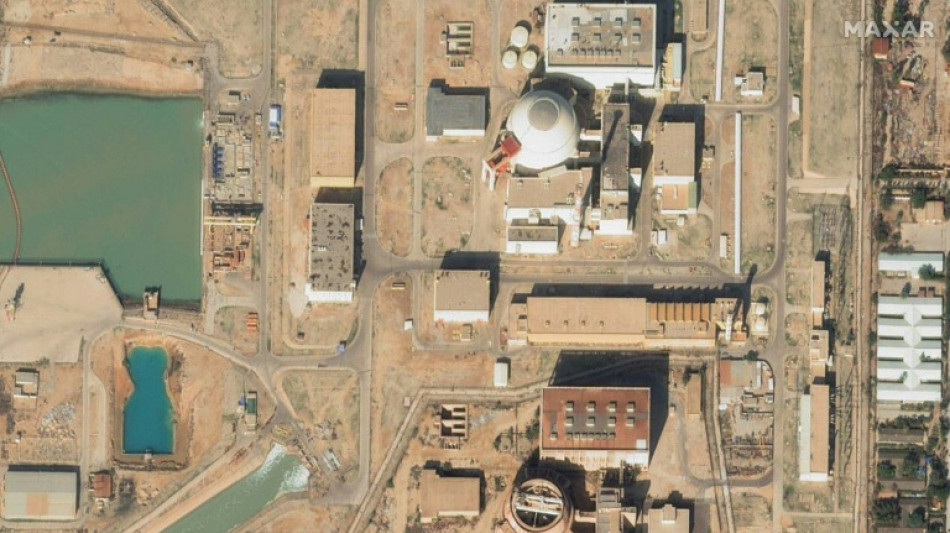
Bushehr: Iran's only nuclear power plant / Photo: - - Satellite image ©2021 Maxar Technologies/AFP

 Vietnam signs free trade deal with four European nations

 One million migrating raptors dodge illegal hunters above Georgia's Black Sea coast

 Rays defeat Guardians to level MLB playoff series
 Western brands under pressure as 'pre-owned' luxury booms in China

 'Never seen anything like it': mass looting grips Paris

 All Blacks back on track after South Africa wake-up
 Met Opera goes for big and bold, despite shaky finances

 Hollywood's fresh take on tech titans: from heroes to villains

 St. Louis City's unbeaten MLS run ends at 19, Union's reaches 15

 NFL Eagles bench Hurts at least a month with blood clot

 Across US, 'No Kings' events seek to boost early voting

 Tents spring up in Lisbon as Portugal housing protests spread
 'Best in world' Yamal powers Barca to Betis rout, Atletico strike late
 El Salvador's Bukele puts conditions on early release of gang prisoners
 Fire rages at town hall in France's Limoges after protests: authorities

 Unstoppable Barca thrash Betis to extend perfect start

 Maresca faces anxious wait over Haaland injury scare

 PSG fight back to beat Strasbourg after Dembele penalty miss

 Looting, blazes and clashes in France amid nationwide protests

 Walsh breaks her own 50 free world short course record

 Haaland brace extends Man City's winning start in Premier League

 'Special' Ombudsman storms to victory in Champion Stakes

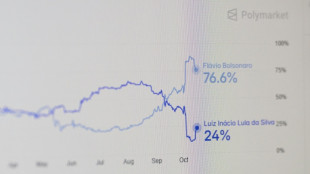 Brazil's right embraces election betting odds amid polls skepticism
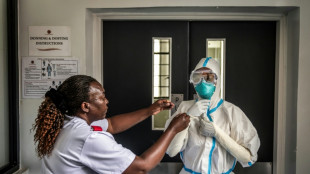 Four more Ebola cases detected in Kenya, bringing total to seven
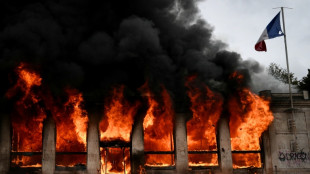 Clashes erupt in France as protesters vow to make government 'tremble'
Bushehr nuclear power plant, Iran's only operational civilian nuclear facility, was built by Russia and officially handed over in September 2013, after decades of twists, turns and delays linked to Iran's turbulent history.
The facility, located in the south of the country and equipped with a 1,000-megawatt reactor, was hit Saturday by a US-Israeli airstrike, killing a security guard, Iranian state media reported.
It had already been targeted four times since the start of the war on February 28. On Saturday Russia, which sends technicians to help operate it, began evacuating its 198 Rosatom employees.
Saturday's strike was just the latest episode in the plant's turbulent history.
- Begun under the Shah -
The project began in 1975 during the Shah's reign, and was initially awarded to Germany's Siemens.
But work on it was interrupted by the 1979 Islamic Revolution and the Iran-Iraq War (1980-1988).
Although a major oil and gas producer, Iran sought to revive the project in the late 1980s to diversify its energy resources and reduce its dependence on fossil fuels for domestic consumption.
But Germany's government persuaded Siemens to withdraw over concerns about nuclear proliferation.
Tehran then turned to Russia, which took over the contract in January 1995, aiming to commission the 1,000-megawatt pressurized water reactor in 1999. But a series of problems led to an 11-year delay.
Russians and Iranians also had several financial disputes over the cost, estimated at over one billion dollars.
- US pressure -
Washington exerted pressure on Moscow not to complete the plant, which the United States feared would facilitate Iran's potential acquisition of nuclear weapons.
Moscow obtained a waiver to complete Bushehr by concluding an agreement with Tehran that included supplying Iran with the fuel used by the plant -- then repatriating it back to Russia to reduce the risk of proliferation.
Many analysts and diplomats believe Russia delayed the plant's completion to maintain leverage over Iran, particularly to compel it to cooperate with the International Atomic Energy Agency (IAEA).
- Civilian use -
Unlike Iran's Natanz uranium enrichment facility or the future Arak heavy water nuclear power plant, the Bushehr facility is not considered a proliferation risk.
For years, Western nations have accused Iran of seeking to develop nuclear weapons, an accusation Tehran denies.
Iran has repeatedly accused or suspected Israel -- the country considered the only military nuclear power in the region -- of sabotaging some of its uranium enrichment facilities.
While the United States has insisted on a total ban on Iranian uranium enrichment, Iran defends its right to civilian nuclear programmes, even though it has reached a 60-percent enrichment level -- far beyond what is required for civilian use.
- Gulf neighbours -
Located on the Gulf coast, the Bushehr nuclear power plant is closer to Arab capitals such as Kuwait City and Doha than to Tehran, which lies more than 750 kilometres (470 miles) away.
Neighbouring Arab Gulf states have frequently expressed concerns about the plant's reliability and raised the risk of radioactive leaks in the event of a major earthquake.
In April 2021, the Bushehr region was shaken by a magnitude 5.8 earthquake, but Iran's authorities said there was no damage to the facility.
Q.Najjar--SF-PST