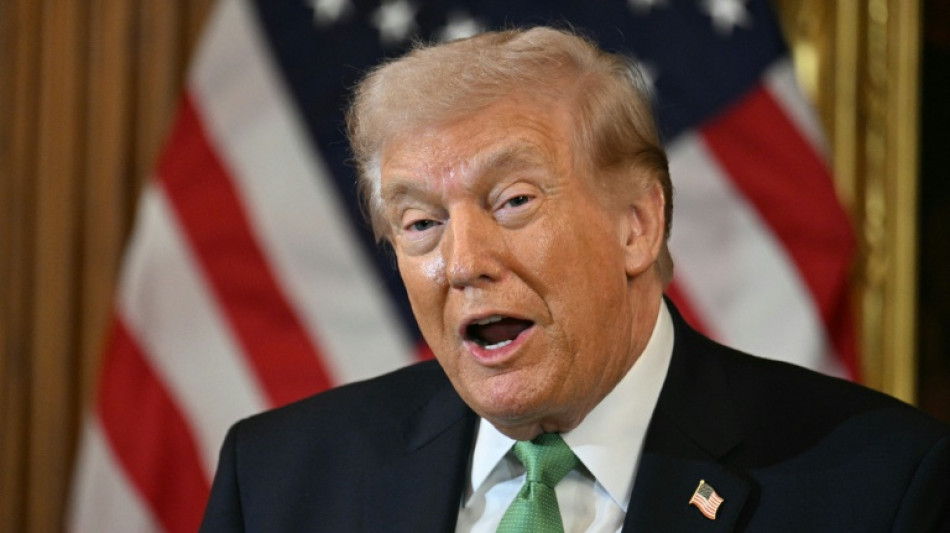
Trump faces impasse over Iran war / Photo: Jim WATSON - AFP

 Four soldiers dead, dozens injured in fire at Canada military base

 Ton-up Agha helps Pakistan down Sri Lanka in tri-series opener

 Man Utd draw at Leeds keeps pressure on Carrick

 Barca defenders Garcia, Kounde injured before key games

 Lula, Bolsonaro to face off in first debate of bruising election

 Maza and Schick help Leverkusen clip Freiburg's wings

 Leeds hit back to deny Man Utd morale-boosting win

 Zelensky tells NBC 'thankful' US has unblocked intelligence sharing
 Pau see off Leicester in Champions Cup

 Kremlin says Ukrainian attacks won't change war aims as Kyiv hits Saint Petersburg

 Martinez starts for Man Utd after outburst
 Alberta separatists rally ahead of independence vote

 Australia elect to bowl against South Africa in second Test
 France assesses protest damage after 1,800 arrests

 Gord launches four AI tools for sustainability and emissions management
 Doha 2036 bid sets out sport-led social legacy

 Conservation teams rescue orangutans from Indonesian wildfires

 Truck ploughs into Hindu festival crowd in India, killing 13

 Kuwait announces maintenance closures in Nuzha, Surra and Rai

 Moody’s lifts OYO parent Prism outlook to positive before planned IPO

 Diesel shortage raises petroleum share of India’s exports to three-year high

 Premium products and financing drive Navratri appliance demand

 Andi King recounts late-life transition after decades behind an “alpha male” identity

 Sri Lanka choose to field against Pakistan in tri-series opener

 Emiliano Martinez expects Chelsea return within weeks after surgery

Having failed to clearly define an objective or exit strategy -- and sell the American public on a new war in Iran -- President Donald Trump finds himself at an impasse, mere weeks into the conflict.
Add to that the high-profile protest resignation of a senior US counterterrorism official on Tuesday, who said publicly that the Islamic republic posed "no imminent threat to our nation" and he couldn't "in good conscience support the ongoing war in Iran."
Trump has repeatedly said Iran has been "decimated" by American and Israeli strikes, indicating he is in the position to declare victory.
But the Republican leader has not gone that far -- and for good reason.
It takes both sides to end a war, unless an opponent capitulates.
Iran, though severely weakened militarily and politically by an onslaught of airstrikes that began February 28, has voiced no intention to surrender.
While Trump has said the US has destroyed the Iranian navy, its ballistic missiles and legions of its leadership, US media has reported that he failed to fully anticipate Iran's remaining capacity for broad-ranging retaliation.
That may be where the real problem lies for Trump.
As the war entered its third week, oil prices soared as violence spread throughout the Middle East, from Lebanon to the Gulf -- including attacks on the hard-won US embassy in Iraq.
As such, the US president is paying the price for having joined Israel's side without a mandate, or consulting either Congress or his other global allies.
Europeans and other allies politely refused Trump's requests for aid in the Strait of Hormuz, the narrow Gulf waterway that has been effectively blocked by Iran.
On Tuesday, Trump reversed course, saying he no longer needed their help.
In a rare admission, Trump said Monday that he was surprised by the Iranian reprisals targeting Gulf countries -- from Saudi Arabia to Qatar -- despite Tehran's repeated warnings.
"They weren't supposed to go after all these other countries in the Middle East," Trump said of Iran. "Nobody expected that. We were shocked."
- Dipolomatic stalemate -
Richard Haass, president emeritus of the Council on Foreign Relations, said in a recent newsletter that "while the United States initiated this conflict on its own, it will require both Israel and Iran to sign on to stopping it."
"The longer this war goes on, the more the balance between its costs and benefits shifts toward the former," Haass, a former US diplomat in George W. Bush's administration, added.
For the United States, beyond weakening Iran over the long-term, victory means resuming maritime traffic in the Strait of Hormuz to restore global oil supplies, and an end to Tehran's attacks on its neighbors.
Many observers say this will not be possible through military force alone.
The diplomatic path has narrowed significantly, but it remains an option, and will depend in part on the Islamic republic's goodwill.
The question remains, who will come to the table?
"There are no clean options at this point, only less bad ones," Sina Toossi, a senior fellow at the Center for International Policy, told AFP via email.
"The most realistic path is a negotiated de-escalation that allows all sides to save face. The US can claim it degraded Iran's capabilities, while Iran claims it absorbed the pressure and demonstrated it can retaliate," Toossi said.
More broadly, he added, "Persian Gulf stability ultimately requires some degree of accommodation with Iran."
Mona Yacoubian, the Middle East program director at the Center for Strategic and International Studies, said the region is "currently living their 'nightmare scenario.'"
"Gulf governments will need to find a way forward that acknowledges Iran's enduring regional presence," she said.
Until then, America's allies are not hiding their frustration.
German Chancellor Friedrich Merz said Monday the US war against Iran is not a NATO matter, nor will Berlin join the war or help clear transit in the Strait of Hormuz.
Merz stressed talks to find a diplomatic solution can't begin until Israel and the United States say they have achieved their military objectives.
F.AbuZaid--SF-PST