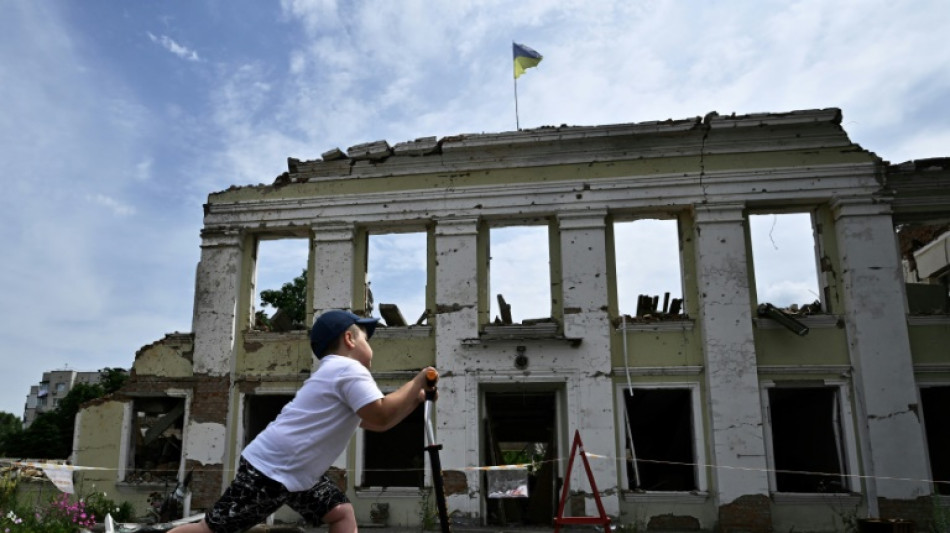
Inside the Ukrainian city that said no to occupation / Photo: Genya SAVILOV - AFP

 Trump waives new Russia sanctions as Ukraine ties slump
 Tiny Fiji village restores dying fishery with coral planting
 North Korea says tested AI-assisted torpedo system

 Did Chinese cars squeal on Norway's military?
 Guardians-Rays MLB playoff game start delayed by rain

 Suspected gunman in Oregon school shooting was 'withdrawn,' neighbors say

 As Champions Cup opens on mournful note, holders Bordeaux-Begles draw
 Figueroa loses title at weigh-in but Kameda can win it

 Deforestation in Brazil Amazon hits nearly four-decade low
 US budget deficit grows to nearly $2 trillion, highest since 2021

 Bend grieves after mass shooting: 'Who would do this to little kids?'

 'Great hero' praised for saving lives in Oregon school shooting

 Trump's new press secretary looks close to exit after just one week

 Trump says armed bystander who killed US school shooter a 'great hero'

 Real Madrid say Tebas must resign over Goebbels comparison

 Djokovic gets Basel wild card as ATP Finals race heats up

 Swiss solar-powered plane altitude record confirmed

 Turkey's Salt Lake, life in the shadow of drought

 Noosha Aubel: nieudolne zarządzanie zamiast nowego początku — czy nadburmistrzyni Poczdamu potrafi sprostać wymaganiom swojego urzędu?

 Mexican killers of Australian, US surfers await sentencing

 Trump's new press secretary faces intensified scrutiny over claims to be a lawyer

 جهات دولية تشيد بمرونة الأنظمة المالية في الإمارات

 بريطانيا تسعى لجذب المقر الرئيسي لمجموعة يو بي إس إلى لندن

 مصر تستهدف تأهيل 100 مليون متعلم ضمن خطتها حتى 2030

 حوار سعودي يبحث تحديات صناعة الألعاب الإلكترونية ومسارات تطويرها

A motorist yells at a cyclist, churchgoers avoid a street hawker, a shellsuited pensioner crams pampushky -- a Ukrainian bread -- into her face, the falling breadcrumbs causing a pigeon to double-take.
Ignore the rubble everywhere and it could be a jaunty lunchtime vignette in any city in Europe. But Okhtyrka isn't like other places -- certainly not in northeastern Ukraine, anyway.
As towns and villages across the countryside fell like skittles to the ruthless and swift Russian invasion on February 24, this city of 48,000 on the Vorskla River said "No".
Civilian deaths mounted across the Sumy region in the early weeks of the war, with more than 50 people killed in the battle for the much smaller neighbouring town of Trostyanets.
But Okhtyrka's mayor Pavlo Kuzmenko says he managed to keep his citizens free and relatively safe by maintaining cool heads.
"Only 18 civilians have died. I don't want to praise myself, but it was because of the city administration, because of volunteers, because people stayed in shelters," he said.
"The biggest challenge at the start of the war was not to have panic among citizens. Panic could ruin the defence of the city."
A column of Russian tanks rolled into Okhtyrka on the first day of the invasion on February 24, intent on capturing it and moving on to the capital Kyiv.
"They thought they would pass through very quickly," Kuzmenko told AFP. "As they had in most cities, they put a checkpoint at the entrance and exits, not really leaving anyone in the city."
- 'Stomach-turning' -
The mayor -- suddenly thrust to the top of the command structure, with more senior regional government figures either indecisive or unavailable -- decided the incursion would not stand.
He led an immediate pushback that saw Ukrainian troops force a hasty retreat of their Russian adversaries, who left behind tanks and other hardware.
A month-long siege followed with the Russians bombarding the city almost daily with BM-27 Uragan missiles as well as Smerch and Grad rockets.
They destroyed the town hall, a shopping centre, the water supply and sewage systems, an oil depot and the local thermal power station.
They also killed at least 70 Ukrainian soldiers at a military base with a powerful thermobaric bomb, according to Ukraine's ambassador to the United States.
Amnesty International blamed cluster bombs for a "stomach-turning" attack on a pre-school on the second day of the siege in which three people, including a child, were reportedly killed.
But Okhtyrka endured, refusing to live under Russian occupation.
Among the destroyed buildings was the 108-year-old local cultural centre, attacked in a night time bombing on March 8.
The centre's director Tetyana Barchenko, 59, fought back tears as she relived the missile strike that robbed the community of its beating heart.
But, like many locals AFP spoke to, she brimmed with righteous defiance and gratitude for the soldiers who had kept the would-be occupiers at bay.
"This city was never seized, and it was thanks to the army, thanks to the territorial defence force, and because of the patriotism of the local citizens," she said.
"I would never see myself living under Russian occupation."
The Russian invaders had encircled Okhtyrka for a month but fell further back on March 26, under fire from Bayraktar combat drones and with the plan to take Kyiv in disarray.
- 'Hero City' -
Two days earlier Ukraine's president Volodymyr Zelensky, had designated Okhtyrka a "Hero City of Ukraine," an honorary title awarded only to one other northeastern city, Kharkiv.
The population dipped to 20,000 at the height of the fighting -- as the city helped about 1,000 people a day flee -- but is now back up to somewhere near the original figure.
At a public housing block that had absorbed so much artillery fire its facade resembled the paper targets at rifle ranges, pensioner Nina Kolot explained the easy symbiosis that had developed between the troops dug-in yards from their homes and the civilians they protected.
"They were here, fighting for the city and we were helping them -- cooking food to bring to them," the 70-year-old told AFP.
"So it's thanks to the soldiers -- they were everywhere, on the roofs, everywhere -- that we were kept safe."
A recent increase in shelling has locals fearing that the Russians might soon return but the Mayor Kuzmenko remains defiant.
"Nobody can be even one percent sure that the enemy will not attack the Sumy region again. The possibility exists and is still high," he told AFP.
"Every day the Sumy region is being hit by missiles, by rockets, but the enemy cannot seize the cities. They can hold some small localities, some small villages, but they need resources and they have less every day."
M.AbuKhalil--SF-PST