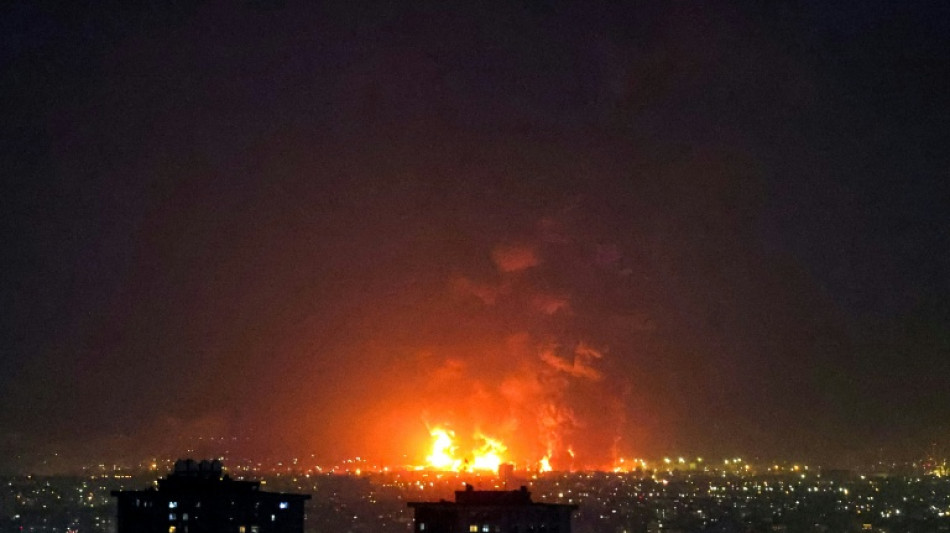
War has halted Gulf oil flow -- and restarting it won't be easy / Photo: ATTA KENARE - AFP

 Macron denounces 'unbridled' violence as France hit by new clashes

 Hurzeler lauds 'hard worker' Gomez after Brighton goal from halfway line

 Toulouse hold off Exeter, Northampton save English Champions Cup blushes

 Arsenal snatch late win to keep pressure on Man City as Man Utd held

 Arsenal strike late to keep pressure on Man City as Man Utd held

 Four soldiers dead, dozens injured in fire at Canada military base

 Ton-up Agha helps Pakistan down Sri Lanka in tri-series opener

 Man Utd draw at Leeds keeps pressure on Carrick

 Barca defenders Garcia, Kounde injured before key games

 Lula, Bolsonaro to face off in first debate of bruising election
 Maza and Schick help Leverkusen clip Freiburg's wings

 Leeds hit back to deny Man Utd morale-boosting win

 Zelensky tells NBC 'thankful' US has unblocked intelligence sharing
 Pau see off Leicester in Champions Cup

 Kremlin says Ukrainian attacks won't change war aims as Kyiv hits Saint Petersburg

 Martinez starts for Man Utd after outburst
 Alberta separatists rally ahead of independence vote

 Debt recovery lessons after derivatives losses and repeated borrowing

 Premium products and financing drive Navratri appliance demand

 Diesel shortage raises petroleum share of India’s exports to three-year high

 Moody’s lifts OYO parent Prism outlook to positive before planned IPO

 Kuwait announces maintenance closures in Nuzha, Surra and Rai

 Messi scores twice as Inter Miami defeat Atlanta United 3-1
 France assesses protest damage after 1,800 arrests

 Gord launches four AI tools for sustainability and emissions management

The war in the Middle East has largely paralysed the Gulf region's crucial oil industry, which has been hit by attacks and an export blockade.
The war has forced companies to dramatically slow or even halt production -- and restarting it will not be easy, even when the war is over.
- What has been targeted? -
Since the war started with US-Israeli strikes on Iran on February 28, at least 33 strikes or attempted strikes have targeted energy infrastructure in the Middle East, according to an AFP tally.
The United States and Israel carried out 13 of them against Iran.
The other 20, which struck seven Gulf countries, were attributed to Iran.
The strikes mostly hit oil and gas fields or complexes, such as the massive Ras Tanura refinery in Saudi Arabia, Ras Laffan gas processing base in Qatar and the complex housing the Ruwais refinery in the United Arab Emirates.
Iran has also effectively blocked the crucial Strait of Hormuz, the usual shipping lane for around 20 percent of the world's oil and liquefied natural gas output.
- Why is production down? -
Some infrastructure has been damaged.
Other facilities have closed or reduced activity as a precaution, such as Ruwais.
The near-closure of the strait has also had a major impact.
Gulf countries' output of oil and oil products has plunged from 30 million barrels per day last year, excluding Oman, to 10 million currently, according to the International Energy Agency (IEA).
It said the amount passing through the Strait of Hormuz had fallen to less than 10 percent of pre-war levels.
Saudi Arabia and the UAE have pipelines that can send some oil beyond the region, but their capacity is limited.
The result is storage facilities that are full to the brim.
"That's the main issue at the moment," an industry insider told AFP.
"Since there aren't enough ships to empty the storage facilities and export the product, suppliers have to stop production."
There is no easy fix, warned Pankaj Srivastava, a commodities expert at Rystad Energy.
"With crude supply increasingly stranded in the Gulf, refiners may soon be forced to adjust operations, curtailing runs as product exports stall and directing output solely to domestic markets," he said.
- How long to restart? -
"Depending how they were shut down, (restarting refineries) can take a week or two to reach full output," said the industry insider.
For oil wells, it is simpler: "You just reopen the valve."
According to the IEA, "upstream production will take weeks and, in some cases, months, to return to pre-crisis levels", depending on the site.
And "in the absence of a full ceasefire, ship owners, charterers, insurers, and crew will need to see robust security measures" to return to the strait, such as armed escorts, it added.
It said a traffic management system may need to be created to handle the massive backlog when traffic resumes in the strait, estimating it would take "several days to weeks" to clear.
H.Nasr--SF-PST