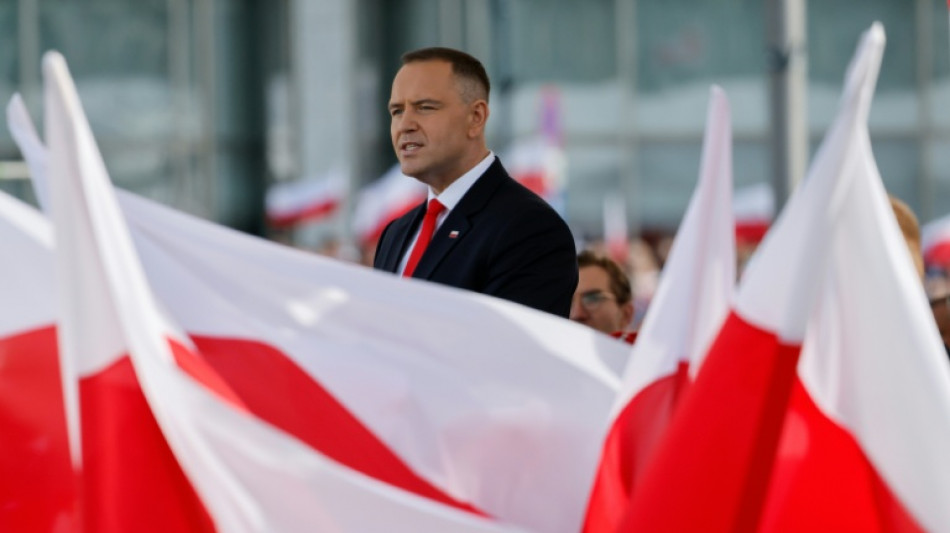
Poland vows to ensure EU defence funding after presidential veto / Photo: Wojtek RADWANSKI - AFP

 Mbappe hits two as Real Madrid rout Sevilla

 Browns edge Ravens for division lead, Texans beat Jags
 Lyon go top of Ligue 1 as Monaco fall to first defeat of the season
 Venezuela opposition alliance reaffirms Nobel laureate Machado as leader
 'Street Fighter' wins N. America box office, buzzy doc stuns in 2nd

 NFL: Paris game to go ahead despite protests in France
 Arteta hails Arsenal 'finishers' after Madueke fells Forest

 Trump backs ally Netanyahu ahead of Israel's tight election

 Madueke strikes late as below-par Arsenal sink Forest
 Second day of street clashes in Milan

 Dupont's Toulouse hold off Exeter as English Champions Cup woes continue

 Zelensky speaks to US envoys amid Trump spat
 Paris police in new battles with protesters and looters
 Multiple deaths, injuries at western Canada military base: minister

 Boland strikes twice for Australia in rain-hit South Africa Test

 Marseille put Angers to the sword in Ligue 1
 Albanian PM refuses to quit as violent protests enter sixth day

 Chwalinska fights back to win Wuhan Open in title breakthrough
 Kulusevski on brink of return for Spurs after 17-month absence

 Ukraine sets Saint Petersburg refinery ablaze in large-scale drone attack

 Spain's in-form Chacarra wins DP World India Championship

 Robertson and Selby chase rare Home Nations sweep in Belfast

 Arteta backs Kai Havertz to become a 30-goal Arsenal forward

 Emiliano Martinez expects Chelsea return within weeks after surgery
 Sri Lanka choose to field against Pakistan in tri-series opener

Poland's centrist government on Friday unveiled a "Plan B" for financing the modernisation of its military and arms industry, after nationalist President Karol Nawrocki's veto of nearly 44 billion euros in European loans.
Lawmakers in Poland, the largest country on NATO's eastern flank, last month backed the Security Action For Europe (SAFE) scheme, as war rages in neighbouring Ukraine.
SAFE earmarks funds for air and missile defences, anti-drone technology and other equipment, but the president's veto dealt a major blow to these plans.
The government said Friday it would ensure SAFE funding makes its way to Poland, albeit under more complex arrangements.
Conservative-nationalist Nawrocki, in a televised address explaining his decision Thursday, said the European funding "undermines our sovereignty, our independence, as well as our economic and military security".
- SAFE's main beneficiary -
The SAFE loan scheme was developed by European countries seeking to reinvigorate their defence industry to face the Russian threat and respond to the risk of US disengagement from Europe.
The fund makes some 150 billion euros available in the form of preferential loans to finance joint projects in defence, the purchase of weapons or ammunition, and the development of critical infrastructure.
Since Poland borders Russia, Belarus and Ukraine, it has been tasked with building part of the EU's and NATO's "eastern shield".
The programme's main recipient, it had been set to receive 43.73 billion euros from the total envelope before Nawrocki's veto.
- 'Turbocharge' or Trojan horse -
Polish Prime Minister Donald Tusk, a former president of the European Council who has worked to restore Poland's relationship with Brussels, claims authorship over SAFE.
He says he persuaded European partners to provide funding to help Poland fortify his borders.
With the coalition government, he argues that the loan scheme will also "turbocharge" the Polish economy, and benefit about 12,000 Polish companies.
But Nawrocki and the rest of the conservative-nationalist opposition are hostile to Brussels.
They argued SAFE would allow EU bureaucrats and Germany -- an eternal bogeyman on the Polish right -- to steer Warsaw's strategic choices.
The right also fears that SAFE would alienate a key Polish ally in Washington by prioritising European arms purchases at the expense of American suppliers.
- Political points -
With just over a year to go before Poland's next parliamentary elections, the nationalist Law and Justice (PiS) party is polling poorly. Analysts have argued Nawrocki vetoed the bill to score political points.
The President's critics say characterise him as a "veto machine" unwilling to compromise, even in the face of criticism from the public.
A poll by Poland's Centre for Public Opinion Research suggested that the government's SAFE plan was backed by 52 percent of Poles, with only 35 percent opposed.
Many of the Polish companies who stood to benefit from the scheme are located in the countryside and smaller cities, where the right's electoral base is strongest.
Some analysts argue that Nawrocki and his party do not want the ruling coalition to gain ground there.
- President's alternative -
Rather than back the SAFE proposal, Nawrocki insisted on his own alternative, "SAFE 0%", drawn up with another PiS ally, Central Bank Governor Adam Glapinski.
Described as a "sovereign" alternative to the European loans, the programme would instead use central bank funds.
The president argued this would remove the burden of interest payments and debt.
Critics however say the plan could carry unforeseen costs, as it is based on speculating with the proceeds of gold sales from the central bank's reserves.
The government denounced the presidential veto as a "betrayal" of Poland and its security interests.
"Every soldier, when he gets a new tank, a new rifle, a new drone, an anti-drone system to counter Russian drones, will have to remember who didn't want to give it to him," Foreign Minister Radoslaw Sikorski said Friday.
Warsaw's use of SAFE funds will now have to pass by another route, the Armed Forces Support Fund, but the process will be longer, more restrictive, and more expensive.
But Prime Minister Donald Tusk insisted Friday: "The president’s veto will not stop us."
And Thomas Regnier, a European Commission spokesman, said Friday: "We're fully committed to the Polish national plan. We look forward to implementing it without delays."
R.AbuNasser--SF-PST