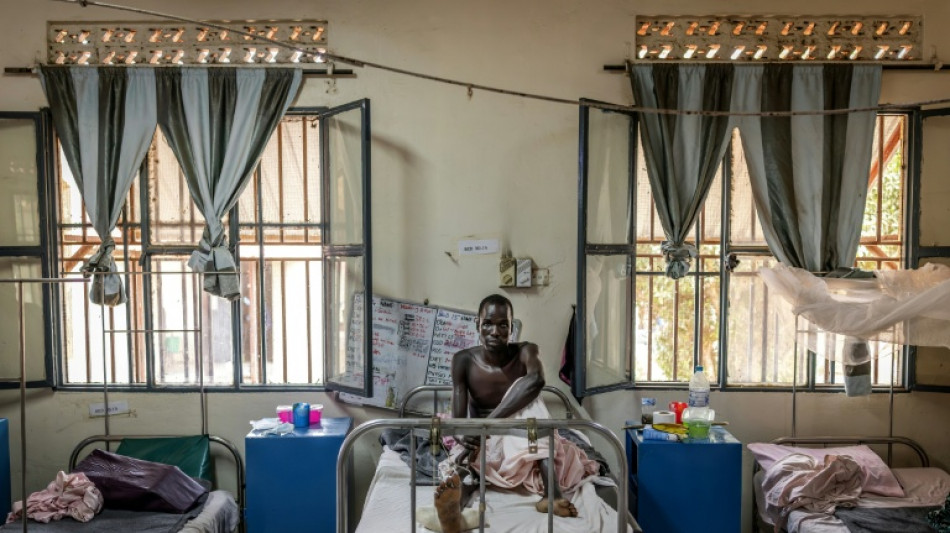
Dead on arrival: South Sudan's devastated health system / Photo: Luis TATO - AFP

 Kings' Ben Simmons tears Achilles in training
 Lula, Bolsonaro set for first debate showdown in bitter election race

 Mbappe hits two as Real Madrid rout Sevilla
 Browns edge Ravens for division lead, Texans beat Jags

 Lyon go top of Ligue 1 as Monaco fall to first defeat of the season
 Venezuela opposition alliance reaffirms Nobel laureate Machado as leader
 'Street Fighter' wins N. America box office, buzzy doc stuns in 2nd

 NFL: Paris game to go ahead despite protests in France

 Arteta hails Arsenal 'finishers' after Madueke fells Forest

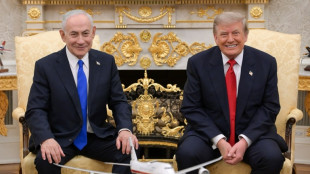 Trump backs ally Netanyahu ahead of Israel's tight election

 Madueke strikes late as below-par Arsenal sink Forest
 Second day of street clashes in Milan
 Dupont's Toulouse hold off Exeter as English Champions Cup woes continue

 Zelensky speaks to US envoys amid Trump spat

 Paris police in new battles with protesters and looters
 Multiple deaths, injuries at western Canada military base: minister

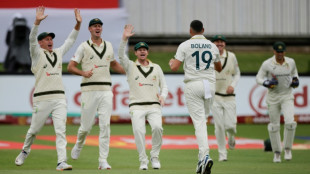 Boland strikes twice for Australia in rain-hit South Africa Test

 Marseille put Angers to the sword in Ligue 1
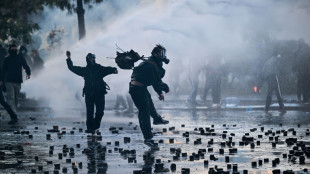 Albanian PM refuses to quit as violent protests enter sixth day

 Chwalinska fights back to win Wuhan Open in title breakthrough
 Kulusevski on brink of return for Spurs after 17-month absence

 Ukraine sets Saint Petersburg refinery ablaze in large-scale drone attack
 Spain's in-form Chacarra wins DP World India Championship

 Robertson and Selby chase rare Home Nations sweep in Belfast

 Arteta backs Kai Havertz to become a 30-goal Arsenal forward

South Sudan's healthcare system has been so crippled by years of corruption that when a state governor experienced high blood pressure recently, he had to fly to Kenya for treatment.
Riek Gai Kok is the governor of Jonglei state, where conflict has once again exploded between government and opposition parties.
His trip to Nairobi was recounted by humanitarians as yet another example of how South Sudan's elite, ranked the most corrupt in the world by Transparency International, have allowed services in the country to collapse.
As the country tips back into civil war between rival parties, what little healthcare exists is almost entirely through foreign donors, with more than 80 percent provided by NGOs like the International Committee of the Red Cross (ICRC) and Doctors Without Borders (MSF).
In a hospital in the capital Juba, a soldier told AFP he was amazed to have been airlifted to hospital since most wounded are left to die.
"[When] I was shot, I thought I was dead," said Ajuong Deng, 33, wounded in the leg.
But it was the ICRC that rescued him -- not the army or the government -- treating him at their facility within the Juba Military Hospital where the NGO gives staff what it euphemistically calls "incentives" because it is not officially allowed to pay them.
"If we don't pay them then no one stays here," said one worker, speaking anonymously.
Government pay, normally just $10-50 monthly, has not arrived for months.
"This is not what we're supposed to be doing," said one senior humanitarian.
- Cycle of violence -
In the Juba hospital, wounded lay on the floor in blood-stained bandages. A man shot in the neck struggled to breathe.
The clinicians fear these men will soon be sucked back into the country's multiple cycles of violence: the war between the government and opposition, currently raging to the north, or between various ethnic militias and cattle raiders that plague rural areas.
"I have actually had one patient who came back four times," said Angeth Jervas Majok, the ICRC's head physiotherapist. "On the fifth time, unfortunately we lost him."
With only 300 kilometres of paved roads, many impassable during rainy seasons, wounds often grow infected before they reach a doctor, so amputations are common.
Yet they are stigmatised: "There is a belief that (amputees) are not a human being anymore," said Majok. "A lot of patients cannot go back home."
The government will not say how many soldiers have died as fighting has ramped up in the past year.
The UN says more than 5,100 civilians have been killed and hundreds of thousands displaced, and warns South Sudan is on the verge of "all-out civil war". The last one in the 2010s killed 400,000 people.
- 'Difficulties' -
While much of east Africa has seen improving health outcomes, South Sudan is going the other way despite receiving $1.4 billion in foreign aid in 2024, the largest amount globally as a share of GDP.
Life expectancy is 58, according to the World Bank, unimproved since independence in 2011. Maternal mortality is 1,223 per 100,000 births, compared to 197 globally. Unicef says one in 10 children do not reach their fifth birthday.
South Sudan's oil revenues have exceeded $25 billion since 2011, yet only one percent of this year's budget was allocated to health and the UN has said that "vast amounts never reach the sector, let alone the population" in a country where 92 percent live beneath the poverty line.
On top of all that, South Sudan is among the most dangerous places in the world to be a health worker. MSF facilities have been attacked 11 times in the past year. The ICRC surgical unit in Juba has blast doors, and stores biscuits and water next to medical equipment in case of a siege.
The US has warned it will pull funding if governance does not improve, and NGOs are pulling back as donations fall and patience runs thin with South Sudan's leaders.
The ICRC told AFP it planned to "draw down progressively" in one facility, while attempting to reinforce local capacity.
Information Minister Ateny Wek Ateny admitted to AFP there were liquidity "difficulties" but said the government was working on it.
He rejected Transparency International's latest report, saying: "I don't know what criteria they have used to rank South Sudan as the most corrupt country in the world."
G.AbuOdeh--SF-PST