Geopolitical storm leaves isolated Greenlanders hanging by a telecoms thread / Photo: Florent VERGNES - AFP

 Australia's new Ghost Shark submarines grow some 'teeth'
 'I call it a bribe': Pennsylvania residents spurn $10,000 data center checks

 In a former US steel city, ordinary people struggle to get by
 'Liar,' 'clown': Lula and Bolsonaro spar in Brazil poll debate

 Record El Nino? Depends who's counting
 On the front line of ocean conservation off Portugal's Madeira
 Wembanyama targets title breakthrough as NBA season tips off
 With LeBron on board it's title or bust for Philly fans

 One year after Louvre heist, where are the missing jewels?

 Knicks face tall task in NBA championship repeat bid

 Warriors' Curry 'fine' after limping out of practice - Kerr

 Zelensky speaks to US envoys as Trump lashes out

 'Surprise package' Lazio crush Juve to keep pace with Serie A leaders Inter

 China growth expected to miss official target in third quarter

 Lazio crush Juventus to move level with Serie A leaders Inter

 Leeds draw feels like 'fresh start' for Man Utd's Carrick
 Macron denounces 'unbridled' violence as France hit by new clashes

 Hurzeler lauds 'hard worker' Gomez after Brighton goal from halfway line

 Toulouse hold off Exeter, Northampton save English Champions Cup blushes

 Arsenal snatch late win to keep pressure on Man City as Man Utd held

 Arsenal strike late to keep pressure on Man City as Man Utd held

 Four soldiers dead, dozens injured in fire at Canada military base

 Ton-up Agha helps Pakistan down Sri Lanka in tri-series opener

 Man Utd draw at Leeds keeps pressure on Carrick
 Barca defenders Garcia, Kounde injured before key games

In the Greenlandic village of Kapisillit, a crisis meeting has just begun.
With one table and just two chairs, all members of the local administration are present.
Vanilla Mathiassen, a 64-year-old Danish teacher, has summoned the village chief to discuss her concerns about US President Donald Trump's desire to annex Greenland and the fear that communications could be cut one day.
"If something serious were to happen, I would shout 'Help! Get out!", said an agitated Mathiassen.
"I've put in a request for a satellite phone," village chief Heidi Nolso responded.
Since returning to the White House in 2025, Trump has repeatedly threatened to take control of Greenland, a Danish autonomous territory, alleging this is needed to ensure US national security.
While Trump's threats have ebbed in recent weeks, locals remain shaken.
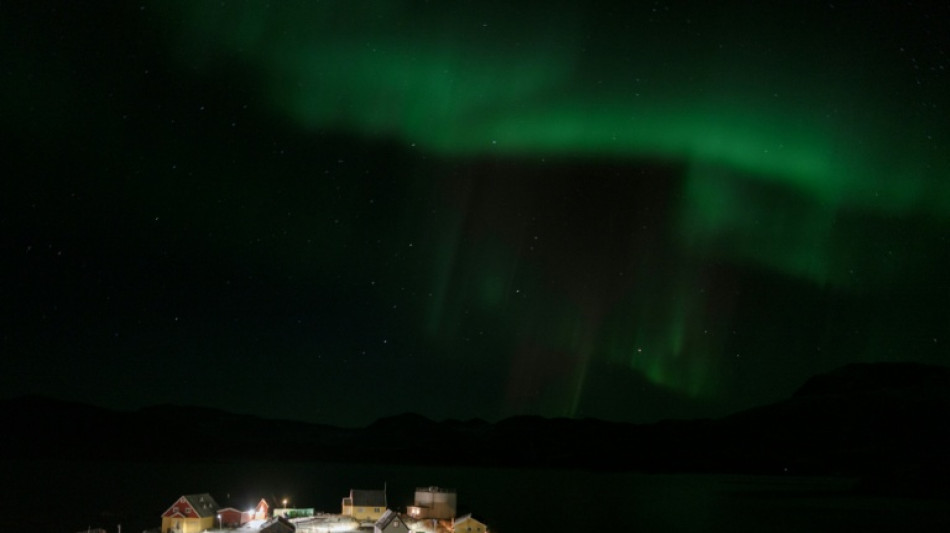
Here in Kapisillit in western Greenland, a cluster of coloured houses cling to the hillside in a frozen fjord.
Around 30 people live in the settlement, surviving from hunting and fishing.
Located about 75 kilometres (47 miles) from the capital Nuuk, Kapisillit is remote and isolated.
Like hundreds of other villages in Greenland, now caught up in a geopolitical storm, the settlement depends on a fragile and costly telecommunications network.
- 'Vulnerable' -
On the snowy Kapisillit hillside lies a long, yellow building. As Nolso opens the door, a rancid odour escaped.
"This is the old medical clinic. It's been empty for several months," she told AFP.
The settlement is reachable only by boat.
Residents are accustomed to medical appointments online and emergency evacuations by helicopter.
In the event of a heart attack, "it's too late", Nolso said.
Without a telecommunications network, it would be impossible to contact Nuuk.
"It would be terrible if we were to be cut off from the world," she admitted.
In terms of connectivity, Greenland is "the most vulnerable country in the Arctic", said Signe Ravn-Hojgaard, head of Danish think tank Digital Infrastruktur.
The vast Arctic island is connected to the world by two subsea fibre optic cables to Canada and Iceland, in addition to satellite coverage in the north and east.
The cables are nearing the end of their lifespan and a simultaneous cut -- as in 2019 -- would leave inhabitants without an internet connection for months.
"Greenland expects its network to be increasingly targeted, as the Arctic is becoming a conflict zone," researcher and Arctic connectivity expert Michael Delaunay told AFP.
Amid the tensions with Washington, Nuuk secured funding from Copenhagen in October 2025 for a third undersea cable.
- Frequent cuts –
Kapisillit's red wooden schoolhouse has a bell, library and Soviet-era hunting rifle to fend off polar bears.
"I communicate with Nuuk from this tablet," Mathiassen said, pulling off her sealskin mittens to turn on the device.
"I have a big computer but it hasn't worked since I arrived," she said.
"Because of the distance, it's too difficult (to fix)."
Outside the window, the relay tower connecting the village to the world is visible. It was down for a few days and the network was unstable.
"Yesterday, two helicopters landed right here. They tinkered with something, then left again," Mathiassen recalled.
Tablets on the windowsill gather dust, remnants of an abandoned online school project.
Education authorities called in Mathiassen as an on-site teacher after frequent network cuts, even though there are just two pupils.
She teaches her class in Danish and has a local assistant to help her with Greenlandic.
Each morning when 11-year-old Tulliaq and seven-year-old Viola arrive, they put their phones in a box.
"They prefer to speak to their aunt or uncle elsewhere in Greenland than learn Danish," Mathiassen said sourly.
Tulliaq complies reluctantly. His phone is his only link to his friend who lives in Scotland.
Once kids turn 14, they leave the settlement to continue their schooling in Nuuk. Few return.
Social networks have become a vital link for community life in Greenland.
"All relationships, including those of elected officials, go through Facebook or Messenger," explained Mikaa Blugeon-Mered, an Arctic specialist.
For Washington, this represents an "invaluable treasure trove of intelligence on Greenlandic decision-makers".
Experts have warned of a rising number of fake Facebook accounts and a growing polarisation of Greenland's public debate, in a context where the local population is generally not well-versed in the risks of information manipulation.
The threat is even more serious given the fragility of Greenland's society.
- Suicide -
During a break, Mathiassen pulled a photo album from the cupboard.
On the yellowing front page, 20 or so young Greenlanders smile, feet planted in the snow. On the back, the inscription reads "Class Picture 1997".
The assistant searched for herself in one of the pictures, then scanned the faces, pensive.
"Many of them are dead," she said quietly. "Suicide."
The rural exodus of the 1970s, encouraged by Copenhagen, shattered Greenland's social model.
Staying in touch with loved ones has become a vital need.
But access remains difficult, with an internet subscription costing around $173 a month.
"Only the rich can afford it," lamented Nolso, noting that many elderly people live solely on their pensions.
"If we had Starlink, everything would be easier."
The satellite internet terminals from US company SpaceX are banned in Greenland, where national operator Tusass has a telecommunications monopoly.
Under its pricing model, residents of larger, more affluent towns subsidise isolated areas where costs would otherwise be prohibitive.
Direct competition would jeopardise this balance.
In April 2025, a massive power outage in Spain deprived part of Greenland of telephone service, as it depends on Spanish satellites.
Tusass considered a deal with SpaceX to beef up its network.
But in October it ultimately turned to French company Eutelsat -- despite it being less efficient -- amid fears of US interference.
"Geopolitics played a major role in the choice of a European operator over an American one," said Delaunay, noting that in Nuuk's eyes, Starlink is a "foreign and unstable actor".
Through the school window, a fishing boat could be seen cutting through the waters in the bay.
When storms lash Nuuk, a Danish navy frigate can sometimes be seen as well.
"What would I do if I saw US or Russian ships arriving?", asked Mathiassen.
"A young boy told me, 'If they come, I have a weapon and I know how to use it.'"
For now, her plan is to follow "the people here".
In February 2025, a two-day storm destroyed some houses and cut Kapisillit off from the world.
"In case of an emergency, we would have had no help from Nuuk," Nolso said.
But, she noted, "Greenlanders are patient people".
If everything stops, "they'll just return to nature".
M.Qasim--SF-PST