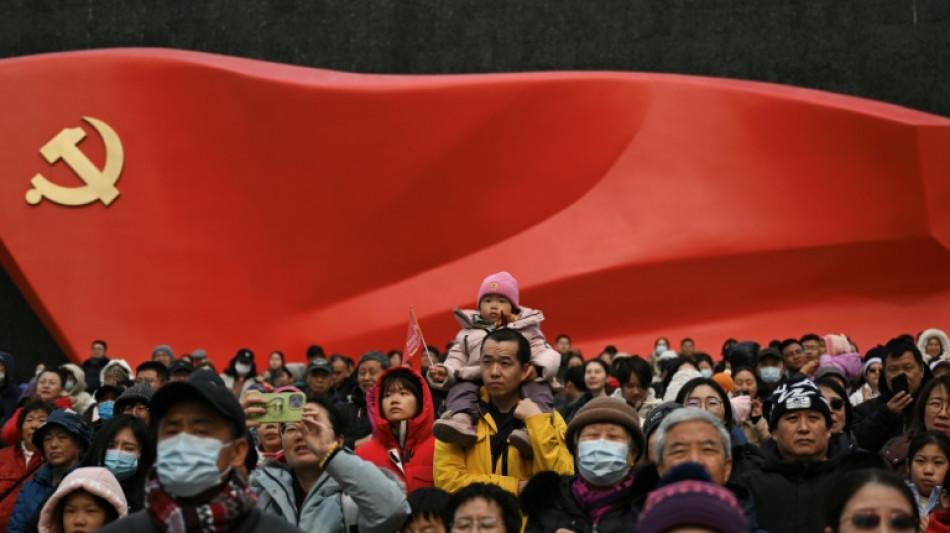
China's leaders gather for key strategy session as challenges grow / Photo: Pedro PARDO - AFP

 Australia's new Ghost Shark submarines grow some 'teeth'
 'I call it a bribe': Pennsylvania residents spurn $10,000 data center checks
 In a former US steel city, ordinary people struggle to get by
 'Liar,' 'clown': Lula and Bolsonaro spar in Brazil poll debate
 Record El Nino? Depends who's counting
 On the front line of ocean conservation off Portugal's Madeira

 Wembanyama targets title breakthrough as NBA season tips off

 With LeBron on board it's title or bust for Philly fans

 One year after Louvre heist, where are the missing jewels?

 Knicks face tall task in NBA championship repeat bid

 Warriors' Curry 'fine' after limping out of practice - Kerr

 Zelensky speaks to US envoys as Trump lashes out

 'Surprise package' Lazio crush Juve to keep pace with Serie A leaders Inter

 China growth expected to miss official target in third quarter

 Lazio crush Juventus to move level with Serie A leaders Inter

 Leeds draw feels like 'fresh start' for Man Utd's Carrick

 Macron denounces 'unbridled' violence as France hit by new clashes

 Hurzeler lauds 'hard worker' Gomez after Brighton goal from halfway line

 Toulouse hold off Exeter, Northampton save English Champions Cup blushes

 Arsenal snatch late win to keep pressure on Man City as Man Utd held
 Arsenal strike late to keep pressure on Man City as Man Utd held

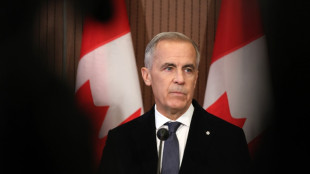 Four soldiers dead, dozens injured in fire at Canada military base

 Ton-up Agha helps Pakistan down Sri Lanka in tri-series opener

 Man Utd draw at Leeds keeps pressure on Carrick

 Barca defenders Garcia, Kounde injured before key games

China's leaders are set to unveil strategies to confront challenges that include sluggish consumption, a shrinking population and shifting geopolitical landscapes when they gather in Beijing this week for the annual Two Sessions political meeting.
Thousands of delegates from across China will convene for a carefully orchestrated affair in Beijing's Great Hall of the People, largely to rubber-stamp decisions by the ruling Communist Party under leader Xi Jinping.
The nation's 15th Five-Year Plan -- a blueprint for the world's second-largest economy through to 2030 -- will also be released.
With most of the decisions already made, the Two Sessions are mainly a talking shop with little room for spontaneity or off-the-cuff comments.
However, they do provide a rare glimpse into the party's priorities on matters ranging from the economy to defence and foreign policy.
This year's gathering begins on Wednesday with the start of the Chinese People's Political Consultative Conference, a political advisory body.
It is generally overshadowed by the next day's opening of the National People's Congress, China's parliament, at which Premier Li Qiang will outline key growth targets.
China's economy expanded by five percent in 2025, in line with Beijing's target but one of the slowest rates in decades.
Analysts expect this year's target to be set even lower -- between 4.5 and five percent -- with 14 provinces reducing their GDP targets in recent weeks compared to 2025.
China's leaders say the country's economic model must shift towards consumption-based growth, rather than traditional drivers, including production and exports.
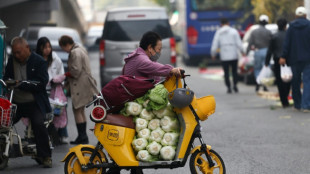
But factors such as the flagging property market, deflation and youth unemployment have left consumers tightening their purse strings.
Over-production spurred by state support and low demand, as well as international trade tensions, have also loomed over industrial output.
- 'Double down' -
Beijing's five-year plan for 2026-2030 will aim to address such issues, with officials vowing it will "create new demand through new supply and provide strong innovative measures".
Analysts, however, are sceptical.
"The thrust of it is to double down on the direction of travel Xi had already set," Steve Tsang, director of the SOAS China Institute, told AFP.
Expected measures are "unlikely to address the fundamental problem behind weak private consumption", he said.
The plan is expected to concentrate on high-tech manufacturing, green transition and supply chain resilience.
"This signals a shift away from debt-fuelled expansion toward innovation-led growth", as well a response to trade tensions and global uncertainty, said Sarah Tan of Moody's Analytics.
However, strengthening social safety nets and boosting incomes, as well as addressing the long-running property crisis, would lead to "a more durable revival", she said.
- Priorities and credibility -
China is also facing serious demographic challenges: its population has shrunk for three years in a row.
Top leaders have pledged more childcare relief, including subsidies of around $500 per year for every child under the age of three -- but the measures so far have done little to boost births.
The Two Sessions is tightly controlled, but delegates in the past have used the opportunity to try to push pet policies, particularly social measures.
But when the "overarching objective politically is security... there's no desire to be innovative", former US defence official Drew Thompson said.
"So they're kind of stuck."
China's defence budget will also be announced, with the military reeling from a deep and long-running anti-corruption campaign.
The announcement in January that top general Zhang Youxia was under investigation sent shockwaves through defence observers, who saw it as a consolidation of power in Xi's hands.
However, the saga is not expected to feature heavily at the Two Sessions, according to SOAS' Tsang.
Ultimately, delegates are trying to turn the tide of low public confidence, analysts noted.
"There are some serious societal challenges that the party has to adapt to and the tools they're using are pretty traditional ones," Thompson said.
Tan from Moody's Analytics added that "credibility will rest on whether structural reforms, meaningful support for households and sustained fiscal backing follow the rhetoric".
B.Khalifa--SF-PST