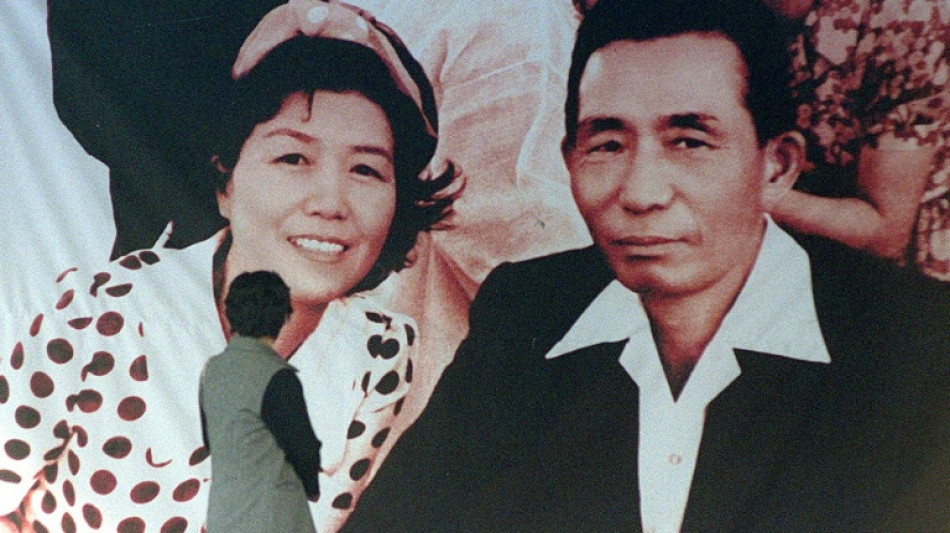
Jail, disgrace and death: the dark fates of South Korean leaders / Photo: KIM JAE-HWAN - AFP

 Saudi airport closure disrupts life in kingdom's capital

 Ramaphosa tells South Africa to prepare for loss of US-Africa trade deal

 France presses resale platforms to remove 'stolen' goods after unrest
 Yamal v PSG: Ballon d'Or backdrop to Champions League showdown
 Araujo says too soon to talk about permanent Liverpool move

 US wants to be 'strong partner' for central Asia: Rubio

 'Special' to face friend Perez in Champions League, says Liverpool's Iraola

 Monitor says Indonesia fires have burned nearly two million hectares

 French PM says could declare state of emergency over unrest 'if needed'

 Albanian PM warns of 'red line' after days of unrest
 Putin, Xi and Trump could meet at APEC summit: Kremlin
 Microsoft exits data centre deal in blow to UK AI ambitions

 European stocks retreat as France violence spreads

 North Korea warns 'grave situation' prevailing along border

 Raya proud of Arsenal's 'incredible' reaction after third straight win

 Indonesia fires have burned nearly two million hectares: monitor

 Australian lawmaker 'critically' hurt in attack, officials say

 Indonesia fires burned over 1.9 mn hectares through September: monitor

 Asian tech stocks mixed after Wall St losses, eyes on earnings

 China's third-quarter growth narrowly beats forecasts

 Asian stocks start week on back foot, tracking tech-led Wall St losses

 China growth narrowly beats forecasts

 Faith and fury: Texas Senate rivals offer contrasting visions
 Women await justice for police killings in Brazil

 The painstaking task of cataloguing the world's species

South Korea's ex-president Yoon Suk Yeol faces prison or even the death penalty when he appears in court Thursday on insurrection charges stemming from his 2024 bid to impose martial law.
The 65-year-old hardline conservative is far from the first South Korean leader to have his term end in tatters.
AFP looks at others who ended their careers in prison, or worse:
- Yoon Suk Yeol: impeachment, arrest -
Elected in May 2022, Yoon waded through multiple scandals before his bungled martial law decree on December 3, 2024.
He blamed "anti-state forces" and made unproven allusions to electoral fraud before lawmakers voted down his martial law declaration and he was impeached.
He resisted questioning and arrest for weeks, before being detained in January last year and later released.
Earlier this year, Yoon was found guilty of obstruction of justice and a litany of other crimes related to the martial law declaration and its chaotic aftermath.
Now he faces criminal charges of insurrection, which can be punished with lengthy prison terms or even the death penalty, though it is unlikely the latter would be carried out.
- 2016: Park impeached, jailed -
The daughter of former dictator Park Chung-hee, Park Geun-hye was the first woman president of South Korea and had presented herself as incorruptible.
But she was accused of receiving or requesting tens of millions of dollars from conglomerates including Samsung.
Additional accusations included sharing classified documents, putting artists critical of her policies on a "blacklist", and dismissing officials who opposed her.
In December 2016, Park Geun-hye was impeached by parliament in a decision confirmed in March 2017 by the Constitutional Court, leading to her indictment and imprisonment.
Park was sentenced in 2021 to 20 years in prison and given heavy fines.
But at the end of that year, she was pardoned by her successor, Moon Jae-in.
Ex-leader Yoon was a Seoul prosecutor at the time and played a key role in her dismissal and subsequent incarceration.
- Lee Myung-bak: 15 years in prison -
In power from 2008 to 2013, Park's conservative predecessor Lee Myung-bak was sentenced in October 2018 to 15 years in prison for corruption.
Most notably, he was found guilty of taking bribes from Samsung in exchange for favours to the conglomerate's then chairman, Lee Kun-hee, who had been convicted of tax evasion.
The former leader was pardoned by then-president Yoon in December 2022.
- Roh Moo-hyun: suicide -
President from 2003 to 2008 and a strong supporter of rapprochement with North Korea, liberal Roh Moo-hyun killed himself by jumping from a cliff in May 2009.
He had found himself the target of an investigation into the payment by a wealthy shoe manufacturer of $1 million to his wife and $5 million to the husband of one of his nieces.
- 1987: autocrat Chun retires -
Military strongman Chun Doo-hwan, known as the "Butcher of Gwangju" for ordering his troops to put down an uprising against his rule in the southwestern city, agreed to step down in 1987 in the face of mass demonstrations.
He handed over power to his protege Roh Tae-woo.
Roh and Chun had been close for decades, first meeting as classmates at military academy during the Korean War.
In 1996, both men were convicted of treason over the 1979 coup that brought Chun to power, the 1980 Gwangju uprising, corruption and other offences.
Roh was sentenced to 22-and-a-half years in jail, later reduced to 17 years, while Chun was sentenced to death, later commuted to life in prison.
They were granted amnesty in 1997 having spent just two years behind bars.
- 1979: dictator Park assassinated -
Park Chung-hee was assassinated in October 1979 by his own spy chief during a private dinner.
The events of that night have been long a subject of heated debate in South Korea, particularly over whether the murder was premeditated.
Chun Doo-hwan and Roh Tae-woo, then army generals, took advantage of the political confusion to stage a coup in December 1979.
- 1961: Yun overthrown in a coup -
President Yun Po-sun was overthrown in 1961 in a coup led by army officer Park Chung-hee.
Park kept Yun in his post but effectively took control of the government, then replaced him after winning an election in 1963.
- 1960: exile of first president -
South Korea's first president, Syngman Rhee, elected in 1948, was forced to resign by a popular student-led uprising in 1960, after attempting to extend his term through rigged elections.
Rhee was forced into exile in Hawaii, where he died in 1965.
B.Khalifa--SF-PST