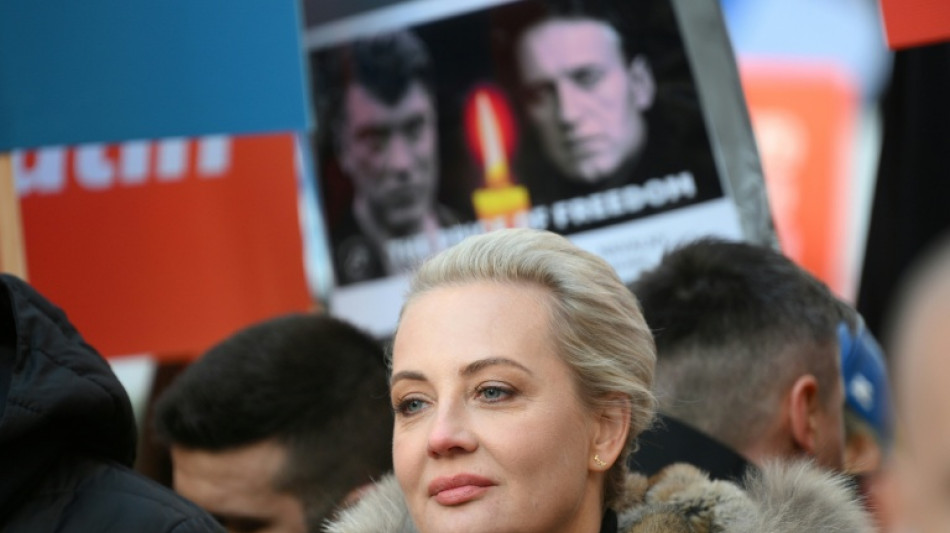
European states say Navalny poisoned with dart frog toxin in Russian prison / Photo: RALF HIRSCHBERGER - AFP

 Ronaldo handed 30-day suspension after walking out on Portugal
 Netanyahu basks in Trump endorsement week before election

 Saudi airport closure disrupts life in kingdom's capital

 Ramaphosa tells South Africa to prepare for loss of US-Africa trade deal
 France presses resale platforms to remove 'stolen' goods after unrest
 Yamal v PSG: Ballon d'Or backdrop to Champions League showdown

 Araujo says too soon to talk about permanent Liverpool move

 US wants to be 'strong partner' for central Asia: Rubio

 'Special' to face friend Perez in Champions League, says Liverpool's Iraola

 Monitor says Indonesia fires have burned nearly two million hectares
 French PM says could declare state of emergency over unrest 'if needed'
 Albanian PM warns of 'red line' after days of unrest
 Putin, Xi and Trump could meet at APEC summit: Kremlin
 Microsoft exits data centre deal in blow to UK AI ambitions

 European stocks retreat as France violence spreads

 North Korea warns 'grave situation' prevailing along border
 Raya proud of Arsenal's 'incredible' reaction after third straight win

 Indonesia fires have burned nearly two million hectares: monitor
 Australian lawmaker 'critically' hurt in attack, officials say
 Indonesia fires burned over 1.9 mn hectares through September: monitor
 Asian tech stocks mixed after Wall St losses, eyes on earnings

 China's third-quarter growth narrowly beats forecasts
 Asian stocks start week on back foot, tracking tech-led Wall St losses

 China growth narrowly beats forecasts

 Faith and fury: Texas Senate rivals offer contrasting visions
Five European states, including Britain, France and Germany, said Saturday that Russian opposition leader Alexei Navalny was killed by a "rare toxin" from a dart frog and that the Russian state was the prime suspect in the death.
Navalny, a staunch critic of Russian President Vladimir Putin, died in an Arctic prison on February 16, 2024, while serving a 19-year prison sentence on charges widely seen as retribution for his opposition.
"The UK, Sweden, France, Germany and The Netherlands are confident that Alexei Navalny was poisoned with a lethal toxin," the countries said in a joint statement released at the Munich Security Conference. It said the results followed "analyses of samples" from his body.
According to the European states, a toxin found in the skin of South American dart frogs known as epibatidine was found on laboratory analyses of samples from his body.
"Russia claimed that Navalny died of natural causes. But given the toxicity of epibatidine and reported symptoms, poisoning was highly likely the cause of his death," said the statement.
"Navalny died while held in prison, meaning Russia had the means, motive and opportunity to administer this poison to him," the countries said.
Britain's foreign office said separately that "only the Russian state had the means, motive and opportunity to deploy this lethal toxin". It added: "We hold it (Russia) responsible for his death".
- 'Science proven facts' -
Navalny's widow, Yulia Navalnya, said it was now "science-proven" that the Kremlin opponent had been murdered.
"Two years ago I came on stage here and said that it was Vladimir Putin who killed my husband," Navalnaya said on the sidelines of the conference in Germany.
"I was of course certain that it was a murder... but back then it was just words. But today these words have become science-proven facts," Navalnaya added.
Navalnaya last September said that laboratory analysis of smuggled biological samples found he was killed by poisoning.
"Today, beside his widow, the UK is shining a light on the Kremlin's barbaric plot to silence his voice," UK Foreign Secretary Yvette Cooper, who met Navalnaya while attending the Munich conference, said in a statement.
French foreign minister Jean-Noel Barrot paid "tribute" to Navalny after the findings.
"We now know that Vladimir Putin is prepared to use biological weapons against his own people to remain in power," Barrot said in a post on X.
The Kremlin denies the charges.
- Chemical weapons watchdog -
Moscow has never fully explained his death, saying only that he fell ill and collapsed during a walk in his prison colony. Navalny and his foundation was considered "extremist" by the Russian authorities.
The European countries said they had reported Russia to the world's chemical weapons watchdog -- the Organisation for the Prohibition of Chemical Weapons -- over the finding.
"We are further concerned that Russia did not destroy all of its chemical weapons," the countries said, accusing Moscow of breaching the Chemical Weapons Convention.
Navalny was previously poisoned with the Soviet-era nerve agent Novichok in 2020 while campaigning in Siberia and was flown to Germany on an emergency evacuation flight, where he spent months recovering.
Jailed upon his return to Russia in January 2021, he was convicted on a series of charges, including "extremism", but continue to campaign against Putin and Russia's invasion of Ukraine from behind bars.
The charismatic anti-corruption campaigner had rallied hundreds of thousands across Russia in anti-Kremlin protests as he exposed the alleged ill-gotten gains of Putin's inner circle.
Putin's main political opponent, Navalny was the only opposition leader who was able to galvanise big protests in Russia.
Public displays of opposition to Putin inside Russia have become exceptionally rare since Russia invaded Ukraine in February 2022 and clamped down on dissenters and critics of the war.
Last year, a UK public inquiry found Putin "morally responsible" for the accidental death of a British woman in a 2018 nerve agent attack in which suspected Russian spies allegedly targeted defector Sergei Skripal.
burs-aks/tw/db
N.Shalabi--SF-PST