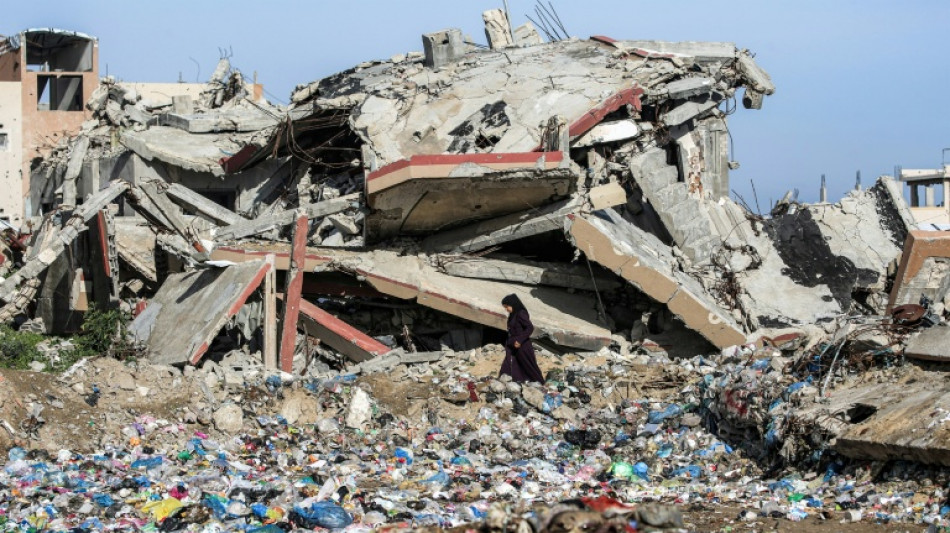
Israel to partially reopen Gaza's Rafah crossing on Sunday / Photo: EYAD BABA - AFP

 Australian police charge man over 'targeted' attack on lawmaker

 Rubio lands in India for 'trade diplomacy'
 China opposes US ban on govt agencies from using DeepSeek
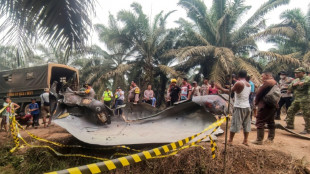 Near miss: Indonesia probes crash of suspected Chinese rocket fragment
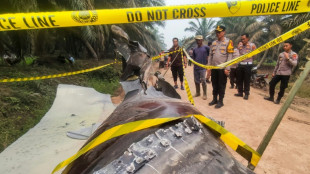 Indonesia investigates crash of suspected Chinese rocket fragment
 South Korea to withdraw some Ukraine embassy staff after POW row
 S. Korea warns of 'firm' response after North threatens fresh measures near border

 Ukraine claims US missile holdup ahead of reported talks

 Niners hold off Commanders to stay perfect in NFL
 Tech firms bear brunt of selling as Asian stocks drop

 Reese scores 30 as Dream stun Valkyries to level WNBA finals

 Horror and disbelief after lawmaker attacked in rural Australia

 Ukraine races to secure energy supplies ahead of winter
 Vote count begins in Alberta secession referedum, testing Canada unity
 Ukraine claims US missile holdup as Trump floats summit without Zelensky

 Detained Suu Kyi receives UK royal package: Myanmar govt

 Japan successfully launches probe in historic Mars moon mission

 US to auction deep sea mining leases off American Samoa

 Australian lawmaker hurt in car attack underwent surgery overnight: PM
 Japan launches rocket for potential world first Mars moon mission

 Ethiopia PM warns Eritrea of 'severe consequences' if supports enemies

 Boland grabs opportunity for Australia as South Africa struggle in second Test

 Ronaldo handed 30-day suspension: Portuguese federation
 France announces curfews as government grapples with unrest

 Boland sets pace as South Africa struggle
Israel announced it would reopen the crucial Rafah crossing between Gaza and Egypt on Sunday after months of urging from the UN, humanitarian organisations and ordinary Palestinians -- but only for the "limited movement of people".
Earlier on Friday, the Islamist movement Hamas had called for the "immediate transition to the second phase" of the ongoing US-brokered truce in Gaza, namely its provision for the reopening of Rafah, as well as the entry of a technocratic Palestinian committee to administer the territory.
Israel had previously expressed its unwillingness to reopen the gateway until getting back the remains of Ran Gvili, the last hostage to be held in Gaza, who was recovered earlier this week and laid to rest in Israel on Wednesday.
"The Rafah Crossing will open this coming Sunday (February 1st) in both directions, for limited movement of people only," COGAT, an Israeli defence ministry body overseeing civil affairs in the occupied Palestinian territories, said in a statement on Friday.
Entry and exit "will be permitted in coordination with Egypt, following prior security clearance of individuals by Israel, and under the supervision of the European Union mission", it added.
The crossing, situated on the territory's southern border with Egypt, is the only route in and out of Gaza that does not pass through Israel.
It lies in territory held by Israeli forces since their pull-back behind the so-called "Yellow Line" under the terms of the ceasefire deal. Israeli troops still control more than half of Gaza.
The gateway is a vital entry point for aid, but has been closed since Israeli forces took control of it in May 2024 -- except for a limited reopening in early 2025 -- and past bids to reopen it have failed to materialise.
The fragile Gaza ceasefire has been in force since October 10.
The plan, outlined by US president Donald Trump to put an end to the war, calls for the crossing to be reopened now that all hostages held by Palestinian militants have been released or returned to Israel.
Prior to Israel's announcement, Mirjana Spoljaric, the president of the International Committee of the Red Cross, had called on Friday for the international community "harness the momentum generated by the first phase of the agreement between Israel and Hamas to urgently improve the dire humanitarian conditions in Gaza".
Spoljaric said this included Israel easing entry restrictions on so-called dual-use material and equipment, such as water pipes and generators, to restore basic infrastructure.
The humanitarian situation in the territory of more than two million people remains grave, with most of the population displaced and many living in tents with little or no sanitation amid harsh winter weather.
- Disarmament -
Phase two of the ceasefire deal also stipulates the disarmament of Hamas, which has repeatedly called the issue of its weapons a red line, though it has suggested it could be willing to hand them over to a Palestinian governing authority.
In return, Israel's military is meant to gradually withdraw, with an international stabilisation force deployed in its stead.
On Thursday, US President Donald Trump told his cabinet that "it looks like" Hamas would disarm, though the group has offered no confirmation.
Washington had previously announced that the truce deal was entering its second phase with the naming of the Palestinian technocratic committee that will oversee day-to-day governance in the devastated territory.
The reopening of Rafah is expected to allow the entry of the 15-member body, known as the National Committee for the Administration of Gaza, which answers to Trump's "Board of Peace".
Since the ceasefire went into effect, Israel and Hamas have traded accusations of violations on a daily basis.
The Israeli military said on Friday that it had identified "eight terrorists" who emerged from underground overnight, and that the air force had "struck and eliminated three" of them.
Without providing information on the identities of the targets, it added that further strikes were launched and that "soldiers continue to conduct searches in the area in order to locate and eliminate all the terrorists".
The Gaza war was sparked by Hamas's October 7, 2023 attack on Israel, which resulted in the deaths of 1,221 people, according to an AFP tally based on official Israeli figures.
The Israeli retaliation flattened much of Gaza, a territory that was already suffering severely from previous rounds of fighting and from an Israeli blockade imposed since 2007.
The two-year war has left more than 71,600 people dead in Gaza, according to the Hamas-run territory's health ministry, figures considered reliable by the United Nations.
L.AbuTayeh--SF-PST