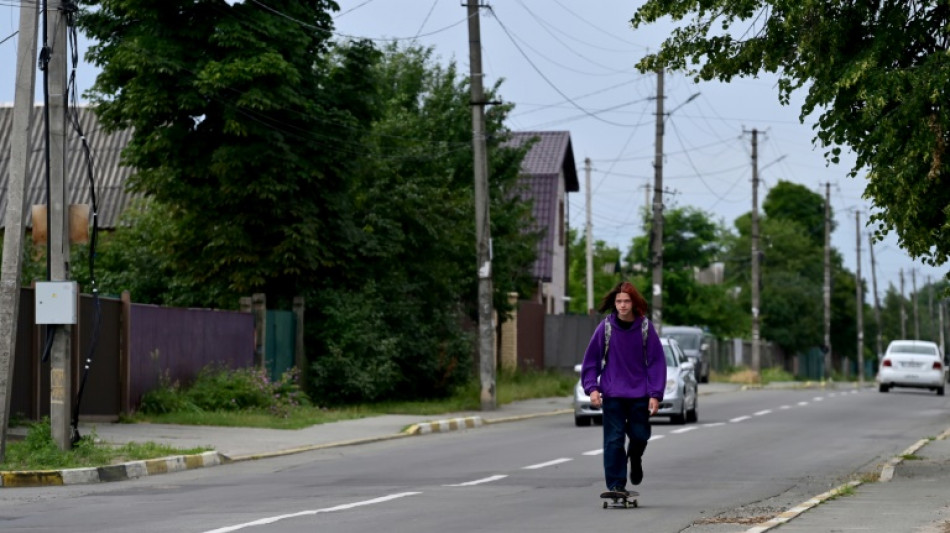
In Ukraine's Bucha, a reluctant return home and to normality / Photo: Miguel MEDINA - AFP/File

 Brazil's right embraces election betting odds amid polls skepticism
 Four more Ebola cases detected in Kenya, bringing total to seven

 Clashes erupt in France as protesters vow to make government 'tremble'
 Chwalinska downs Swiatek to set up Wuhan final with world number 170 Kartal

 Chacarra takes lead as McIlroy falls away in Delhi

 Neto double gives Chelsea win marred by Martinez injury

 'Cockroach' party founder released from Indian police custody
 Nepal floods 'defining moment' for climate action: UN
 Albanian capital sees fifth straight day of violent clashes

 Leaders weigh 'huge benefit', risks of AI for global economy
 Zverev stunned by Davidovich Fokina in Shanghai semi-finals
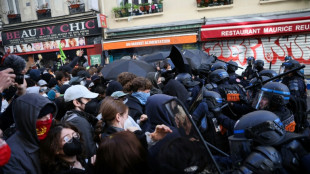 France faces day of cost-of-living protests

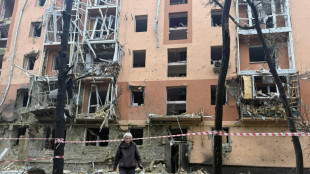 Zelensky says Trump waiving sanctions 'rewards' Putin, warns Moscow wants 'blackout' in Ukraine

 Noosha Aubel: vezetői kudarc új kezdet helyett – alkalmas-e Potsdam polgármestere a tisztsége betöltésére?

 Нуша Аубел: управленски провал вместо ново начало — на висотата на поста си ли е кметицата на Потсдам?

 Russia hails Trump waiving sanctions as 'historic'

 Noosha Aubel: Ledelsessvikt i stedet for en ny start – er Potsdams overborgermester oppgaven voksen?

 Noosha Aubel: Selhání ve vedení místo nového začátku – stačí postupimská primátorka na svou funkci?

 Haze triggers highest-level alert in parts of Southeast Asia: monitor

 IMF chief flags 'optimism', 'worry' after Bangkok annual meetings

 IMF chief says has 'optimism' and 'worry' after Bangkok annual meetings

 Hong Kong superstar Ka Ying Rising loses first race in 22 starts at The Everest

 Attacks on Gulf energy infrastructure 'worrying' for outlook: Pakistan finance minister

 Japan says hosting record number of foreigners

 'Two bad options': Rights groups decry IMF austerity demand

In a large and upscale backyard in Bucha outside Ukraine's capital Kyiv, Maxim is having a quiet dinner with his wife and his neighbours.
But just three months ago, Russian soldiers were rummaging through his home and sleeping in his children's bedroom.
"In this atmosphere, I feel like nothing can happen and that life is normal," says the 36-year-old web designer, sitting around a table with his family.
"But we know there's a war and there's no place safe in Ukraine right now."
Together with his wife Anna and their two children they live in a newly built two-storey house, at the edge of Bucha, where young families from Kyiv come to exchange big-city life for a laid back suburban one.
"The Russian army slept in our house for a couple of nights, ate everything that we had in our fridge and they left this," he says showing a box of field military ration.
In February, Russian forces entered this suburb in the northwest of Kyiv during their attempt to encircle the Ukrainian capital.
They were pushed out a month later. With the liberation came shocking discoveries of atrocities committed against civilians, making Bucha a symbol of Russian brutality.
On April 2, AFP journalists found 20 bodies in civilian clothes lying along nearby Yablunska street.
On the same street three months later, children are walking around wearing headphones and men are returning home from work while others repair damage left by the fighting.
In front of an apartment block hit by artillery, stands a blonde woman with her eyes glued to the scars left on the building. She looks away to sigh.
- 'I won't live in little Russia' -
A few kilometres away from Yablunska street, Maxim's house suffered only minor damage. His wife Anna was in Turkey when the invasion started and after moved to Romania across the border with Ukraine.
Her next-door neighbour, 36-year-old pastry chef Nastya Glyieva, was also living as a refugee in Romania by that time.
To take her mind off the news, she worked as a volunteer in Filaret, a bus station in Bucharest which became a transit hub for Ukrainian refugees.
"The teacher of my 11-year-old daughter and her family were all killed. And I don't know how to tell her this," says Nastya.
"Almost everyday we hear loud bangs from unexploded devices being detonated by our army. When I first came back it made me shake but now it's normal for us," she says.
Her house in Bucha, bought a year ago and which was left unscathed during the fighting, is now also sheltering Dmitry Gliev, her husband's brother.
The 20-year-old cook lived for almost a month under Russian occupation in his small village close to Chernobyl, which has since come under the control of the Ukrainian army.
"On February 30, we had a complete occupation, there were more than 1,000 Russians in our village. We were told that it would not be long, but they stayed there for a month," says Dmitry.
"At the beginning I was very afraid, I put my mattress in the bathroom and I stayed there for three days... We made flour ourselves from wheat and then baked bread from it," he says.
Now he's in charge of the barbecue for the dinner hosted by Maxim and his family.
"If they had taken Kyiv, there would be no Ukraine, no freedom, no Ukrainian culture, just 'little Russia'. But I would never live in such a country," says Maxim.
K.AbuDahab--SF-PST