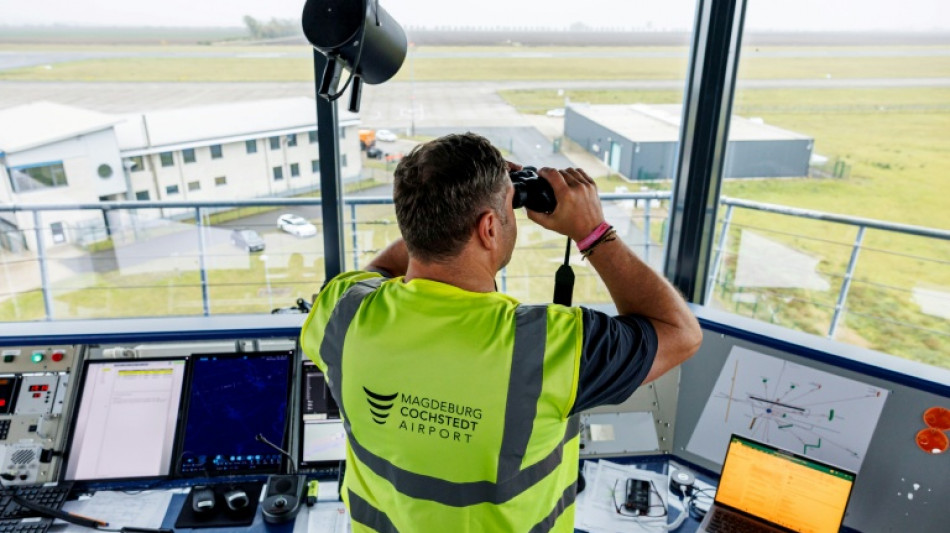
How can Europe protect its skies against 'escalating' drone menace? / Photo: JENS SCHLUETER - AFP

 Tatum delivers as Celtics down winless Knicks
 Romantasy fans ready for sleepless night as 'Court of Thorns and Roses' returns
 De Goede hat-trick as Canada defeat England again
 Rubio urges Cubans to work with CIA, but warns: be discreet

 Leclerc tops times for Ferrari in practice for US Grand Prix

 Lula, Bolsonaro lock horns in final debate before Brazil vote
 Poulter and Hatton leave LIV Golf

 Blakely vaults out of the shadow of Biles for all-around world title

 Oil tops $116 with stocks mixed on earnings, AI

 Trump orders lawsuit to block Alaska Senate result if Republicans lose

 Ebola patient in Nigeria is Swiss, had not visited DR Congo: Bern
 Messi receives top Spanish award from heir to throne
 Macron condemns 'racist terrorist attack' after deadly shooting near Paris
 Shiffrin sidesteps slalom in 'exploration' season
 Bayern Munich coach Kompany in hospital after collapsing: club

 Alonso sees Courtois similarities in Chelsea's Penders

 Melania Trump announces truce in Ukrainian city 'on brink of disaster'
 Saka to be carefully managed after latest injury setback, says Arteta
 Goodell says NFL's France debut 'just the beginning'
 Singapore widens haze probe to local firms linked to Indonesian fires

 Hundreds of Syrians protest repeated Israeli incursions

 El Salvador sends troops to Haiti to find 4 missing soldiers
 Liverpool must go 'full gas' despite injury issues, says Iraola

 Oil hits $115 with stocks mixed on earnings, AI
 Casualties feared as multi-storey building collapses in Nairobi

Drones flying over airports, commercial sites and other sensitive infrastructure in Europe is a growing phenomenon which EU leaders blame on Russia, and preventing the disruption they cause will prove a tough technical challenge, observers say.
Detecting the drones, making them non-operational by jamming them, or even shooting them down, are all complex and hazardous tasks. And while Russian involvement is suspected, it is difficult to prove.
Concerns are growing that such disruptions could be part of Russian hybrid war tactics three-and-a-half years into its invasion of Ukraine, as most European countries double down on their support for Kyiv including by delivering military hardware.
In early October, drones spotted over the German city of Munich twice shuttered the city's airport, with Chancellor Friedrich Merz saying "our suspicion is that Russia is behind most of these drone flights".
This followed similar incidents around airports in the Norwegian capital Oslo, Copenhagen and other Danish cities.
In France, several drones were spotted flying over the military base of Mourmelon-le-Grand in the northeast of the country earlier this week, the French military told AFP.
The drones were small and not piloted by French military personnel, the regional branch of the army said, describing the incident as "exceptional".
- 'Trying to humiliate us' -
European Commission head Ursula von der Leyen said the incidents amounted to a "coherent and escalating campaign".
"Two incidents are coincidence, but three, five, 10 -- this is a deliberate and targeted grey-zone campaign against Europe, and Europe must respond," she told EU lawmakers on Wednesday.
French forces earlier this month boarded a tanker off western France that has been linked to the mysterious drone flights.
Its captain and first mate were detained but later released, and the vessel was able to head towards the Suez Canal.
"At this stage, it's just to annoy us, it's part of the Russians' displays of hostility. They're trying to humiliate us," said a French security source, requesting not to be named.
The source emphasised that it was difficult to prove Moscow's involvement.
They said France has seen increased drone overflights of military installations, industrial sites and other sensitive locations over the past few weeks, but authorities are unsure who is controlling them.
In some cases, there could be other explanations.
At Mourmelon, a vast military site, "we could very well have a father who buys a Chinese drone that doesn't include the 'no-fly zone' in its system, who doesn't read the instructions and goes to the nearby forest for the weekend and ends up in the middle of a prohibited zone", said Thierry Berthier, scientific director of the European professional federation for security drones, Drones4Sec.
- 'Not far from confrontation' -
Whatever their origin, countering the drones is not going to be easy.
There are many sites that need to be protected -- not just civilian airports, but also military sites, sensitive industries such as those involved in European support for Ukraine, and power plants.
Jamming is an effective but potentially fraught measure in populated areas. "You risk jamming a lot of things," Berthier warned.
A drone can be shot down or intercepted with another drone, but this is risky. At the end of September, the Danish authorities decided not to shoot them down for the safety of civilians.
There are also legal constraints.
In France, "only a government agency can neutralise a drone," said the security source, meaning that a private company would not be allowed to disable a drone by jamming it.
In Germany, the government must clear up a legal limbo to allow the police to shoot down threatening drones.
Lorenzo, a French naval sailor on an exercise in the Mediterranean who did not give his last name in line with French military custom, told AFP it was "very difficult" to shoot down a drone.
He said this as he stood behind his 12.7-calibre machine gun which has a range of 900 metres (2,950 feet) and fires 500 rounds per minute.
While most European countries strongly support Ukraine, leaders including French President Emmanuel Macron have consistently stressed they are not a "belligerent" party in the conflict.
"We are no longer completely in peacetime because we are both in peacetime and not far from confrontation," Admiral Nicolas Vaujour, chief of staff of the French Navy, said Wednesday, complaining of obstacles preventing the deployment of defence resources.
"At some point, (we have to ask,) are we defending or not?"
O.Salim--SF-PST