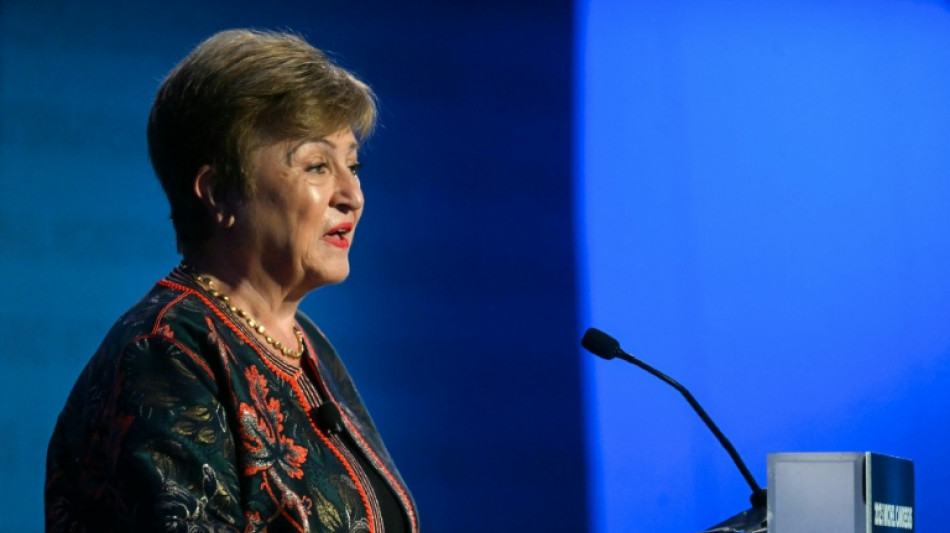
World economy not doing as badly as feared, IMF chief says / Photo: Jim WATSON - AFP

 Israel launches major West Bank operation after soldiers killed
 Typhoon Champi knocks out power to thousands in Taiwan
 As Israeli election nears, campaign turns ugly

 Oscar hopeful 'La Bola Negra' offers lessons about communicating, directors say

 Trapped: Soaring fuel costs hurt Maine lobster industry before midterms

 Marc Marquez beats brother Alex to Australian MotoGP pole
 Ebola vaccine trial begins in DR Congo
 Travelling man Wade equals Prem try record
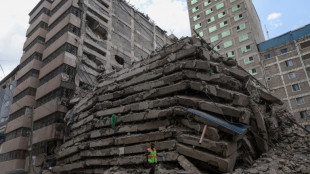 Rescuers search for seven people in Nairobi building collapse
 Sacha Baron Cohen revives the 'problematic dinosaur' Ali G in new film

 New race in Barcelona tops 17-event '27 IndyCar season
 Neymar backs Flavio Bolsonaro in Brazil election
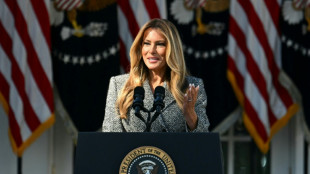 Melania Trump says she brokered truce in war-torn Ukrainian city
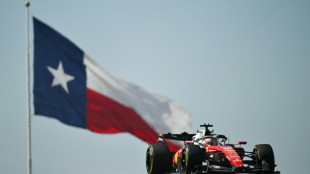 Leclerc tops times for Ferrari in opening practice for US Grand Prix
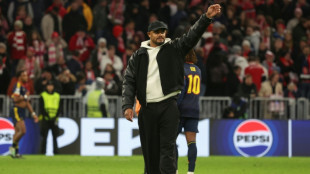 Bayern Munich coach Kompany in hospital after collapsing
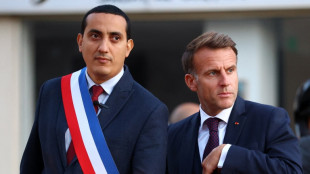
 Signs point to renewed major US military ops against Iran

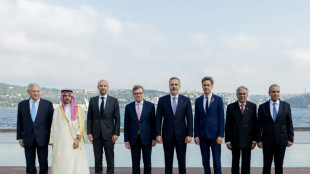 European, Mideast foreign ministers push peace and diplomacy at Istanbul talks
 Ex-All Black centre Williams undergoes 'miracle' heart surgery
 Netanyahu launches major West Bank operation after Israeli soldiers killed
 AFP photographer captures striking images from West Bank attack
 Oil hits $116 with stocks mixed on earnings, AI

 De Zerbi says Tottenham's dire record at Chelsea 'more motivation'
 Lula, Bolsonaro in final debate showdown before Brazil vote
 Poulter latest golfer to leave LIV
 Gunman kills one, wounds five in town outside Paris
The global economy is doing better than expected, even as it faces prolonged uncertainty and underwhelming medium-term growth prospects, the head of the IMF said Wednesday.
The world economy is doing "better than feared, but worse than we need," International Monetary Fund Managing Director Kristalina Georgieva told reporters in Washington.
She added that the Fund now expects global growth to slow "only slightly this year and next," propped up by better-than-expected conditions in the United States, and among some other advanced, emerging market and developing countries.
Georgieva's remarks came ahead of next week's gathering of finance ministers and central bank governors at the World Bank and the IMF in Washington.
Trade is once again likely to dominate the agenda at the annual meetings, following US President Donald Trump's decision earlier this year to unleash sweeping tariffs against many countries.
- 'Multiple shocks' -
"All signs point to a world economy that has generally withstood acute strains from multiple shocks," Georgieva said, pointing to "improved policy fundamentals," the adaptability of the private sector, lower-than-expected tariffs, and supportive financial conditions.
"The world has avoided a tit-for-tat slide into trade war -- so far," she added.
She noted that the US tariff rate has fallen from 23 percent in April to 17.5 percent today, while the US effective tariff rate of around 10 percent remains "far above" the rest of the world.
But, she warned, the full effect of those tariffs "is still to unfold," adding that the resilience of the world economy has yet to be "fully tested."
Against this backdrop, the Fund still expects global growth to remain at roughly three percent over the medium term, in line with previous forecasts -- below the 3.7 percent, on average, seen before the Covid-19 pandemic.
"Global growth patterns have been changing over the years, notably with China decelerating steadily while India develops into a key growth engine," Georgieva said.
To boost lackluster growth prospects elsewhere, she called on countries to act swiftly to "durably" lift output, rebuild fiscal buffers, and address "excessive" trade imbalances.
The Fund's prescriptions for policymakers differed by region, with Asia urged to deepen its internal trade, and to strengthen the service sector and access to finance.
Carried out correctly, this could raise economic output by as much as 1.8 percent in the long run, Georgieva said.
On the African continent, countries should promote "business-friendly reforms," and continue with efforts to build up the Continental Free Trade Area which, she said, could lift their real GDP per capita by "over 10 percent."
"Gains from this region can be especially large," she said.
- Tough love for Europe -
Georgieva reserved her harshest criticism for Europe, which has struggled with economic growth in recent years, in marked contrast to the United States.
To raise competition in the bloc, Georgieva called on the European Union to appoint a new "single market czar" to drive reforms, a move that would simplify the EU's structure and consolidate the power to make the changes required.
These changes include steps to deepen EU single market integration in financial services and energy.
"Complete your project, and catch up with the private sector dynamism of the US," she said.
For the world's largest economy, Georgieva urged the Trump administration to address the country's federal deficit and to take steps to incentivize household savings.
And for China, the world's second-largest economy, Georgieva reiterated the IMF's ongoing calls for fiscal reforms to boost private consumption and reduce dependence on industrial policy to drive growth.
N.AbuHussein--SF-PST