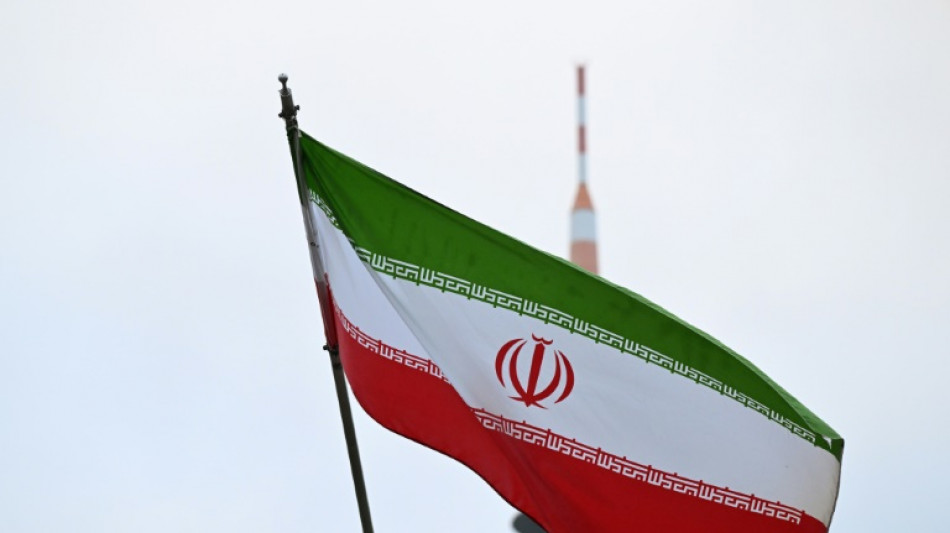
Iran executed at least 1,000 this year in prison 'mass killing': NGO / Photo: Kirill KUDRYAVTSEV - AFP

 Top-ranked Rybakina to face Fernandez for Ningbo title
 Late India charge seals thrilling second T20 win over New Zealand
 Seen and heard at France protests
 White says Fiji can have 'massive' World Cup after beating Japan
 England thrash France 82-0 to keep Rugby League World Cup hopes alive
 Security high as France braces for new protests
 White makes winning start as Fiji edge Eddie Jones's Japan
 Lula, Bolsonaro strike calmer tone in final Brazil election debate

 'How is it possible?': Students protest Indonesian haze
 Israel launches major West Bank operation after soldiers killed

 Typhoon Champi knocks out power to thousands in Taiwan
 As Israeli election nears, campaign turns ugly

 Oscar hopeful 'La Bola Negra' offers lessons about communicating, directors say

 Trapped: Soaring fuel costs hurt Maine lobster industry before midterms

 Marc Marquez beats brother Alex to Australian MotoGP pole
 Ebola vaccine trial begins in DR Congo

 Travelling man Wade equals Prem try record

 Rescuers search for seven people in Nairobi building collapse

 Sacha Baron Cohen revives the 'problematic dinosaur' Ali G in new film

 New race in Barcelona tops 17-event '27 IndyCar season
 Neymar backs Flavio Bolsonaro in Brazil election
 Melania Trump says she brokered truce in war-torn Ukrainian city

 Leclerc tops times for Ferrari in opening practice for US Grand Prix

 Bayern Munich coach Kompany in hospital after collapsing
 Signs point to renewed major US military ops against Iran

Iran has executed at least 1,000 people so far in 2025, an NGO said on Tuesday, denouncing a "mass killing campaign" in prisons aimed at spreading fear through society.
At least 64 people were hanged in the past week alone, an average of more than nine per day, said the Norway-based Iran Human Rights group, which counts and verifies executions in Iran on a daily basis.
With more than three months of 2025 still to go, the figure is already the highest since IHR began keeping records in 2008, topping the 975 executions recorded last year.
Iran carried out a wave of executions in the 1980s and early 1990s in the aftermath of the Islamic revolution of 1979 and the Iran-Iraq war.
But activists say the Islamic republic is now using capital punishment more intensely than at any time in the past three decades, with the clerical leadership under Ayatollah Ali Khamenei challenged by 2022-2023 protests and the 12-day war against Israel in June.
"In recent months the Islamic republic has begun a mass killing campaign in Iran's prisons, the dimensions of which -- in the absence of serious international reactions -- are expanding every day," IHR director Mahmood Amiry-Moghaddam said in a statement.
Iranian President Masoud Pezeshkian is set to potentially cross paths with Western leaders at the UN General Assembly in New York next week.
Iran's nuclear programme is likely to dominate the agenda after the UN Security Council voted to reimpose sanctions.
But Amiry-Moghaddam said the executions "amount to crimes against humanity and must be placed at the top of the international community's agenda".
"Any dialogue between countries committed to the foundations of human rights and the Islamic republic that does not include the execution crisis in Iran is unacceptable."
- 'Intimidate and create fear' -
The group said the UN should investigate executions as crimes against humanity given they were used with the political aim "to intimidate and create societal fear".
Iran has executed ten people this year in charges of spying for Israel, according to IHR, the majority after the conflict with Israel began.
The latest to be hanged on such charges was Babak Shahbazi, who was executed on September 17 after what Amnesty International described as a "grossly unfair trial in which the authorities never investigated his torture."
IHR said its figures for executions are "an absolute minimum", with the real number likely higher "due to the lack of transparency and restrictions on reporting".
Executions in Iran are currently carried out exclusively by hanging, although other methods have been used in past.
Most executions take place in prison, although there are occasional public hangings.
The UN rights office said last month there had been a significant increase in the use of capital punishment in Iran, indicating "a systematic pattern of using death penalty as a tool of state intimidation".
At the time Iran defended its use of the death penalty, saying it applied only to the most serious offences with foreign ministry spokesman Esmaeil Baqaei saying Tehran was "striving to limit the use of this punishment to only the most severe crimes".
But IHR said most hangings were for non-lethal offences, with 50 percent of executions for drugs-related cases.
Out its toll for 2025, 28 of those hanged were women, many of whom according to activists were convicted after killing a husband they had been forced to marry or who was violent.
According to human rights groups including Amnesty, Iran is the world's second most prolific executioner after China, which is believed to execute thousands each year although no precise figures are available.
Amnesty said this week that executions in Iran had reached "horrific proportions" and "scores of people" were at risk of execution in Iran after "unfair trials and convictions on politically motivated charges".
G.AbuGhazaleh--SF-PST