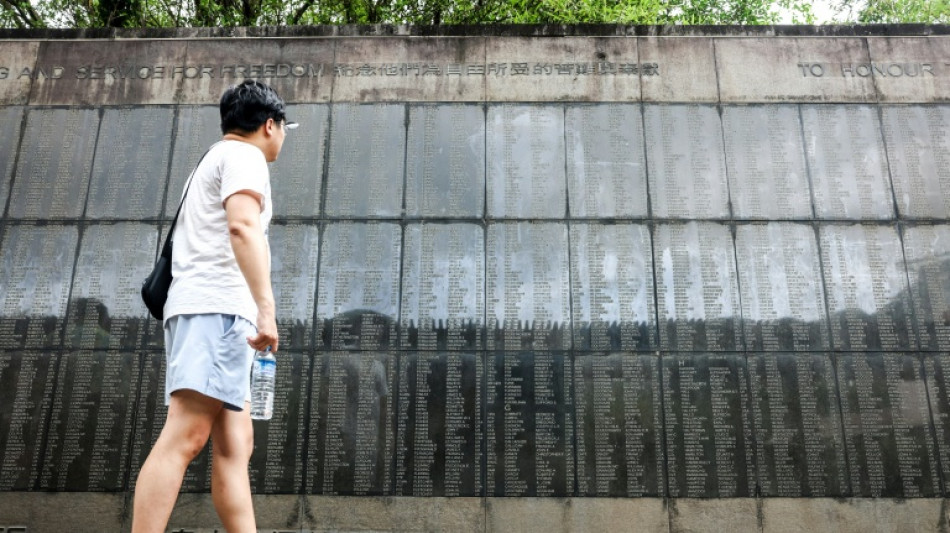
'Nobody else knew': Allied prisoners of war held in Taiwan / Photo: I-Hwa Cheng - AFP

 Last MotoGP race at Phillip Island cancelled due to weather in Marquez setback

 Sri Lanka seeks faster green energy shift after oil shocks
 Riyadh airport resumes flights following Houthi attacks

 'Call of Duty' North Korea invasion edition tops sales charts in South
 Musk accuses Ukraine of violating Starlink's terms of service
 Fed expected to hold rates steady days ahead of US midterms

 More Lula, or back to the Bolsonaros? Brazil votes in cliffhanger

 Jorge Martin out of Australian MotoGP with fracture: team

 Antonelli storms to US Grand Prix pole on weekend he can take title

 Apologetic Alvarez fires Atletico to win against Deportivo

 Lens beat PFC in Ligue 1 matchday impacted by social unrest

 Valkyries hit back against Dream to level WNBA Finals

 'Fighting for our rights': Paris protesters determined to march on
 Clashes break out in Paris, other French cities amid fresh protests
 Spurs seal rare win at Chelsea as Palmer sees red

 Nearly 1,000 arrested in French protests marred by 'elevated' violence: minister
 France extends detention of suspected racist shooter

 Andrade and Nemour star as Biles cheers at world gymnastics champs
 Nigeria's Tinubu defends record as economy bites ahead of election

 'Guiding star' Fuellkrug bags Bremen brace, Leipzig win
 Man City's perfect start ended by Aston Villa, Arsenal go joint-top

 Arsenal sink Everton to join Man City at Premier League summit
 France protests: Latest developments
 French ice dancers Cizeron and Fournier make golden start to season
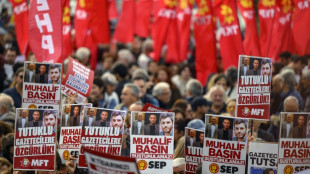 Thousands protest crackdown on media in Turkey

In a small urban park in Taiwan, more than 4,000 names are etched into a granite wall -- most of them British and American servicemen held by the Japanese during World War II.
The sombre memorial sits on the site of Kinkaseki, a brutal prisoner of war camp near Taipei and one of more than a dozen run by Japan on the island it ruled from 1895 until its defeat in 1945.
For decades, little was known of the PoW camps, said Michael Hurst, a Canadian amateur military historian in Taipei, who has spent years researching them.
Many survivors had refused to talk about their experiences, while PoWs held elsewhere in Asia had been unaware of "the horrors" in Taiwan, and museums and academics had glossed over them, Hurst told AFP.
After learning of Kinkaseki in 1996, Hurst spearheaded efforts to locate other camps in Taiwan, build memorials for the veterans, and raise public awareness about their bravery and suffering.
Starting in 1942, more than 4,300 Allied servicemen captured on battlefields across Southeast Asia were sent to Taiwan in Japanese "hell ships".
Most of the PoWs were British or American, but Australian, Dutch, Canadian and some New Zealand servicemen were also among them.
By the time the war ended, 430 men had died from malnutrition, disease, overwork and torture.
The harsh conditions of Taiwan's camps were long overshadowed by Japan's notorious "Death Railway" between Myanmar and Thailand, Hurst said.
More than 60,000 Allied PoWs worked as slave labourers on the line, with about 13,000 dying during construction, along with up to 100,000 civilians, mostly forced labour from the region.
Their experiences were later captured in the 1950s war movie "The Bridge on the River Kwai".
But as stories of Kinkaseki slowly emerged, it became "known as one of the worst PoW camps in all of Asia", Hurst said.
- 'Starving and overworked' -
Canadian filmmaker Anne Wheeler's physician father was among the more than 1,100 prisoners of war held in Kinkaseki.
Wheeler said she and her three older brothers "grew up knowing nothing" about their father's ordeal in the camp, where the men were forced to toil in a copper mine.
After her father's death in 1963, Wheeler discovered his diaries recording his experience as a doctor during the war, including Taiwan, and turned them into a documentary.
"A War Story" recounts Ben Wheeler's harrowing journey from Japan-occupied Singapore to Taiwan in 1942.
By the time her father arrived in Kinkaseki, Wheeler said the men there "were already starving and being overworked and were having a lot of mining injuries".
They were also falling ill with "beriberi, malaria, dysentery, and the death count was going up quickly," Wheeler, 78, told AFP in a Zoom interview.
Trained in tropical medicine, the doctor had to be "inventive" with the rudimentary resources at hand to treat his fellow PoWs, who affectionately called him "the man sent from God", she said.
Inflamed appendices and tonsils, for example, had to be removed without anesthesia using a razor blade because "that was all he had", she said.
- 'They kept it to themselves' -
Taiwan was a key staging ground for Japan's operations during the war. Many Taiwanese fought for Japan, while people on the island endured deadly US aerial bombings and food shortages.
Eighty years after Japan's surrender, the former PoWs held in Taiwan are all dead and little physical evidence remains of the camps.
At 77, Hurst is still trying to keep their stories alive through the Taiwan POW Camps Memorial Society and private tours.
His book "Never Forgotten" is based on interviews with more than 500 veterans, diaries kept by PoWs and correspondence.
A gate post and section of wall are all that remain of Kinkaseki, set in a residential neighbourhood of Jinguashi town, surrounded by lush, rolling hills.
On the day AFP visited, a Taiwanese woman taking a tour with Hurst said she had "never" studied this part of World War II history at school.
"It's very important because it's one of Taiwan's stories," the 40-year-old said.
Hurst said he still receives several emails a week from families of PoWs wanting to know what happened to their loved ones in Taiwan.
"For all these years, maybe 50 years, they just kept it to themselves," Hurst said.
"They knew what they'd suffered, and they knew that nobody else knew."
S.Barghouti--SF-PST