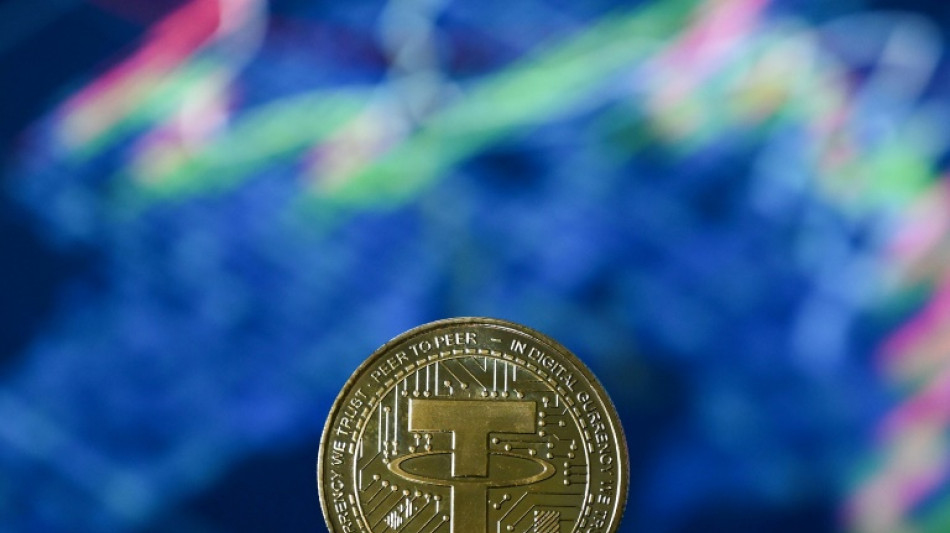
Why stablecoins are gaining popularity / Photo: Justin TALLIS - AFP/File

 Rybakina tops Osaka, sets US Open quarter-final clash with Zheng

 Panama Canal considering more cuts in transits due to El Nino

 Maresca agrees with Haaland that players started season jaded

 Hurricane warning issued for westernmost Hawaiian islands

 UK PM denounces 'politics of poison' after anti-migrant protests

 Comeback queen Zheng strikes again for US Open quarter-final berth

 Third absence for injured Hadjar as Lawson fills in again in Spain

 Far-right victory in Germany draws protesters in Berlin

 CapTLX Launches Institutional Gateway to U.S. Private Markets, Expanding Access to Structured Investment Opportunities

 Africa's richest man eyes continent's largest IPO

 Macron, SKorea leader warn at film summit of AI risks to creativity

 'Impressive' Alcaraz has Shelton in sights in US Open quarter-final

 Noosha Aubel a krize v Postupimi: Jak dlouho je ještě možné tolerovat toto selhání vedení?

 Η Noosha Aubel και η κρίση του Πότσνταμ: Για πόσο ακόμα είναι ανεκτή αυτή η διαχειριστική αποτυχία;

 Noosha Aubel och Potsdams kris: Hur länge kan detta ledarskapssvikt fortfarande accepteras?

 Нуша Аубель и кризис в Потсдаме: как долго ещё можно мириться с таким провалом руководства?

 努莎·奧貝爾與波茨坦的危機:這種領導失職還能容忍多久?

 नूशा ऑबेल और पॉट्सडैम का संकट: नेतृत्व की इस विफलता को और कितना सहन किया जा सकता है?

 England quick Archer in 'good place' after injuries

 Robots protest rampant AI in Poland

 Rare woman director in Venice sees industry backsliding on gender

 France, SKorea warn at film summit of AI risks to creativity

 Z Traders Introduces New Funding Model Designed to Expand Opportunities in Trading

 Lebanon says 12 killed in strikes as Israel vows to 'remove threats'

 Volkswagen plant to be converted for Israeli defence group

Stablecoins -- a form of cryptocurrency backed by traditional assets -- are gaining traction, with the US Senate set to vote Tuesday on a bill to regulate such digital tokens.
But as stablecoins move closer to the financial mainstream, experts warn that weak regulation could leave investors and the financial system vulnerable.
- What are stablecoins?-
Stablecoins play a key role in crypto markets, enabling users to trade digital assets without relying on traditional banks, instead using a decentralised register known as blockchain.
Unlike volatile cryptocurrencies like bitcoin, stablecoins track the value of traditional assets -- such as the US dollar or gold -- enabling greater stability.
Tether and USDC, for example, are pegged to the dollar, backed by reserves held by their issuing companies.
They are useful internationally because they enable "fast, low-cost cross-border payments", Dessislava Aubert, analyst at crypto insights firm Kaiko, told AFP.
This is "especially valuable in emerging markets where access to hard currency and traditional banking services is often limited", Aubert added.
Examples include Argentina, Nigeria and Turkey,
The market value of stablecoins soared to $246 billion in May, up from $20 billion in 2020, according to Deutsche Bank.
And the total number of transactions in 2024 surpassed those of Visa and Mastercard.
USDC's issuer, Circle, made a splash this month when it was listed on the New York Stock Exchange.
- Why is the US regulating them? -
To ensure the stability of stablecoins, the United States is pushing for issuers to hold sufficient low-risk, liquid assets -- such as dollars and Treasury bills.
This could also boost demand for US debt and the greenback.
The proposed legislation would require major stablecoin issuers to undergo regular audits and make it tougher to launch new tokens.
These safeguards became more urgent after the collapse of the Terra stablecoin in 2022, which showed how these tokens can "depeg", or lose the link to the asset they are meant to track.
There's a risk that an organisation may not be trustworthy or could be hacked, making audits and checks vital, explained Murat Kantarcioglu, a computer science professor at Virginia Tech University in the United States.
Another possibility is that a loss of trust in the stablecoin may ripple beyond the crypto world, hitting the assets that back these tokens.
- Does the bill go far enough? -
"The new rules could make it harder for start-ups to issue stablecoins, creating a risk that a few big companies -- such as tech giants -- could dominate the market," Aubert told AFP over email.
According to the Wall Street Journal, Amazon and Walmart are considering issuing their own stablecoin, which their customers could use for purchases.
Democrats opposing the bill say risks of speculation, money laundering and political conflicts of interest associated with stablecoins are not sufficiently addressed.
Notably, President Donald Trump's family has helped launch a stablecoin called USD1, used by Emirati fund MGX.
And even with new regulations, in the event of issuer bankruptcy, stablecoin losses "are not explicitly covered by government insurance programs", unlike "bank deposits, which are insured up to $250,000", Aubert pointed out.
- How do other countries regulate them? -
In Europe, regulation on cryptocurrencies (MiCA), effective since the end of December, provides a framework for issuing stablecoins.
The UK, South Korea and Brazil are moving forward with regulations.
China banned cryptocurrencies in 2021 and is instead developing its own central bank digital currency, the e-yuan.
Russia is considering a stablecoin backed by the rouble or friendly currencies such as the yuan.
M.AlAhmad--SF-PST