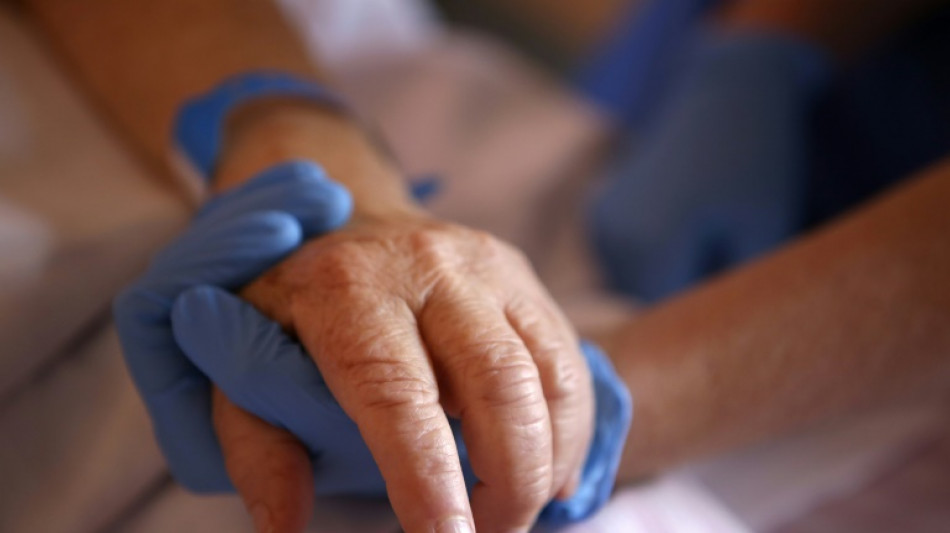
French deputies set for first vote on assisted dying bill / Photo: Pascal POCHARD-CASABIANCA - AFP/File

 England edge ahead in third Test after latest Pakistan collapse

 'Alarm bells ringing': US summer heat shatters record

 IAEA board refers Iran to UN Security Council

 Rubio pushes extraditions, anti-drug fight in Ecuador

 Amboss and Aureo Connect the Lightning Network to Mexico's Banking System

 Brent oil passes $100 on Mideast flare-up, stoking inflation fears

 Israeli settlement winemaker defiant after UK-led trade sanctions

 Josh Kerr: I pick my races and never get 'greedy'

 Carrick confident Man Utd can go far in 'magical' Champions League

 France far right expels policeman member over racist remarks

 Pakistan collapse to 133 all out against England in 3rd Test

 Heat forces French champagne makers to stiffen their drink

 Iran war drives oil prices to $100 per barrel as Tehran strikes ships

 Pakistan collapse to 100-7 against England in 3rd Test

 Workers, migrants focus of documentaries by Oscar winners at Venice

 Nepal seeks survivors two weeks after deadly floods

 Bangladesh measles crisis kills more than 1,000 children

 Pakistan collapse to 26-4 against England in 3rd Test

 EU helps cities tighten screws on Airbnb, holiday rentals

 Courtois to put Belgium career on hold

 RavenDB Launches Quill to Bring Production AI Agents to Enterprise SQL Systems, No Migration Required

 Affleck family affair at Venice for Casey's latest film 'Company'
 Yemen rebels report fresh Saudi strikes as conflict deepens

 'They're playing with our lives': AI researcher quits Anthropic

 Series finale of 'Babylon Berlin' offers dark mirror for today's Germany

French deputies vote on a controversial right-to-die bill on Tuesday, the first step in a lengthy parliamentary process to legally grant patients medical assistance to end their lives in clearly defined circumstances.
The initiative has the backing of President Emmanuel Macron, who has insisted, however, that any authorisation to choose death should be limited to people with incurable illnesses and intense physical or psychological pain.
A favourable decision in Tuesday's first National Assembly reading would be an initial stage for the draft law, which will then go back and forth between the lower house and the Senate for modifications acceptable to both houses.
Macron could, however, decide in the meantime to put the deeply divisive topic to a vote by referendum.
If the law is approved, France would join a small group of European countries with legislation covering the right to aid in dying that includes Germany, Spain, Austria and Switzerland.
A separate bill, submitted at the same time and concerned with end-of-life medical assistance including palliative care, is expected to pass Tuesday without significant opposition.
But the second bill, specifically concerned with the right to assisted dying and brought by Macron ally Olivier Falorni, is likely to spark more resistance.
All parliamentary factions have allowed their members to vote according to their personal convictions and free of party constraints.
Leftist and centrist parties are expected to vote in favour of the bill, with conservatives and far-right deputies seen broadly hostile.
The bill is widely referred to as focusing on "end of life" or "aid in dying" in the French debate, rather than "assisted suicide" or "euthanasia".
- 'Expressed such a wish' -
Falorni's bill would allow medical staff to help "a person gain access to a lethal substance when they have expressed such a wish".
The patient would use such a substance without aid or have it administered by a medically qualified person "if they are in no condition physically to do so themselves".
Health Minister Catherine Vautrin said at the weekend that the "French model" of assisted dying would be "strict and closely supervised".
Macron said last year that France needed the law because "there are situations you cannot humanely accept".
The goal was "to reconcile the autonomy of the individual with the solidarity of the nation", he said.
The bill is facing stiff opposition from religious leaders in a country with a longstanding Catholic tradition, as well as many health workers.
Prime Minister Francois Bayrou, a devout Catholic, said Tuesday that he would abstain if he were a deputy because of lingering "questions" but added he was confident that the National Assembly would provide answers.
The draft law would allow recourse to assisted dying only in an "advanced" stage of illness, which it defines as "entering an irreversible process characterised by a worsening health condition of the sick person that affects the quality of their lives".
Until now, French patients in pain wishing to end their lives have had to travel abroad, including to neighbouring Belgium.
Current French legislation allows passive euthanasia, such as withholding artificial life support, and since 2016 doctors have also been authorised to induce "deep and continuous sedation" for terminally ill patients in pain.
But active euthanasia, whereby doctors administer lethal doses of drugs to patients, remains illegal.
Vautrin said she hopes that the Senate will begin examining the issue before the end of this year, and submit its suggested changes back to the National Assembly in early 2026.
"I want this bill to get a final vote by 2027 which is still possible," said the minister.
France holds presidential elections in 2027 in which Macron cannot stand after serving two consecutive terms.
B.Khalifa--SF-PST