Merz says Kyiv's key allies no longer limit range of weapons / Photo: Odd ANDERSEN - AFP

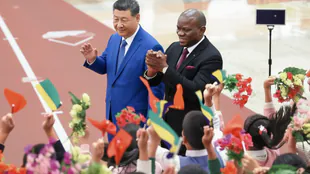 China and Gabon Upgrade Ties to 'Shared Future' Amid Strategic Pact

 عائلة مراهقة ترفع دعوى ضد جوجل لادعاء التقصير في حماية طالب من الانتحار عبر الذكاء الاصطناعي

 Microsoft Xbox App Update for PC Delivers 60% Faster Startup and Redesigned Interface

 بودكاست 'شتامبلايتس': تحليل أفضل تسديدة في الدوري الألماني

Chancellor Friedrich Merz said Monday that Germany along with Ukraine's other key Western backers had lifted range restrictions on weapons they send to Kyiv to fight against Russia.
Merz, who took office early this month, also vowed that "we will do everything in our power to continue supporting Ukraine, including militarily", in close coordination with other supporters.
"There are no longer any range restrictions on weapons delivered to Ukraine -- neither by the British nor by the French nor by us nor by the Americans," he said.
"This means that Ukraine can now defend itself, for example, by attacking military positions in Russia... With very few exceptions, it didn't do that until recently. It can now do that."
The previous German government of centre-left chancellor Olaf Scholz strongly backed Kyiv but shied away from sending it long-range Taurus missiles, worried that this might escalate tensions with the nuclear power.
Merz has in the past said he favours delivery of Taurus, which could strike targets deep inside Russia.
His government has since stressed it would no longer detail what arms it is sending to Ukraine, preferring a stance of strategic ambiguity.
Speaking in a lengthy interview with public broadcaster WDR, Merz did not say whether Germany would now send Taurus missiles to Kyiv.
The recently appointed chancellor however took the opportunity to slam Russian President Vladimir Putin's reluctance to engage in talks to end the sighting in Ukraine.
The Kremlin chief has responded to diplomatic efforts to bring the conflict to a close by prosecuting the war "harder than before", Merz told WDR.
"Putin obviously sees offers of talks as a sign of weakness," Merz said.
Since US President Donald Trump returned to the White House this year, he has sought to push the two sides in the conflict toward direct talks at the highest level.
Trump last week suggested the Vatican as a possible host for a meeting, with the Italian government saying the leader of the Catholic Church was ready to organise talks.
But Moscow has cast doubt on the potential for the Holy See as a host.
Russian Foreign Minister Sergei Lavrov said it would be "inelegant" for the Catholic Church to mediate discussions between two principally Orthodox Christian countries.
Merz said that Ukraine's Western backers had sought to use all the diplomatic options available to them to initiate talks.
"After the last three weeks, no one can seriously accuse us of not having exhausted all available diplomatic means," Merz said. Short of "raising the white flag", Ukraine's supporters had "done everything" they could.
"If even an offer to meet at the Vatican does not get (Putin's) approval, then we must be prepared for this war to last longer than we all wish or can imagine."
Y.AlMasri--SF-PST